Hofstadter nuclear electron scattering experiment
ID: hofstadter-nuclear-electron-scattering-experiment

Robert Hofstadter's Stanford installation selected Electrons up to . Magnetic spectrometer scans counted shielded Lucite Cherenkov radiation pulses per monitor charge. Carbon-12 at and resolved elastic scattering and inelastic scattering ( excitation). Calibration used forward-beam energy, hydrogen nuclear recoil and carbon-12 energy levels. Closed entrance slits checked background.[ref]
Electron Scattering and Nuclear Structure by Robert Hofstadter. §III(b)(1), pp. 222–223, Fig. 11; §IV(a), pp. 227–231, Figs. 14–17
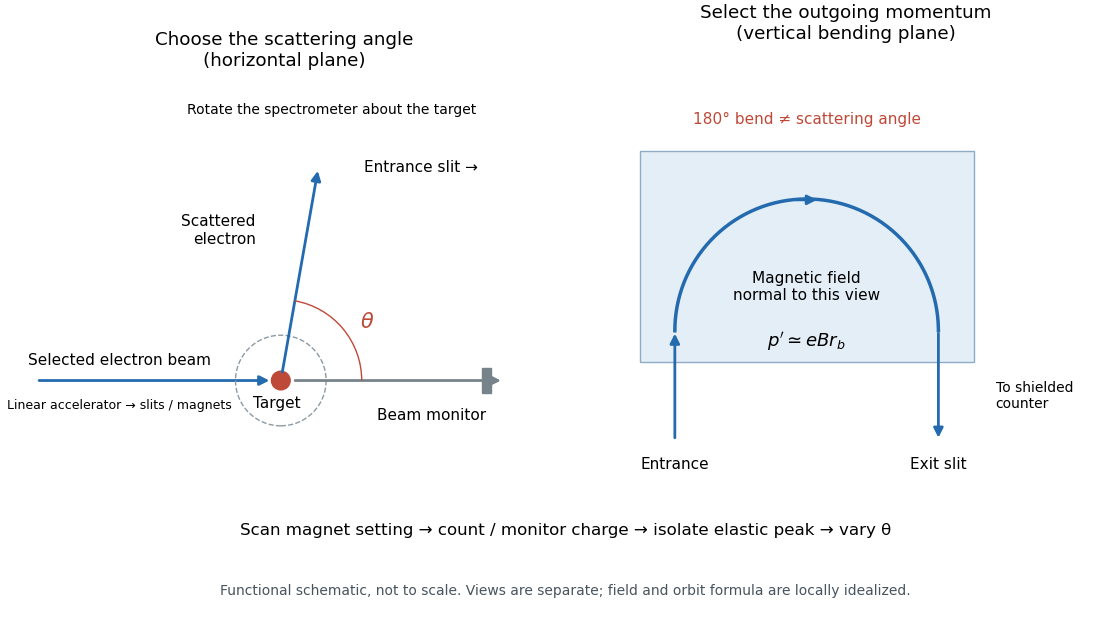

The key distinction is between an Electron counter and an energy measurement. Here the counter registers particles admitted by the magnetic spectrometer; changing its magnetic field selects another outgoing momentum. A peak is therefore reconstructed from a scan, rather than read as one pulse whose height equals the scattered Electron energy. Dividing counts by monitored incident electric charge compensates for changes in beam intensity. A peak's height alone is insufficient: its area and the instrument's accepted momentum interval determine the selected yield.
An inelastic scattering peak corresponds to a different final nuclear quantum state, so including it in the elastic scattering yield would answer a different structural question. Conversely, finite energy resolution can hide sufficiently nearby excitations beneath an apparent elastic scattering peak. Background subtraction, target-loss corrections, angular acceptance and counter efficiency all enter before counts become a differential scattering cross-section. A dip in uncorrected counts is therefore not automatically a zero of a nuclear charge form factor.
New to topics? Read the docs here!