
An idler gear is an intermediate gear that passes rotation between other gears without using a separately sized, rigidly coupled gear to form another reduction stage. In a simple gear train, its tooth count cancels from the ideal endpoint ratio, but it changes placement, intermediate speed and the number of direction reversals.
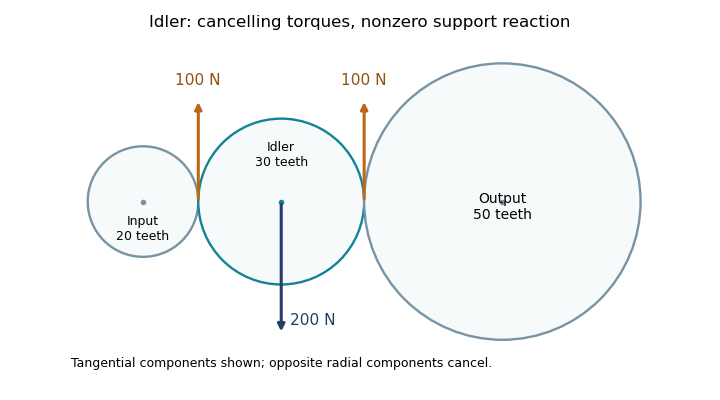
For example, a20-tooth input driving a30-tooth idler gear that drives a50-tooth output givesAt750 input revolutions per minute, the idler turns at500 in the opposite direction and the output at300 in the original direction. Replacing the idler by60 teeth preserves output speed but changes idler speed to250 revolutions per minute.[ref]
With standard module and collinear centers, the30-tooth idler gives input/output axis spacingThe60-tooth replacement gives190mm, despite the unchanged output ratio.
An idler support reaction also remains necessary even when its net transmitted torque is zero. For the30-tooth arrangement, suppose input torque is , so both ideal mesh tangential loads are . Their moments about the idler's center cancel, but in this collinear layout the two tangential forces point in the same direction on the idler. Equal, opposite radial mesh components cancel, leaving a mesh-induced shaft-support reaction of opposite the tangential forces.

New to topics? Read the docs here!