Information projection and Euclidean projection
ID: information-projection-and-euclidean-projection

The word "projection" does not mean ordinary perpendicular projection in the plotted Euclidean space. For the same reference and mean constraint, minimizing the squared Euclidean distance in the three probability coordinates instead givesThus the Euclidean minimizer is , whereas the information projection has . The squared Euclidean objective at its own minimum is ; its relative entropy is approximately nats, larger than the optimum nats. Both distributions satisfy the same constraint.
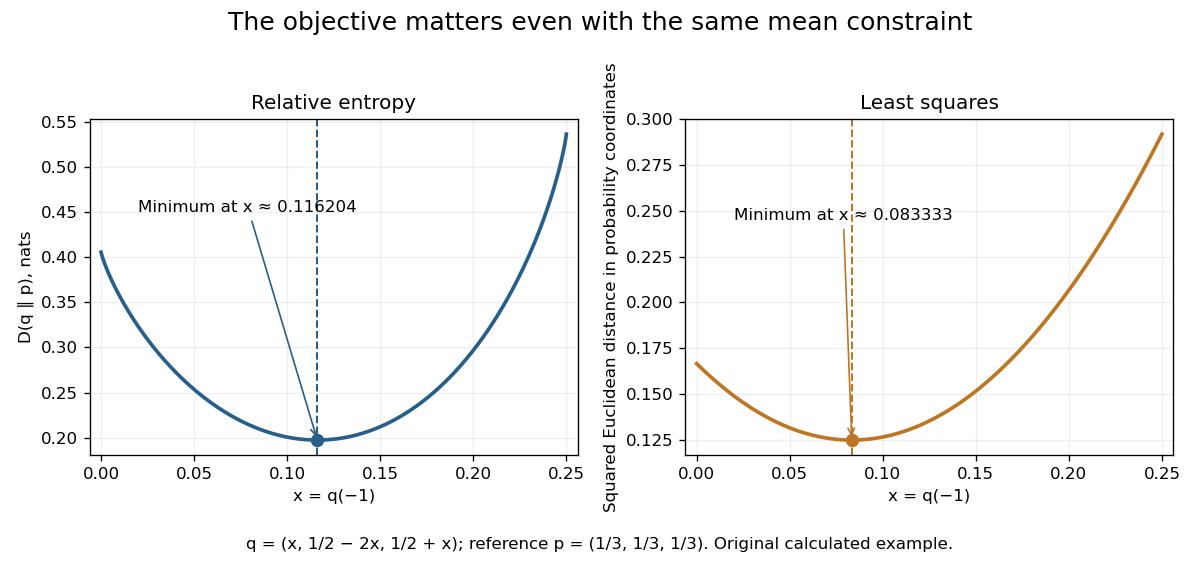

The reference and objective encode what "least change" means. Relative entropy is asymmetric and is not a metric; its minimization answers a different question from linear least squares. The useful geometric analogy comes from a Pythagorean inequality for information projection, rather than from an assertion that the colored contours are circles.
New to topics? Read the docs here!