
In the Laue method, a fixed single crystal structure receives a collimated beam containing many wavelengths. Each reciprocal lattice vector can select its own wavelength; waves with different wavelengths need not interfere with one another. For , the elastic scattering constraint gives the particularly useful testA candidate reflection requires within the source spectrum and an outgoing ray that reaches the detector. Varying wavelength changes the radius and center of the Ewald sphere while leaving the reciprocal lattice fixed. A monochromatic wave instead fixes the radius: rotating the crystal structure or varying the incident wavelength in a scan finds reflections sequentially. A white-beam photograph integrates many spectral selections in one exposure; it is not an angular scan at one known wavelength.
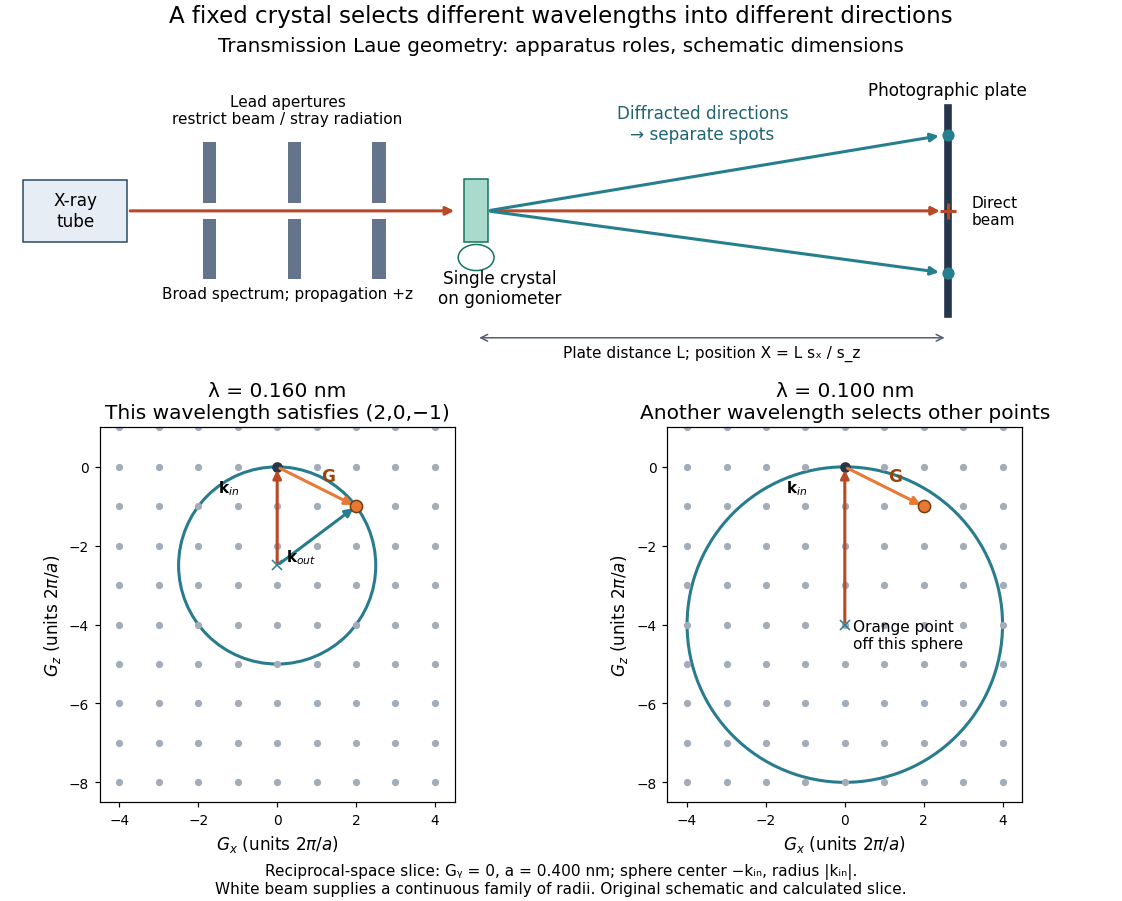

The Laue method is useful for orienting a single crystal structure: tilting it changes which reciprocal lattice vectors meet the spectral and detector conditions. Absolute scale has an ambiguity if the wavelengths are unknown. Scaling all direct lattice translations by and all selected wavelengths by leaves every outgoing direction unchanged. Independently known spectral information or length calibration is needed to remove this ambiguity.
New to topics? Read the docs here!