A crystal structure specifies the chemical species and spatial arrangement of the chemical atoms or ions in a crystal. For an ideal periodic structure, separate two ingredients: a Bravais lattice specifies the translations that repeat the arrangement, and an atomic basis of a crystal specifies the chemical motif repeated at every lattice point. The outward shape, or crystal habit, is a different description: the internal arrangement is what this article describes.
For a concrete two-dimensional model, choose primitive lattice translation vectors and in arbitrary length units. At every lattice point , with integers , place species A at and a different species B at . Translating by or preserves both the positions and their chemical labels. Translating by sends one A position to a B position, so it is not a translation symmetry of the labeled structure. A picture of dots with the labels erased can therefore conceal essential chemical information.
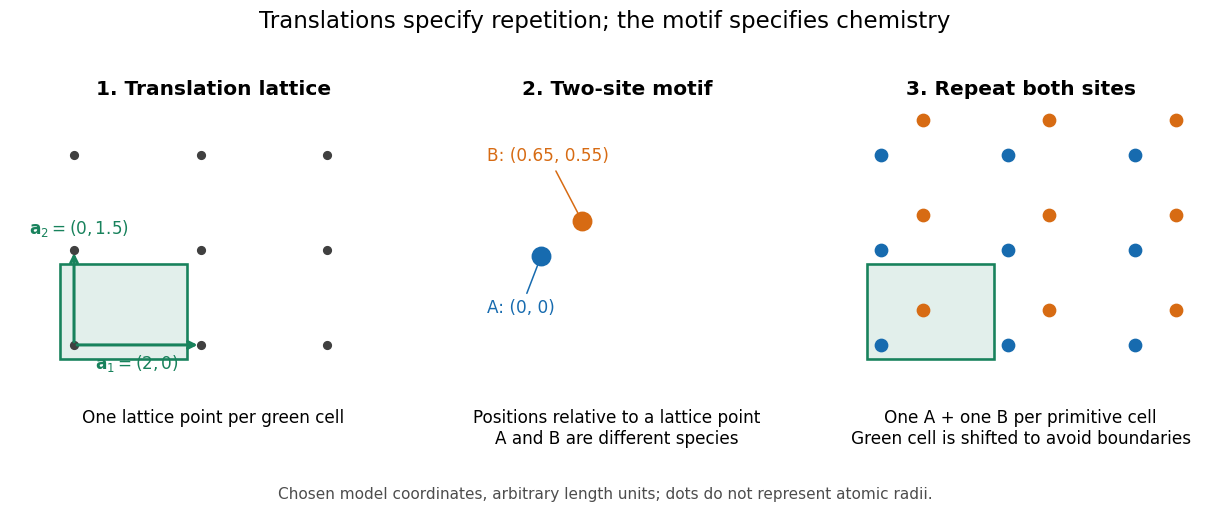
A primitive unit cell contains one lattice point, but may contain several chemical atoms. A conventional unit cell can contain several lattice points to display the symmetry more clearly. Thus the conventional cube of a face-centered cubic lattice contains four lattice points, whereas a body-centered cubic lattice has two. Neither lattice name alone specifies which chemical species occupies the repeated motif. The NaCl conventional cell and coordination example makes the distinction explicit.
This separation is useful experimentally: interplanar spacings constrain the repeating geometry, while relative wave intensities also depend on the atomic basis of a crystal through the crystal basis structure factor. The Bragg crystal reflection experiment of 1913 describes the X-ray spectrometer, angular scans and detector checks in detail. Its conversion from angle to length is developed under Bragg's law; a geometrically possible reflection can still have zero wave intensity.
William Lawrence Bragg's 1913 structure determination supplied a complementary test. He directed X-rays through sodium chloride sections cut parallel to a cube face and recorded spots on photographic plates. Comparing section thicknesses tested how transmission altered the pattern: the relative spot strengths changed. Comparing related salts led him to two interpenetrating face-centered cubic lattices, one for each kind of constituent. He explicitly distinguished evidence for that arrangement from the still-needed identification of a single chemical atom with each scattering center. The photographs were evidence for a structural model, not direct pictures of labeled ions.[ref]
A fractional crystallographic coordinate is one of the dimensionless coefficients expressing a position in the basis of specified unit cell vectors:The three coefficients are also called fractional crystal coordinates. Reporting them requires specifying the cell vectors and origin. The core CIF coordinate items store these fractions rather than Cartesian lengths.[ref]
Fractional coordinates in the IUCr core CIF dictionary.
_atom_site_fract_x, _atom_site_fract_y, _atom_site_fract_z, DefinitionFor an original orthorhombic example, let the mutually perpendicular cell edges have lengths4,6 and8 angstroms. The fractional position has Cartesian coordinates angstroms. Adding an integer to one fractional coordinate selects the corresponding translated position in another cell; it does not change the motif's location relative to the repeating cell.
For an oblique cell, multiplying the fractions by edge lengths is insufficient to obtain Cartesian components. In a two-dimensional example, take and angstroms. The fractional position isThe crystallographic metric matrix records the necessary lengths and angles. A displacement with fractional column vector has squared length . Applying the ordinary Cartesian distance formula directly to the fractions would discard the geometry of the crystal structure.
Fractional crystal coordinates are the dimensionless coefficients in for specified unit cell vectors. They are not Cartesian lengths unless the vectors themselves are included. With primitive vectors, replacing by values differing by integers selects an equivalent position in another unit cell.
In the two-dimensional example under crystal structure, B has position in ordinary length coordinates, but fractional crystal coordinates . Multiplying these coefficients by the two translation vectors recovers the drawn position. Reporting the axes is therefore part of reporting a structure.
The crystallographic metric matrix is the Gram matrix of the three unit cell basis vectors. If has Cartesian columns , thenHere are the angles between ; ; and , respectively. The matrix converts fractional crystallographic coordinate differences into physical lengths: a fractional displacement has squared length .[ref]
Metric tensor in the IUCr Online Dictionary of Crystallography. Definition, direct-basis components and scalar products
For an original oblique cell, choose , , angstroms, and . ThenFor ,Ignoring the off-diagonal entries would instead give , overestimating this distance. The cross terms encode the cell angles.
The reciprocal crystallographic metric matrix is when the reciprocal basis has dot products , with no factor of . Thus the plane spacing for a nonzero Miller index column satisfiesA basis change gives and fractional coordinates , preserving . Distances do not change when the same crystal structure is described in another basis.[ref]
Metric tensor in the IUCr Online Dictionary of Crystallography. Reciprocal-space components and Change of basis
The reciprocal crystallographic metric matrix is the Gram matrix of the reciprocal lattice basis. With direct-basis matrix and the convention , the reciprocal-basis matrix is . Consequently,where is the direct crystallographic metric matrix. If direct lengths are in angstroms, the reciprocal metric entries have units of inverse squared angstroms.[ref]
For an original calculation, takeFor a Miller index column , the corresponding reciprocal vector is . Its squared magnitude determines the interplanar spacing:For this gives , so .
The same matrix also gives angles between plane normals. In this example,The reciprocal angle is120degrees while the corresponding direct-cell angle is60degrees. In an oblique cell, reciprocal directions cannot be recovered by simply inverting the three edge lengths separately.
A convention using reciprocal vectors with dot products multiplies this reciprocal metric by . In that convention the spacing formula includes the matching factor in its numerator. Stating the convention prevents an otherwise systematic length error.
A continuous tetragonal deformation connecting FCC and BCC geometries. In a simple uniaxial version, retain basal conventional edges while reducing the third edge to . The alternate vectors , and form a BCC conventional cube, of half the volume of the deformed face-centered tetragonal cell. The name refers to Edgar Bain. Real metallurgical transformations can also change the other edges; this geometric path alone does not specify the energetic or kinetic transformation mechanism.
A collective displacement of atoms from equilibrium positions. Normal modes have a wave vector, branch label and polarization; their quantized excitations are phonons.
Nearest touching spheres on an FCC conventional cell meet along face diagonals, giving and four spheres per cell. In BCC they meet along body diagonals, giving and two spheres per cell. Dividing the respective sphere volumes by proves the displayed packing fractions. A coordination-number comparison alone does not calculate the occupied volume.
For basal vectors of equal length separated by120degrees and perpendicular height , cell volume is . A full hexagonal prism drawn around it has three times this volume and must contain three times as many atoms if used for density calculations.
A position surrounded by four nearest sites at tetrahedron vertices. A conventional face-centred cubic cell has eight such sites, at all combinations of quarter and three-quarter fractional coordinates. Whether occupancy constitutes a defect depends on the reference crystal.
A one-atom close-packed structure with a face-centered cubic lattice and close-packed stacking sequence.
The sequence of lateral positions of triangular atomic layers. Cubic close packing has stacking and hexagonal close packing has stacking.
A boundary between crystalline regions or phases. Its excess free energy depends on orientation, chemical bonding and lattice matching.
The excess free energy per interface area, specified for the phases, orientation, temperature and constraints.
An interface without extended one-to-one lattice registry; its local structure and energy differ from those of a coherent crystal interface.
An interface with largely matched regions separated by a network of misfit dislocations.
An interface whose lattice planes match continuously across the boundary. Elastic misfit strain can accumulate when the unstrained lattice parameters differ.
Elastic deformation required to match differing natural lattice spacings across a coherent crystal interface. Its energy can affect precipitate shape and loss of coherency.
An FCC Bravais lattice with a two-atom basis at fractional positions and . Its conventional cubic cell contains eight atoms. Equal scattering amplitudes at the two basis sites produce additional systematic absences beyond the FCC parity selection rule.
Nearest neighbors are separated by , so touching spheres have radius . Eight atoms in a conventional cell occupy fraction . The underlying FCC Bravais lattice does not make this two-atom network close packed.
The point is an inversion centre when an atom is at the origin. Inversion sends to and exchanges the identical FCC sublattices. The individual atomic sites are not inversion centres.
With one atom at the origin and the second FCC sublattice displaced by , the vertical mirrors normal to directions perpendicular to have traces or in fractional coordinates. Checking the atomic heights distinguishes a genuine mirror from a misleading planar projection.
The arrangement of atoms or other constituents attached identically to every lattice point of a Bravais lattice. The lattice specifies translations; the motif specifies the contents repeated by those translations. A multi-atom motif does not make its atoms separate lattice points.
A close-packed structure with hexagonal symmetry. Its basal and c-axis directions need not have equal thermal or irradiation response.
A crystal system with three mutually perpendicular axes that are not constrained by symmetry to have equal lengths.
A Bravais lattice with three perpendicular conventional axes and lattice points at and . A translation by half a diagonal of an face preserves the complete crystal motif; apparent centering of unlabelled molecular centers alone is insufficient.
An ordered, anion-deficient fluorite-related structure often written . It can accommodate compositions and cation sizes outside the stability range of zirconolite polytypes.
A structural variant differing in the stacking sequence of closely related layers. zirconolite polytypes can change as substituted-ion size and composition change.
An ordered binary structure with alternating species layers along a tetragonal axis. In primitive tetragonal coordinates one species can occupy and the other . The latter vector exchanges species and therefore is not a translation of the chemically ordered crystal.
A nonuniform distribution of crystallographic orientations among grains in a polycrystal. It can turn directional single-crystal properties into directional bulk behavior.
A length parameter specifying a periodic unit cell. A conventional cubic edge is not always the nearest-neighbour distance.
A metal-halide perovskite is a crystalline material in which a halide-based framework adopts the perovskite structure or a related arrangement. In the common description, is a metal cation, a halide and a larger charge-balancing cation, which can be inorganic or molecular.
Connectivity and distortion of the metal–halide framework influence electronic structure and optical absorption. This makes the family important in solar cells and light-emitting devices. The structural name alone does not specify one composition, stability or band gap; substitutions, dimensionality and defects can change those properties.
A hexagonal tetrahedrally coordinated structure with ABAB stacking of the relevant bilayers, contrasted with ABCABC stacking in zinc blende. It can occur as a nanowire polytype even when bulk conditions favour another phase.
A local interruption of the normal sequence of close-packed or other crystallographic layers. It can change local symmetry and influence nanocrystal growth.
An orientation relationship between adjacent crystalline regions related by a specific crystallographic symmetry operation. A multiply twinned particle is not one perfect lattice with the composite particle symmetry.
A finite particle composed of several crystallographically twinned domains. A composite fivefold outline does not require one periodic lattice to have fivefold rotational symmetry. In a decahedral fcc model, five tetrahedral domains meet around a common near- axis; elastic distortion accommodates the angular deficit.
A crystallographic direction shared by a set of planes. Aligning a transmission electron microscopy beam along a suitable zone axis can excite multiple useful lattice reflections.
The reciprocal vector of a plane containing the real-space direction is perpendicular to that direction, giving in consistent crystallographic indexing. For a cubic zone, allowed plane indices satisfy .
The orientation of a crystal structure relative to a specimen or instrument coordinate frame. It determines which Bragg diffraction conditions are excited.
An ordered cubic structure with B at cube corners and A at face centres. The chemically labelled Bravais lattice is primitive cubic; its superlattice reflections distinguish it from a chemically disordered face-centered cubic lattice.
A binary crystal structure with one species at the corners of a primitive cubic unit cell and the other at its body centre. Each species has coordination number eight. Distinct chemical labels mean that the body-centre translation is not a translation symmetry; its Bravais lattice is primitive cubic, not body-centred cubic.
An crystal structure with A on a face-centered cubic lattice and B occupying all eight tetrahedral sites of its conventional cubic unit cell. The coordination numbers are eight for A and four for B. The cubic cell contains four formula units.
With anion radius , cation radius and unlike-neighbour contact, the conventional cell gives . At the eight-coordinate limiting contact ratio this is . The cation-contact tetrahedral-hole limit is a different geometric ideal.
A crystal system with mutually perpendicular conventional cell axes and lengths . The physical length of the direction is proportional to ; crystallographic indices are coefficients in a lattice basis, not necessarily Cartesian components of equal scale.
A Bravais lattice with mutually perpendicular primitive vectors of lengths , with . A chemically ordered L10 crystal structure has this translation lattice even when drawn using a larger four-site cell that resembles a distorted FCC conventional cell.
A crystallographic defect is a departure from ideal repeated structure. In an ionic crystal, a missing ion can provide an available site for another ion to move into; movement still requires overcoming an activation energy. This is why an ideal immobile-site model is a limit rather than a universal law for solid electrical conductivity.[ref]
Chemistry 2e. §10.5, “Crystal Defects”: vacancies and other imperfections
An interface between ordered domains related by a displacement that is a translation of the underlying disordered lattice but not of the ordered chemical structure. Slip by that displacement can leave an antiphase boundary behind a dislocation; a second appropriate displacement can restore the order.
An interface between crystalline regions with different orientations. Its structure affects transport, mechanical response and absorption of mobile point defects.
Resistance to plastic flow associated with grain boundaries obstructing or transmitting dislocations. In the ordinary Hall-Petch regime, smaller grains raise the yield stress, but at high temperature the same boundaries can accelerate diffusion creep.
The empirical scaling of yield stress with average grain size in its applicable regime. It is not a universal law for arbitrarily small grains or high-temperature deformation.
A missing carbon-atom inventory in graphene. Local reconstruction changes the nearby ring pattern and electronic states; irradiation and subsequent annealing can change the reconstruction.
A graphene vacancy defect with two carbon atoms removed. A common adjacent-pair reconstruction has a 5–8–5 ring arrangement; other reconstructed arrangements exist and can be selected by energetic processing.
A graphene vacancy defect with one carbon removed. A common reconstruction has a pentagon and nine-membered ring with residual under-coordination. The reconstructed geometry need not retain the symmetry of the unrelaxed missing-atom site.
An extra atom of the host material accommodated outside the ordinary lattice-site inventory. It can migrate, recombine with a vacancy, or join a cluster.
An unoccupied site in an otherwise specified crystal structure. Equilibrium vacancies and an irradiation-driven vacancy supersaturation have different origins.
A vacancy population above its thermal-equilibrium value at the specified temperature. It can drive net vacancy absorption by growing cavities when competing sinks and emission permit.
A vacancy and a displaced atom occupying an interstitial position. Recombination restores the occupied lattice site; spatial separation or trapping can allow the defects to survive.
Notation specifying a defect species, its lattice site and its charge relative to the corresponding ideal lattice site.
A missing carbon atom or group of atoms in a carbon nanotube wall. Local reconstruction can produce a 5–9 monovacancy or 5–8–5 divacancy ring inventory; larger vacancies can interrupt a shell.
A bond rotation that changes four hexagons in a graphitic carbon network into a pentagon-heptagon-heptagon-pentagon ring arrangement without adding or removing atoms.
A line defect in a crystal structure. Its Burgers vector measures the closure failure of a circuit around the line. Motion can produce permanent plasticity without simultaneously breaking every bond across a whole plane.
The dislocation core is the small region near a dislocation line where the smooth linear-elastic continuum description fails. For a screw dislocation, the far-field displacement gradient scales as the Burgers-vector magnitude divided by radial distance, so the predicted elastic stress diverges on the axis. Atomic structure, nonlinear response or local plastic deformation replaces that singular prediction in the core.
A curved dislocation can be approximated as a line with tension of order . The coefficient depends on elastic constants, character and logarithmic length scales. The simple estimate gives a pinning bypass stress for a semicircular segment of free span .
A dislocation whose Burgers vector is not a full translation of the perfect crystal, so its glide can leave a planar stacking fault. Vector conservation and the actual slip plane constrain reactions and dissociation.
A sessile partial junction associated with intersecting stacking faults. A typical FCC resultant has vector . Its Burgers vector and junction line can define a plane outside the ordinary glide family.
An FCC partial dislocation with Burgers vector lying in a close-packed plane. Two suitable Shockley vectors can sum to an FCC perfect vector .
A perfect vector can separate into two in-plane Shockley partials bounding a stacking-fault ribbon. The sum of squared Burgers magnitudes falls from to , reducing the simplest elastic line-energy estimate, while stacking-fault area costs energy.
An order-preserving total dislocation in an ordered crystal, often dissociated into smaller dislocations separated by an antiphase boundary. Two matching dislocations can restore order in the gamma prime phase.
A dislocation that accommodates some lattice mismatch at an interface. An initially coherent epitaxial layer or island can instead store elastic deformation; introducing a misfit dislocation trades some strain energy for the defect's formation energy. A projected image must be indexed before a particular spacing discrepancy is assigned to misfit strain.
Motion of an edge component perpendicular to its glide plane by absorbing or emitting point defects. Unlike conservative dislocation glide, it changes the extra-plane content locally and is coupled to defect transport. Irradiation can drive climb by creating nonequilibrium vacancies and self-interstitials.
Total dislocation line length per material volume, with units . Circular loops with common radius and number density contribute .
A closed dislocation line. Vacancy or interstitial clustering can form a platelet bounded by a loop; its Burgers vector, habit plane and possible stacking fault specify its crystallographic character.
A line segment formed by interaction of dislocations from different slip planes. A junction can impede further dislocation glide. Energetic favourability alone does not establish whether the resulting segment is mobile on a particular plane.
A junction produced when suitable partial dislocations on intersecting FCC slip planes react to form a low-energy sessile stair-rod segment. It obstructs further slip and can promote work hardening. Frank energetic favorability alone is not a complete calculation of junction geometry or mobility.
The energy criterion associated with Frederick Charles Frank states that, for dislocations of comparable length with approximately common line-energy factors, a reaction conserving Burgers vector is energetically favourable when the displayed inequality holds. The rule is an energy estimate, not a proof that the geometry or kinetic barriers permit the reaction. Edge/screw character, elastic anisotropy and changed lengths refine it.
Conservative motion within a plane containing both the dislocation line and its Burgers vector. For a nonscrew line their cross product determines the plane normal; a screw line can belong to more than one such plane.
A lattice-friction stress for dislocation glide, associated with Rudolf Peierls and Frank Nabarro. A simple model gives , where is core width and the Burgers vector magnitude. Spreading slip over many atomic rows reduces the periodic energy barrier; narrower cores are harder to move in this model.
A crystallographic plane together with an allowed dislocation glide direction in that plane. Geometry alone does not determine its activation stress.
Plastic flow involving more than one active slip system. Interactions between dislocations on intersecting systems can give substantially faster work hardening than easy single slip.
Dislocation glide in a hexagonal crystal on its basal plane, ordinarily along a close-packed basal direction in the family. Direction indices must be converted using the actual hexagonal metric, including the ratio .
For uniaxial stress , projection onto a slip-plane normal and a slip direction gives the displayed shear stress. The angles and are measured from the tensile axis to that normal and direction respectively.
The critical resolved shear stress is the shear stress on a specified slip system at which dislocation motion produces slip under stated conditions. For simple uniaxial loading, the resolved component is , with angles to the slip-plane normal and slip direction.
The threshold depends on material state, temperature, obstacles, and deformation history. A crystal can therefore begin to slip at different applied tensile stresses in different orientations even when the slip system has the same critical resolved threshold.
The ratio connecting a macroscopic tensile flow stress to a reference critical resolved shear stress in a specified polycrystal model. Texture, slip families and compatibility assumptions matter. An order-three factor is a conventional estimate for randomly oriented cubic grains, distinct from the factor two for a perfectly oriented single slip system.
The ideal activation criterion compares resolved shear stress with a critical resolved shear stress. Non-glide stresses, notably in some body-centred cubic crystals, can modify this ideal criterion.
In an ideal single-slip tensile test neglecting elastic stretch, the specimen end-to-end vector expressed in crystal coordinates changes as , with unit slip direction and slip-plane normal . It moves towards the slip direction along a great circle. The perpendicular component is unchanged, so . Secondary slip changes this kinematics; equal Schmid factors determine onset only if the systems have equal current critical stresses.
The orientation factor converting the magnitude of uniaxial stress to resolved shear stress. It lies between zero and because the slip-plane normal and slip direction are perpendicular.
For line tangent , a screw dislocation has Burgers vector parallel to , an edge dislocation has it perpendicular, and a mixed dislocation has both components.
A mixed dislocation has a line direction neither parallel nor perpendicular to its Burgers vector, combining screw and edge character. Along a curved dislocation line, the local character can change continuously while the Burgers vector remains fixed.
A dislocation loop therefore need not be assigned one character everywhere. Decomposing a local segment into edge and screw contributions helps analyze its stress field, mobility, and interaction with obstacles.
An edge dislocation is a crystal line defect whose Burgers vector is perpendicular to the dislocation line. It is often pictured as the termination of an extra half-plane of atoms inside the crystal.
Motion of the line allows a slip displacement to advance through the material without every bond across a whole plane changing simultaneously. Its surrounding elastic distortion includes compressive and tensile regions, connecting an atomic-scale defect with macroscopic plastic deformation.
A screw dislocation is a crystal line defect whose Burgers vector is parallel to the dislocation line. Atomic planes around it have a helical arrangement, rather than the extra-half-plane geometry associated with an edge dislocation.
Its motion permits crystal slip. Because several planes can contain the same line and Burgers vector, screw segments can sometimes change their glide plane by cross-slip, with the actual possibility depending on the crystal and defect structure.
The antiplane field has a smooth local gradient on the punctured plane and satisfies the differential strain compatibility condition there. Its circulation around the defect axis is nevertheless , excluding a globally single-valued displacement on that domain. A radial cut permits a branch with an axial jump between the two cut faces; joining faces with that mismatch is the Volterra construction of a screw dislocation with Burgers vector parallel to the axis. The stress has a singular core where linear elasticity requires microscopic or plastic regularization. This example separates a local differential integrability test from global closure around a hole.
Motion of a screw segment from one allowed glide plane to another containing the same Burgers vector.
The lattice translation represented by closure failure of a circuit around a dislocation, with a consistent circuit convention. It is a vector, so dislocation reactions conserve its direction as well as its magnitude.
A missing atom at a lattice site that would be occupied in the reference crystal. A vacancy defect is a point defect and can contribute configurational entropy because many choices of empty sites can have the same macroscopic energy. Formation energy and pressure-volume work oppose this entropy gain. Vacancies can be present in thermal equilibrium; they need not all be preparation mistakes. Their allowed number and creation mechanism depend on whether the lattice size, atom number and surface reservoirs are fixed.
An unoccupied oxygen site in a reference crystal structure. Removing an oxide ion gives an effective charge relative to the perfect lattice; the charge of the actual missing ion is . A physical sample must satisfy overall charge neutrality through other defects, electronic carriers or changed cation valences.
Consider fixed atoms and variable vacancies among sites, each of volume , with vacancy energy . The configuration count is . At fixed pressure and temperature, leading Stirling's approximation gives the excess Gibbs free energy . Its stationary point is the displayed , and its second derivative is . Relative to the vacancy-free Gibbs free energy, the minimum is . The resulting mean-field volume is . Normalizability requires , and large vacancy fractions lie outside a realistic dilute-defect crystal model.
If the variable-site model counts every sector with weight , its exact relative partition sum is . Differentiating its logarithm gives the displayed exact mean. Minimizing the leading extensive Gibbs free energy instead gives , the same result to relative order . Its exact relative equilibrium free energy is . This correction distinguishes a thermodynamic saddle from an exact finite-system average; changing the microscopic site-creation convention can also change subextensive factors.
An interstitial defect is an atom occupying a position between the regular atomic positions in a crystal structure. Small solute atoms or an extra host atom can occupy such positions. Different interstitial orientations can induce anisotropic local strain; an applied stress changes their relative energies. Thermally activated hopping among those positions can then produce delayed elastic strain and the Snoek effect.
A tetragonal crystal structure with sixfold cation and threefold anion coordination numbers. A common fractional-coordinate description has A at and , and B at and , interpreted modulo integer lattice translations. The cation coordination is a distorted octahedron and the anion coordination is a planar triangle. Titanium dioxide in its rutile polymorph is an example.
Articles were limited to the first 100 out of 178 total.
Articles by others on the same topic


A crystal structure refers to the orderly arrangement of atoms, ions, or molecules in a crystalline material. The arrangement is periodic, meaning that it repeats itself in three-dimensional space, forming a lattice structure. Each point in the lattice represents the position of an atom or a group of atoms, known as a unit cell, which is the smallest repeating unit that can describe the entire crystal structure.