
The limiting reagent is the reactant exhausted first if the specified chemical reaction proceeds to the maximum conversion permitted by stoichiometry. With initial values of amount of substance for the reactants and positive consumption coefficients , the largest forward extent of reaction is . Compare these quotients, rather than simply choosing the smallest initial quantity. This calculation predicts the maximum reaction product quantity and identifies which reactant supply must increase to raise it. See Flowers et al., Chemistry 2e, limiting reactants.
Start with of molecular hydrogen, of molecular oxygen and no water. Assume complete conversion by the displayed chemical reaction, without competing reactions. ThenThe molecular oxygen is the limiting reagent. Consumption of of molecular hydrogen and of molecular oxygen forms of water, leaving of molecular hydrogen. Initially there are molecular hydrogen molecules and molecular oxygen molecules; after conversion there are water molecules and leftover molecular hydrogen molecules.
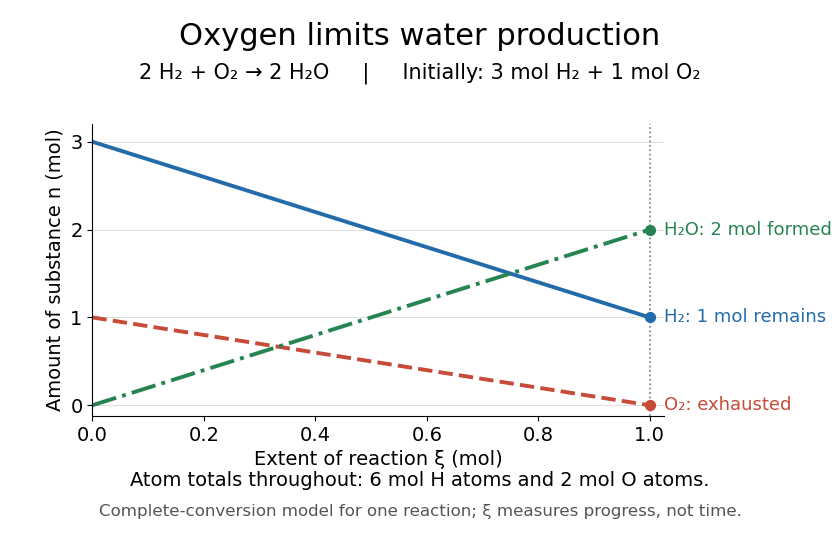
Oxygen runs out while one mole of molecular hydrogen remains
. The horizontal axis is extent of reaction, rather than time. The endpoint assumes complete conversion by one chemical reaction; the curves express stoichiometry. Details.
As a check, the initial inventory has of hydrogen chemical atoms and of oxygen chemical atoms. The final water contains of hydrogen chemical atoms, and leftover molecular hydrogen supplies the remaining . The atom totals balance even though the total amount of substance of molecules falls from four to three moles.
New to topics? Read the docs here!