
An open addressing probe rule that visits modulo , using modular arithmetic, until a matching record or an appropriate stopping slot is found.[ref]
Lecture 10: Hashing III: Open Addressing. 6.006 Introduction to Algorithms, Fall 2011 by Massachusetts Institute of Technology, 6.006 course staff; Lecture 10: Hashing III: Open Addressing, p. 3, Linear Probing formula
For capacity , the hash table probe numbered , starting at zero, inspects the array indexThe hash function gives the first array index. Each subsequent hash table probe moves one slot forward, wrapping from to by modular arithmetic. Keep the hash function and key equality fixed while hash table records are stored.
Use three distinguishable slot states: occupied by a live hash table record; never used since initialization or rebuilding, written
E; or deleted, written D, a tombstone in open addressing. Lookup compares occupied hash table keys using key equality, stops at E, and continues past D.[ref]5.2 LinearHashTable: Linear Probing. Open Data Structures: An Introduction by Pat Morin; Section 5.2, three entry types and find: nil stops lookup, del does not
For an original example, take an eight-slot array, integer hash table keys, and the hash function . Start with all slots
E and insert the hash table records in that order. The insertion hash table probe traces, expressed as array indices, areThe resulting array holds hash table keys at array indices , with E in the other four slots. The first three hash table keys have the same initial array index, a hash collision; the fourth begins at but joins the same linear probing cluster. Lookup of examines array indices , rejecting before returning . Lookup of absent examines , including the stopping E: five hash table probes for a hash table load factor .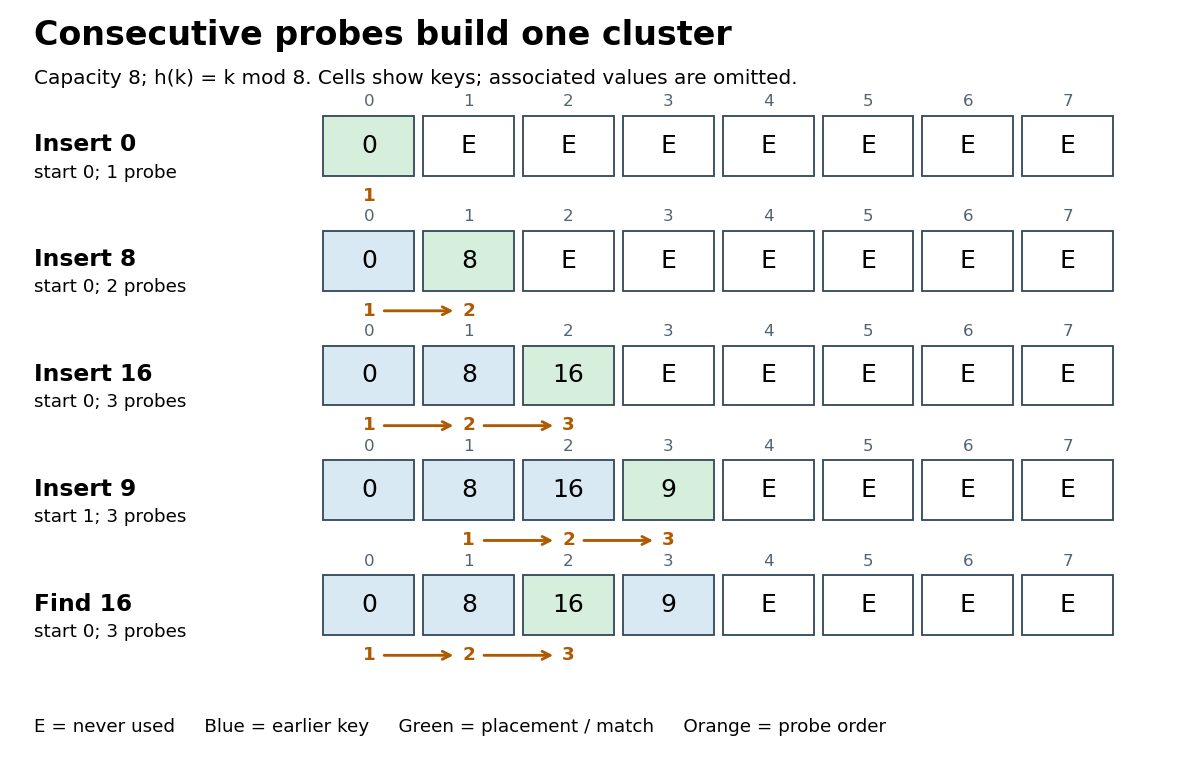
Bound lookup to at most hash table probes, even if no
E remains. For algorithm termination, the first array indices are distinct: equality of and implies that divides by modular arithmetic, and forces . They therefore cover the entire finite set of slots exactly once. If no occupied hash table key matches and no E is encountered, exhausting these hash table probes establishes absence; wrapping around again supplies no new information.[ref]Lecture 10: Hashing III: Open Addressing. 6.006 Introduction to Algorithms, Fall 2011 by Massachusetts Institute of Technology, 6.006 course staff; Lecture 10: Hashing III: Open Addressing, pp. 1–2, probe permutation requirement and Search loop with m trials
The attraction is a compact array and a simple hash table probe rule. Consecutive slots can benefit from spatial locality, although actual memory cache behavior depends on representation and hardware. Correctness rests on preserving the search route; speed depends on how long that route becomes. The linear probing cluster below explains why even a moderate hash table load factor gives no universal constant lookup bound.


Linear probing is a collision resolution technique used in open addressing, a method for implementing hash tables. When a hash function maps a key to an index in the hash table, there may be cases where two or more keys hash to the same index, resulting in a collision. Linear probing addresses this problem by searching for the next available slot in the hash table sequentially.
New to topics? Read the docs here!