A hash collision is a function collision of a hash function : two distinct inputs have the same output, . Repeating the same input is not a hash collision. Unequal hash values prove the keys differ; equal hash values only identify candidates that might be equal. This makes a hash function useful as a compact filter before comparing the original data.
Here is a deliberately simple example using modular arithmetic. Let for nonnegative integer keys, and let a four-bucket hash table use the further bucket index . For keys , the hash values are , while all three bucket indices are . Thus and form a hash collision for ; and share a table bucket even though their full hash values differ. Always specify which function is being compared: a table collision concerns the bucket-index function, which may discard more information than the original hash function.
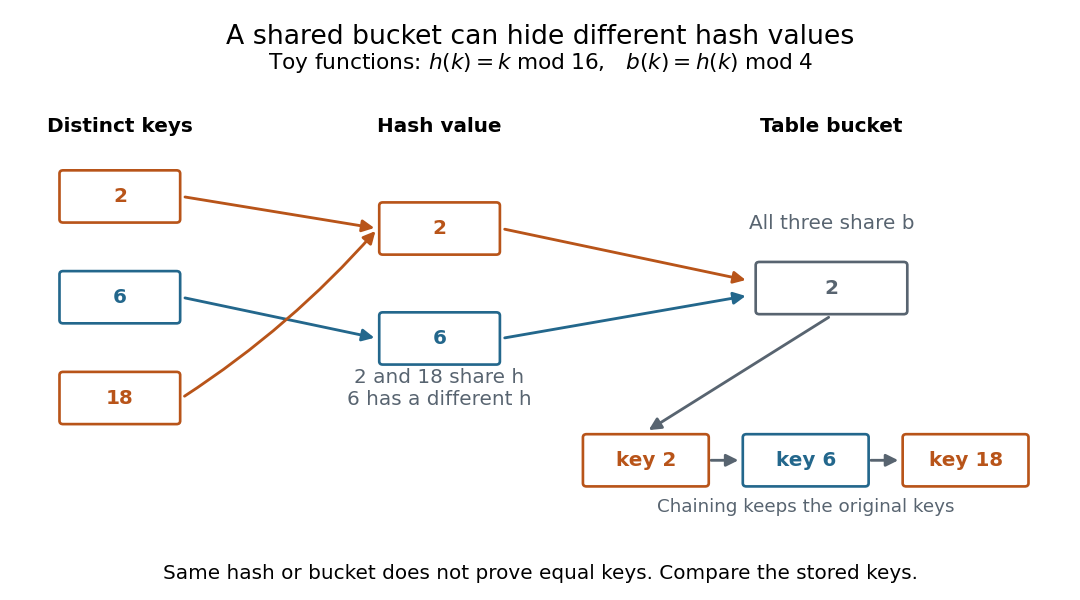

With separate chaining, bucket holds all three records in a linked list. A search for visits that bucket and compares the stored keys until it finds ; a search for visits the same bucket but rejects every stored key. A hash collision changes the search work, while key comparison preserves correctness. Storing only one record per hash value would incorrectly merge distinct keys. This is the purpose of collision handling in a hash table.[ref]
The pigeonhole principle explains inevitability: if a hash function has only possible outputs, any distinct inputs contain a hash collision. In particular, a function whose domain of a function is larger than its finite codomain cannot be an injective function. This is an existence statement; it gives neither an efficient way to find the pair nor a probability for a smaller collection of keys. A particular small collection might have no hash collision at all.
For a cryptographic hash function, collision resistance asks that finding any two distinct messages with equal full digests be computationally infeasible under the specified model and resources. It does not mean that hash collisions do not exist. Preimage resistance asks a different question: given a target digest , how hard is it to find a message with ? The collision finder may choose both messages and their common digest; the preimage finder is given the digest in advance. These definitions distinguish two search tasks, independently of how a hash table stores records.[ref]
https://nvlpubs.nist.gov/nistpubs/Legacy/SP/nistspecialpublication800-107r1.pdf. Quynh Dang, NIST SP 800-107 Revision 1 (2012), section 3.1 and section 4.1, definitions of collision and preimage resistance
Articles by others on the same topic
There are currently no matching articles.