A hash table collision-handling method storing at most one live record per array slot. A hash function chooses a starting slot, and a probe rule chooses further slots. Unlike separate chaining, records occupy the slots themselves.
An open addressing probe rule that visits modulo , using modular arithmetic, until a matching record or an appropriate stopping slot is found.[ref]
Lecture 10: Hashing III: Open Addressing. 6.006 Introduction to Algorithms, Fall 2011 by Massachusetts Institute of Technology, 6.006 course staff; Lecture 10: Hashing III: Open Addressing, p. 3, Linear Probing formula
For capacity , the hash table probe numbered , starting at zero, inspects the array indexThe hash function gives the first array index. Each subsequent hash table probe moves one slot forward, wrapping from to by modular arithmetic. Keep the hash function and key equality fixed while hash table records are stored.
Use three distinguishable slot states: occupied by a live hash table record; never used since initialization or rebuilding, written
E; or deleted, written D, a tombstone in open addressing. Lookup compares occupied hash table keys using key equality, stops at E, and continues past D.[ref]5.2 LinearHashTable: Linear Probing. Open Data Structures: An Introduction by Pat Morin; Section 5.2, three entry types and find: nil stops lookup, del does not
For an original example, take an eight-slot array, integer hash table keys, and the hash function . Start with all slots
E and insert the hash table records in that order. The insertion hash table probe traces, expressed as array indices, areThe resulting array holds hash table keys at array indices , with E in the other four slots. The first three hash table keys have the same initial array index, a hash collision; the fourth begins at but joins the same linear probing cluster. Lookup of examines array indices , rejecting before returning . Lookup of absent examines , including the stopping E: five hash table probes for a hash table load factor .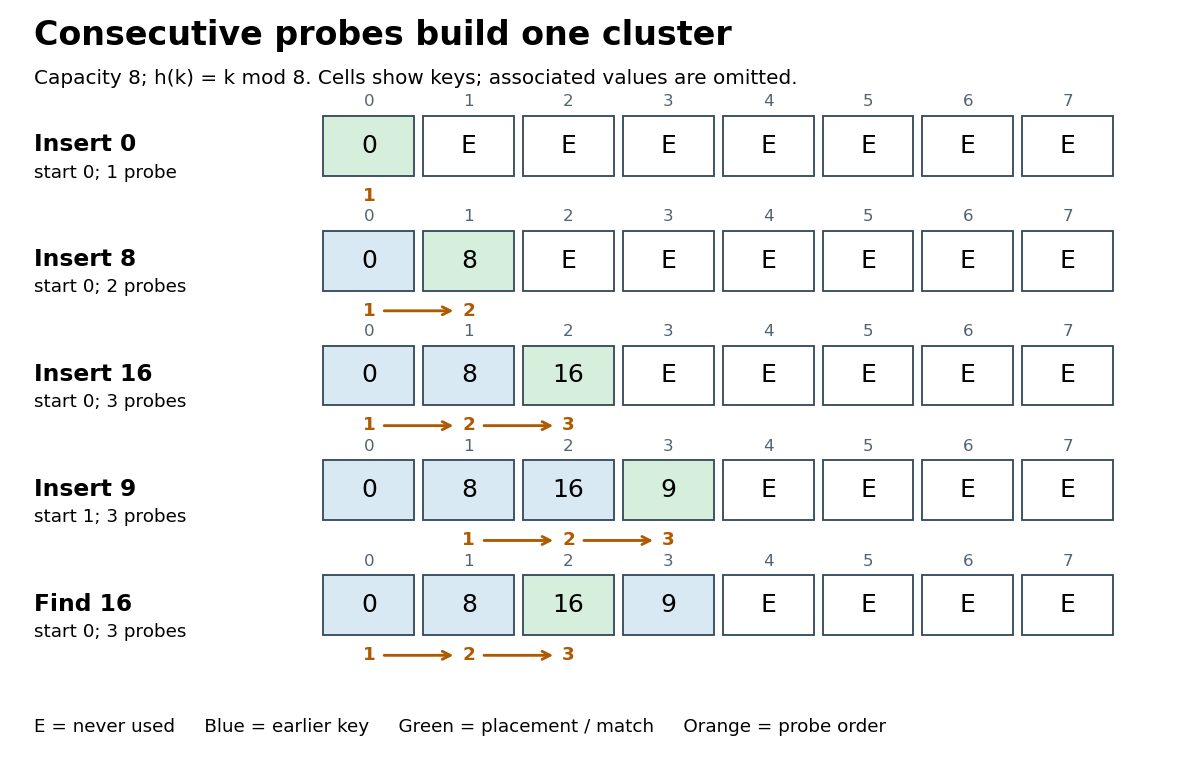

Bound lookup to at most hash table probes, even if no
E remains. For algorithm termination, the first array indices are distinct: equality of and implies that divides by modular arithmetic, and forces . They therefore cover the entire finite set of slots exactly once. If no occupied hash table key matches and no E is encountered, exhausting these hash table probes establishes absence; wrapping around again supplies no new information.[ref]Lecture 10: Hashing III: Open Addressing. 6.006 Introduction to Algorithms, Fall 2011 by Massachusetts Institute of Technology, 6.006 course staff; Lecture 10: Hashing III: Open Addressing, pp. 1–2, probe permutation requirement and Search loop with m trials
The attraction is a compact array and a simple hash table probe rule. Consecutive slots can benefit from spatial locality, although actual memory cache behavior depends on representation and hardware. Correctness rests on preserving the search route; speed depends on how long that route becomes. The linear probing cluster below explains why even a moderate hash table load factor gives no universal constant lookup bound.
A maximal consecutive run of occupied or deleted slots in linear probing, bounded by never-used slots when any exist; adjacency wraps around by modular arithmetic. Deleted slots still belong to the search run.[ref]
5.2 LinearHashTable: Linear Probing. Open Data Structures: An Introduction by Pat Morin; Section 5.2.1, definition of a run using non-nil entries and modular indices
In the eight-slot example, array indices form one linear probing cluster. Inserting absent hash table key starts at , passes the occupied slots , and fills . This extends the same linear probing cluster despite having a different initial array index from . A hash collision at the initial slot is enough to make later slots compete too.
For a worst-case family, insert integer hash table keys into an empty capacity- array, using the hash function , where . They occupy array indices . Lookup of absent needs hash table probes. Taking gives hash table load factor at most while the number of hash table probes grows with . Thus occupancy alone cannot promise constant lookup work.
Before any rebuilding, bounded lookup, deletion by hash table key, and insertion with a duplicate check each have worst-case time complexity in Big O notation, assuming constant-cost hash function evaluation, array access and key equality. The counterexample gives a matching linear worst-case growth in the number of hash table probes. Hash table resizing is additional work; expensive string comparisons or hashing also fall outside these constant-cost assumptions.
In an insertion-only table, an absent hash table key starting anywhere inside a linear probing cluster reaches its far end. Filling a one-slot gap can merge two runs, joining hash table keys with different initial array indices into one long search route. The insertion of above exhibits this effect without a hash collision with at their initial slots.[ref]
Lecture 10: Hashing III: Open Addressing. 6.006 Introduction to Algorithms, Fall 2011 by Massachusetts Institute of Technology, 6.006 course staff; Lecture 10: Hashing III: Open Addressing, pp. 3–4, Linear Probing and Figure 4: Primary Clustering
A deleted-slot marker in open addressing. Lookup continues past it because a hash collision may have displaced a match further along. Linear probing can reuse the slot for insertion after checking for an existing equal key. A genuinely empty slot can terminate lookup; this marker cannot.[ref]
5.2 LinearHashTable: Linear Probing. Open Data Structures: An Introduction by Pat Morin; section 5.2, find, add, remove, and correctness paragraph distinguishing del from nil
Delete hash table key from the original eight-slot example. Writing
E into array index makes lookup of inspect and incorrectly report absence, although its hash table record remains at . Writing D instead makes lookup pass and reach , returning after three hash table probes. The deleted slot must remember that the search route once continued through it.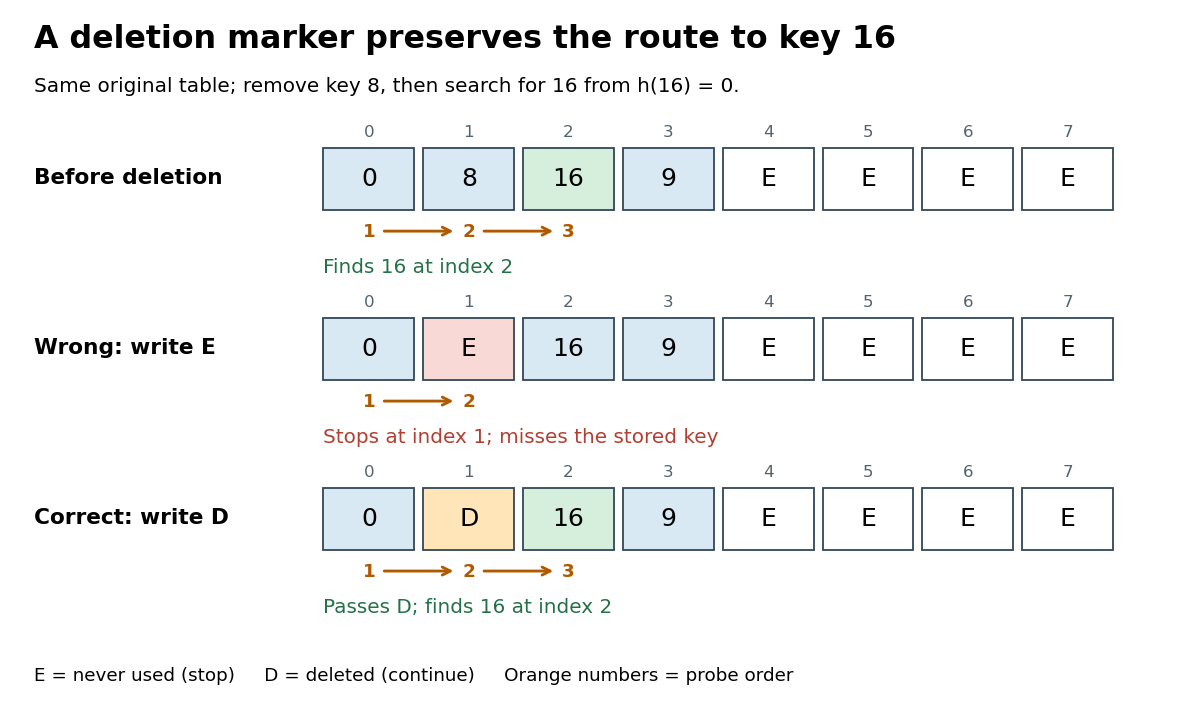
Deleting to an empty slot breaks lookup; a tombstone in open addressing preserves the search route
. Original deterministic comparison: the middle and lower rows are alternative deletions from the top row. E means never used and stops lookup; D means deleted and lets lookup continue. Orange numbers give the hash table probe order for hash table key . Details.
A short algorithm correctness proof uses this invariant: no never-used slot precedes a stored hash table key along its linear probing route. Initially the claim is vacuous. Insertion places a new hash table record no later than the first
E, possibly at an earlier D, and cannot create an E before another stored hash table record. Replacing a value leaves all slots occupied as before. Deletion to D also creates no E. By mathematical induction over operations, the invariant persists, so stopping lookup at E is sound. Deletion directly to E invalidates that argument, as the diagram shows.To implement the hash table map operation
put(k,v) in one bounded scan, remember the first D encountered, but keep checking occupied hash table keys. A later key equality match means replace that hash table record's value and stop. Only after reaching E, or completing hash table probes, is absence established. Then insert at the remembered D, if any; otherwise use the stopping E. If all slots are occupied and no match exists, report full or rebuild before trying again. Merely finding D is not permission to create a second equal hash table key.[ref]Continue from the correctly deleted example, with hash table keys at array indices and
D at . put(16,Z) examines and updates the value at , leaving deleted and retaining three live hash table records. Inserting immediately at would instead create two copies of . Now put(24,W) examines , proves absence at E, and places the new hash table record at the remembered array index . The hash table load factor rises from to ; reusing D avoids extending the linear probing cluster to .For a boundary case, fill all eight slots with hash table keys and then delete all eight to
D. The live hash table load factor is zero, but absent lookup of still needs eight hash table probes. put(16,C) also checks eight slots before reusing the first D, at array index . A loop that waits indefinitely for E would never finish in this state. Rebuilding from the live hash table records into a fresh array removes each tombstone in open addressing and restores never-used stopping slots.[ref]5.2 LinearHashTable: Linear Probing. Open Data Structures: An Introduction by Pat Morin; Section 5.2, resize: reinsert live elements and reset the non-nil count to the live count
One inspection of an array slot during an open addressing operation. Its array index follows the chosen probing rule; its contents determine whether to continue, return a matching hash table record, or establish absence.
Articles by others on the same topic
There are currently no matching articles.