Logical failure of the three-qubit bit-flip repetition code
ID: logical-failure-of-the-three-qubit-bit-flip-repetition-code

Assume that each physical qubit undergoes an independent quantum bit-flip channel with probability during one storage interval, and that encoding, error syndrome extraction, recovery and decoding are all ideal. Use the three-qubit bit-flip syndrome table to apply the indicated minimum-weight recovery. Zero or one bit flips are corrected. Two bit flips have the same error syndrome as the complementary one-site error: for example, gives , so recovery leaves . Three bit flips give and also leave . This exchanges and , and therefore acts as a logical Pauli X gate after decoding.
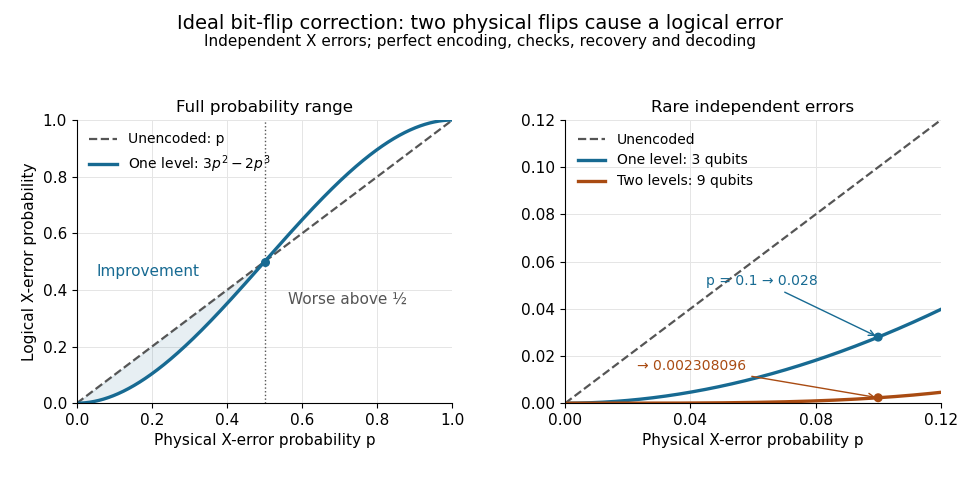
The number of physical bit flips has a binomial distribution with three trials, hence the logical-error probability isFor a logical density operator , the decoded quantum channel is exactly . Here logical failure means a nontrivial logical Pauli X gate error; a particular input such as can be invariant under that error. At , exactly two flips have probability and three flips have probability , giving . The block succeeds with probability compared with for an unencoded qubit. At , , illustrating the quadratic suppression of rare independent bit flips.
Factoring the improvement givesThus one level reduces logical-error probability for , is equal at , and makes it worse for under this same decoder. The suppression arises because a logical error requires at least two physical bit flips. With independent disjoint inner blocks, the same noise model and ideal correction at every level, a concatenated quantum error-correcting code has , with . At , two levels use nine data qubits and give .

This calculation describes ideal correction of stored information with the specified quantum bit-flip channel. Repeated correction in time additionally requires a fresh specified noise model for each interval; imperfect quantum gates, faulty measurements and correlated errors change the calculation. The timed bit flip during repetition-code syndrome extraction and exact encoded-state failure with a faulty parity check show concretely why this storage calculation alone is not a fault-tolerance result.
New to topics? Read the docs here!