A finite-dimensional density operator represents a quantum state on a Hilbert space. It is Hermitian, positive semidefinite, and has trace one:The density matrix is its matrix in a chosen orthonormal basis. In dimension it has real parameters: a Hermitian matrix has , and fixing its trace removes one; positivity restricts the allowed values.
A quantum state ensemble of normalized pure states with positive probabilities givesZero-weight terms can be omitted. Conversely, the spectral theorem gives such an ensemble for every density operator, using its orthonormal eigenvectors and nonnegative eigenvalues, with zero eigenvalues omitted. A pure state has ; a mixed state needs at least two nonzero eigenvalues. [ref]
https://cs.uwaterloo.ca/~watrous/TQI/TQI.2.pdf. Watrous, The Theory of Quantum Information, chapter 2, section 2.1.2, pp. 62–64
For a projective measurement with orthogonal projections , the Born rule isThis is the average of the component pure state probabilities. Positivity makes each outcome probability nonnegative, and makes them sum to one. The same density operator therefore predicts every measurement on the system without requiring a unique preparation history. [ref]
For a closed system, Schrödinger picture evolution under a unitary operator iswhen denotes the time-independent Heisenberg picture state and . In the Schrödinger picture the density operator evolves; in the Heisenberg picture the observables evolve instead, with identical measurement predictions. This unitary operator preserves the eigenvalues and hence the purity of a density operator. [ref]
A historical source for the probabilistic formulation of quantum mechanics is von Neumann's 1927 paper Wahrscheinlichkeitstheoretischer Aufbau der Quantenmechanik. [ref]
https://geodesic.mathdoc.fr/item/NGWGMP_1927__1927_59230/. von Neumann, Nachrichten von der Gesellschaft der Wissenschaften zu Göttingen, Mathematisch-Physikalische Klasse, 1927, pp. 245–272
For a chosen normalized level state , its population is the probability of finding the system in that state. In an orthonormal level basis these diagonal entries are nonnegative and sum to one. Off-diagonal quantum coherence contains information absent from the population vector, so matching all level populations need not prepare a specified coherent superposition.
For a chosen orthonormal basis, the off-diagonal entries of a density operator encode quantum coherence between distinct basis states. A diagonal density operator is an incoherent mixture in that basis. This property is basis-dependent: diagonalizing the operator does not imply that it lacked coherence in the measurement or energy basis of interest. Relative phases affect these entries, while a global wavefunction phase cancels from the density operator. Dephasing damps the entries and can spoil stimulated Raman adiabatic passage by removing the ground-state interference that maintains the dark state.
This collective-unitary-invariant two-qubit state has singlet weight and equal weights on the three triplet Bell states. With the spin singlet state projector, its partial transpose has eigenvalues once and three times. It is entangled exactly when . At , it is the equally weighted mixture of six antiparallel product states along the three Pauli axes. In the interval , convex mixing of this boundary state with explicitly proves separability. The weight here is the singlet probability, not the alternative coefficient multiplying a pure singlet in a white-noise mixture.
Write , with . For positive matrices and , the success probability is . It is at least . Squaring the middle comparison leaves .
Combine the single-copy Werner filtering normalization bound with concurrence scaling under invertible local filters. Every complete classical record of local operations and classical communication has a product filter ; singular branches are separable. Thus every retained branch has concurrence at most that of the input. Coarse-graining successful records preserves the bound by convexity. Since concurrence of a two-qubit Werner state increases strictly with , no successful single-copy protocol can output a Werner state with larger . Several input copies permit collective distillation and are outside this statement.
For any normalized pure two-qubit vector, its squared overlap with a maximally entangled state is at most : in a Schmidt decomposition the overlap is bounded by . Averaging gives . Equality follows from the six-state ensemble , with equal weights, where , and . The coherences cancel and each coefficient determinant gives pure concurrence .
Average the four correlated local Pauli operations to remove coherences in the Bell states basis. A one-party Pauli operation can permute the largest of the four resulting weights into the singlet sector; that weight is at least . Correlated common local unitaries then permute the three triplet projectors, while collective-unitary covariance of the two-qubit singlet keeps the singlet projector unchanged. Averaging all six permutations makes the triplet weights equal, producing a two-qubit Werner state. Shared randomness or local operations and classical communication coordinates these local operations. Common unitaries alone cannot increase an initially small singlet weight, because that weight is invariant under them.
The density operators on a finite-dimensional Hilbert space form a convex set. Its extreme points are exactly the rank-one projectors, hence exactly the pure states. To prove this, suppose with and positive semidefinite. For , is a sum of nonnegative numbers, so every term vanishes. Diagonalizing shows that implies . Thus each is supported on the line spanned by , and its unit trace forces .
Conversely, a density operator of rank at least two has a spectral decomposition with at least two positive eigenvalues. If is one of them, and , where is the normalized remainder. These are distinct density operators, proving that is not an extreme point.
The unitary orbit consists exactly of density operators with the same spectrum. If distinct eigenvalues have multiplicities , its stabilizer is and its real dimension is . A reachable compact group with Lie algebra is transitive on this orbit exactly when equals the orbit dimension. Global phases act trivially by conjugation.
A quantum state ensemble specifies a random preparation: normalized pure states are selected with probabilities , . Without an accessible preparation label, its measurement statistics are those of the density operator . Indeed every POVM effect has probability . Different ensembles can therefore have identical operational statistics: equal mixtures of computational-basis qubits or Hadamard-basis qubits both have density operator . The ensemble decomposition contains information about the preparation, not additional information accessible from the system alone.
A convex roof extension extends a function on pure states to arbitrary density operators by minimizing its ensemble average over all pure state decompositions. It agrees with on pure states: every positive-weight state in a decomposition of a rank-one density operator has the same one-dimensional support. Concatenating nearly minimizing ensembles proves that is a convex function. Moreover, every convex function that is no larger than on pure states is no larger than , by applying convexity to each decomposition. Infima need not be attained; an arbitrarily small additive error suffices when is finite.
If a convex roof extension is non-increasing on average for every pure input to a quantum instrument, then it is non-increasing on average for mixed inputs too. For an input ensemble , let and be its conditional outcome probabilities and states. Linearity of each unnormalized outcome map gives . Convexity gives . Taking the infimum over input ensembles proves the result, even when conditional outputs of pure inputs are mixed, provided the averages are well defined.
For a two-qubit density operator, the real three-by-three matrix encodes the spin-product expectation values: unit measurement axes have . The tensor does not include local Bloch-vector data and alone need not specify the complete density operator. The CHSH optimum from the correlation tensor depends on the two largest eigenvalues of .
The maximally mixed density operator on an -dimensional Hilbert space assigns equal weights to every vector of any orthonormal basis. It is invariant under every unitary operator. Its purity is , the minimum possible because the nonnegative eigenvalues sum to one and obey the Cauchy-Schwarz inequality. For it is a mixed state; for it is the sole pure state. A rank- projector has probability in this state.
Let be a rank- projector with . No unitary operator can map every pure state whose probability equals to a state with the same fixed smaller probability. Average over good and bad basis vectors and both signs. The average density operator is the maximally mixed state, so every unitary preserves its average probability. This contradicts a strictly smaller probability for all states in the ensemble. A preparation tailored to one known starting state is a different resource and is used in exact amplitude amplification.
A mixed state is a density operator that is not a rank-one orthogonal projection. In finite dimension it is characterized by , so its purity of a density operator distinguishes it from a pure state.
Compare a pure state quantum superposition with an equal classical choice between two computational-basis states of a qubit:A projective measurement in the computational basis gives for both density operators. An projective measurement in the Hadamard basis distinguishes them: the Born rule gives for and for . These comparisons use separate copies of each preparation; measuring first changes the state tested by a subsequent measurement.
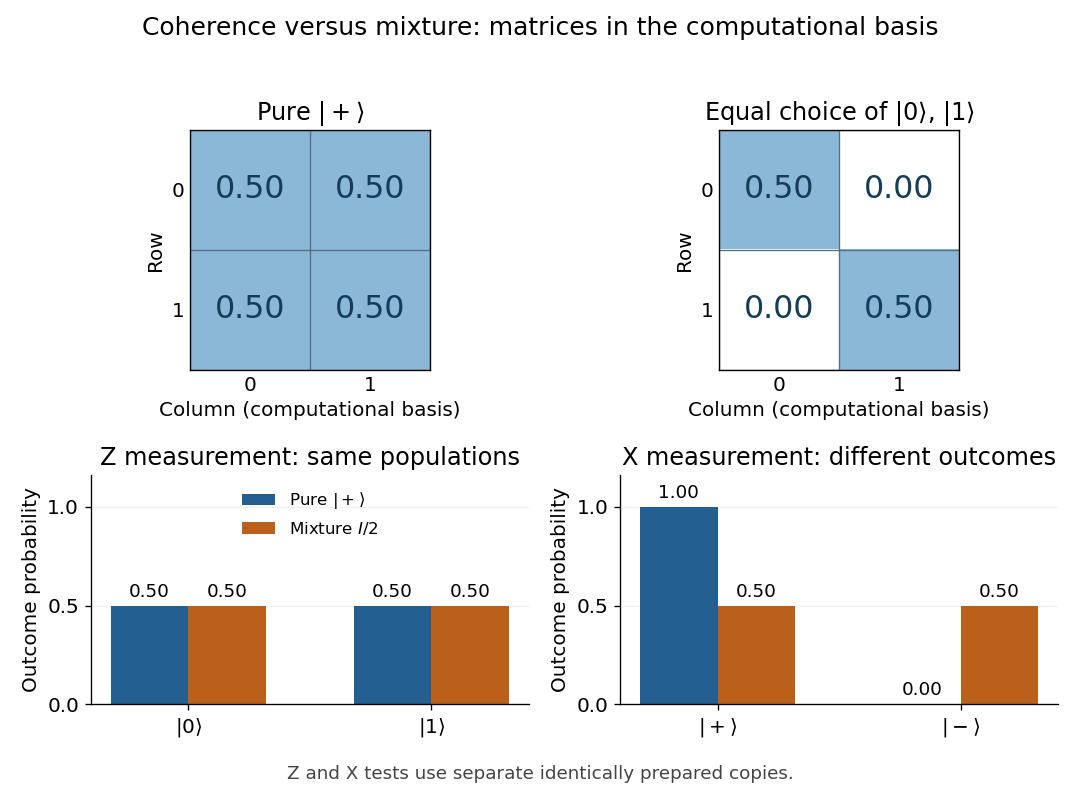
The off-diagonal entries of encode quantum coherence in the computational basis. Such quantum coherence depends on the basis: is diagonal in the Hadamard basis but remains a pure state. Mixedness is independent of the basis, because a unitary change of basis preserves the eigenvalues and the purity of a density operator.
Even the quantum state ensemble is not unique:The off-diagonal entries of the two Hadamard basis projectors cancel. Thus the density operator retains precisely what measurements on the system can reveal, while an accessible preparation label carries additional information. A mixed state can also be the reduced density matrix of an entangled state, even when the whole system is in a pure state; classical ignorance about a selected component is not its only physical origin. [ref]
A purification of a density operator is a pure state on a larger system such that . A spectral decomposition gives the canonical construction .
If subsystem has pure state in a normalized joint pure vector , then . Indeed, for an orthonormal basis of , each squared norm is zero. Therefore the joint vector has no component outside . In particular, if Alice and Bob share a known pure entangled state, an adversary holding a purifying system has no correlations with it. This does not make every pure bipartite state useful for key distribution: a pure product state has no shared random correlations.
For , choose component purifications and an orthonormal flag register. The vector is normalized and reduces to after tracing out and the flag. Orthogonal labels remove the cross terms. This construction turns mixture identities into pure-state overlap arguments and proves joint concavity of quantum fidelity.
Any two purifications of the same density operator on sufficiently large reference spaces differ by an isometry on the reference system, and by a unitary when the reference spaces have the same dimension.
The Hughston--Jozsa--Wootters theorem says that two pure-state ensembles represent the same density operator exactly when their subnormalized state vectors are related by an isometry, or by a unitary after padding the shorter ensemble with zero vectors.
For the nonzero spectral decomposition , every pure-state quantum state ensemble of is specified by the displayed column linear isometry. To prove this, write . Positivity forces each into the support of , and the coefficients have orthonormal columns because . Conversely this column identity reconstructs ; the squared vector norms are the probabilities and sum to one. Complete the columns to unitary bases after adding zero ensemble vectors to obtain the usual unitary-mixing formulation.
Uhlmann's theorem states that the fidelity of two density operators is the maximum absolute overlap between their purifications on a common reference space.
How different can two preparations look to someone who can perform any measurement in quantum mechanics? The trace distance answers this question for density operators on the same finite-dimensional vector space:Here is the absolute value of an operator, and is its trace norm. Because is Hermitian, its trace norm is the sum of the absolute values of its eigenvalues; it is not the sum of the absolute values of its matrix entries. The factor givesThe trace distance is a metric: it is symmetric, vanishes exactly when , and obeys the triangle inequality. Identical preparations have trace distance zero; preparations with orthogonal occupied eigenspaces have trace distance one and can be identified perfectly in a single measurement in quantum mechanics.
Operationally, the trace distance is the largest total variation distance between the outcome probability distributions obtainable by a POVM. Equivalently, the variational characterization of trace distance says it is the largest possible probability gap for one event in a binary measurement in quantum mechanics. For one copy of either known preparation, each chosen with prior probability , the Holevo–Helstrom theorem givesThus trace distance zero leaves only guessing, while trace distance one permits perfect quantum state discrimination. The optimum ranges over measurements; different measurement bases can expose different amounts of distinguishability. [ref]
https://cs.uwaterloo.ca/~watrous/TQI/TQI.3.pdf. Watrous, The Theory of Quantum Information, §3.1, Theorem 3.4 and Proposition 3.5
For a worked example with commuting density operators, take a qubit withTheir difference has eigenvalues , so . Measuring in the computational basis produces outcome probability distributions and , whose total variation distance is also . Guessing on outcome zero and on outcome one succeeds with probability . A projective measurement in the Hadamard basis instead produces for both preparations and gives no discrimination advantage.
The trace-distance contraction under quantum channels ensures that a common quantum channel, including the partial trace, cannot increase the trace distance. This makes trace distance a useful error measure: if , every event in every measurement in quantum mechanics has a probability gap at most . Losing access to a subsystem can hide distinguishability, but cannot create more of it.
For qubit density operators, the trace distance has a particularly simple geometry. Write their Bloch vectors as in the Bloch ball:where is the identity operator and denotes the Pauli matrices. This Bloch vector representation includes both pure states on the Bloch sphere and mixed states in the interior of the Bloch ball. [ref]
The Pauli matrix multiplication law gives . Hence the two eigenvalues of are , and their absolute sum givesThe trace distance is half the straight-line Euclidean distance between the Bloch vectors, not the angular or surface distance along the Bloch sphere. Opposite Bloch vectors have trace distance one; the centre is at trace distance from every pure state.
For the pure states and , the Bloch vectors are and . Their straight-line separation is , soThese Bloch vectors are perpendicular, but the pure states are not orthogonal: . The Helstrom measurement for the zero and plus states measures along the difference direction , rather than along either input Bloch vector.
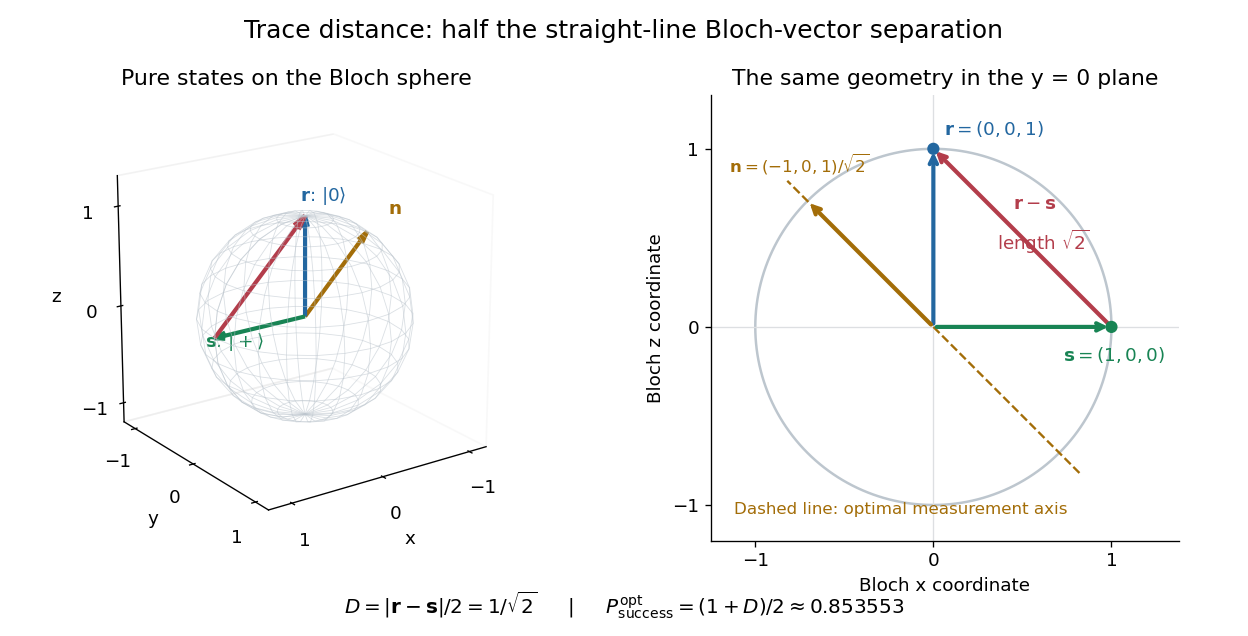
Trace distance is half a Bloch-vector chord, and the optimal zero-versus-plus measurement follows the difference direction
. Details. By the variational characterization of trace distance, maximize over . The adjoint of a quantum channel is positive and unital, so . Moving the channel onto therefore restricts, rather than enlarges, the effects available in the input variational problem. This proves the displayed bound for every pair of density operators.
For the pure qubit , subtracting the output of dephasing channel leaves a Hermitian matrix with zero diagonal and off-diagonal modulus . Its two eigenvalues are that number and its negative, giving the displayed trace distance. For real , this is .
For two normalized pure states, the difference of their projectors has two eigenvalues , giving that trace distance. Write a mixed density operator as . Convexity of the trace norm and weighted Cauchy-Schwarz inequality give . Thus a small probability of failing the pure-state projector test forces trace-distance proximity, including for correlated multipartite outputs.
For the Hermitian difference , define its positive part of a Hermitian operator and negative part of a Hermitian operator . Their supports are orthogonal and . Equal traces give , so the trace distance is both and . This explains why the positive spectral projector attains the variational characterization of trace distance.
For a density operator and pure state , the diagonal absolute-sum bound for the trace norm in a basis containing gives . The quantum fidelity is unsquared. Block-diagonal states with respect to the target and its complement attain equality.
The variational characterization of trace distance turns a matrix distance into the best possible binary experiment. For density operators on the same finite-dimensional vector space,An operator with is an effect of a POVM: both and are positive operators. The Born rule assigns the first outcome probabilities and . Their signed gap is , where . Since , replacing by reverses this gap, explaining the equality with the absolute-value maximum.
One optimal is the spectral projector onto the positive eigenspaces of . In the spectral decomposition of , this choice includes all positive eigenvalues and excludes all negative eigenvalues. Their positive sum equals the trace distance by the spectral-parts formula for trace distance. Any zero eigenspace can be assigned to either outcome without changing the gap. This is the effect selected by the equal-prior Holevo–Helstrom theorem. [ref]
https://cs.uwaterloo.ca/~watrous/TQI/TQI.3.pdf. Watrous, The Theory of Quantum Information, Theorem 3.4, equations (3.16)–(3.19)
The same optimum has a classical description. For any finite-outcome POVM , let and . ThenThe expression is the total variation distance of the entire outcome probability distributions; the expression for is the gap for one event. Grouping outcomes in gives the single effect . Conversely, an effect gives the binary POVM , whose two probability gaps are opposites, so their total variation distance is . Thus the optimum over all POVMs is already attained by one binary projective measurement. [ref]
https://cs.uwaterloo.ca/~watrous/TQI/TQI.3.pdf. Watrous, The Theory of Quantum Information, §3.1.1, Proposition 3.5 and the discussion following Theorem 3.4
For quantum state discrimination with equal prior probabilities, declare on outcome and on outcome . Directly averaging the two conditional success probabilities givesOptimizing this expression gives . For the diagonal example in trace distance, gives a gap . For zero versus plus, that same effect gives only , while the effect in Helstrom measurement for the zero and plus states gives the larger gap . The trace-distance-preserving binary measurement depends on the pair of preparations; a fixed measurement basis does not generally attain the trace distance for every pair.
For two density operators , let project onto the positive spectral subspace of . The binary POVM has output probability difference , where . Its measurement channel therefore preserves this pair's trace distance exactly. The optimizing quantum measurement depends on the pair; a single fixed measurement need not preserve every pair's distance.
The Von Neumann entropy of a density operator isIt vanishes for a pure state and measures mixedness and quantum entanglement in reduced states.
For density operators in dimension , let . The positive and negative parts of their difference have the same trace . Normalize them as and write . Applying the two entropy bounds for a quantum mixture to this common state proves the displayed bound. The function is increasing and concave, with , which also controls average entropy errors in pure-source compression.
For density operators supported on mutually orthogonal subspaces, the eigenvalues of their mixture are , where are the eigenvalues of . Substitution into the definition of Von Neumann entropy gives the displayed decomposition into Shannon entropy of the label and the mean entropy within each block. Zero eigenvalues use .
A mixture of two orthogonal pure qubit states has Von Neumann entropy equal to the binary entropy of its weights. Its entropy difference from the first pure state is exactly and its trace distance from that state is . The elementary bound gives ; entropy also never exceeds one bit. For small , the leading term is .
If a density operator on an dimensional Hilbert space has overlap with a fixed pure state, then . Dephase in a basis containing and apply the entropy bound with one prescribed probability. The abstract state bound is attained by .
On a -dimensional Hilbert space, the Von Neumann entropy is maximized uniquely by . Indeed, nonnegativity of quantum relative entropy giveswith equality exactly when .
If is a nonselective projective measurement, then . Equality holds exactly when is already block diagonal in the measurement decomposition, equivalently for every .
The pinching map is self-adjoint for the trace pairing, and is block diagonal. Thus . The kernel of is contained in that of , so the relative entropy is finite on its support. Expanding the quantum relative entropy gives the displayed identity. Its nonnegativity proves entropy increase, with equality exactly when the original state is already block diagonal.
For a bipartite pure state, the entanglement entropy is the Von Neumann entropy of either reduced density matrix. The two reduced states have the same nonzero eigenvalues, so their entropies agree.
For a bipartite pure state, entanglement entropy is the Von Neumann entropy of either reduced density matrix. When Alice makes a local measurement with pure conditional branches, Bob's reductions average to his original reduction. Concavity of Von Neumann entropy therefore gives . When Bob measures, apply concavity to Alice's reductions. In each pure branch the two reduced entropies coincide by the Schmidt decomposition. Refining measurement outcomes to individual Kraus operators and iterating proves the inequality for arbitrary finite-round LOCC. Discarded local systems can be measured and their outcomes refined as well, so discarding does not evade the bound.
Every finite-dimensional bipartite pure state has a decomposition with positive Schmidt coefficients and orthonormal families on each subsystem.
The operator Schmidt rank of a bipartite linear operator is its shortest expansion as a sum of product linear operators. Expanding in local orthonormal operator bases gives a coefficient matrix; its matrix rank is the operator Schmidt rank, by a singular value decomposition. It is unchanged by invertible local operator-basis changes. A rank-one projector onto a bipartite pure state of Schmidt rank has operator Schmidt rank : its expansion contains all independent products of local matrix units.
If two parties share a pure resource of Schmidt rank , a fully refined branch of their local operations has Kraus operator . Hence its operator Schmidt rank is at most . Local ancillas, locally adaptive readouts and refined discarded environments are included in the branch operators. Shared classical randomness only mixes such branches. Classical comparison of records does not increase their operator Schmidt rank.
For the pure state with real normalized Schmidt coefficients, the two-body Pauli correlators form , . Thus arbitrary local axes give . The negative component follows from the phases in the Pauli operators.
The Schmidt coefficients of a normalized bipartite pure state are the nonnegative numbers in its Schmidt decomposition; they satisfy and their squares are the nonzero eigenvalues of either reduced density matrix.
The Schmidt rank is the number of nonzero terms in a Schmidt decomposition, equivalently the rank of either reduced density matrix of a bipartite pure state.
The coefficient matrix of a bipartite pure state has rank equal to its Schmidt rank, by singular value decomposition. A local product operation sends it to , whose rank cannot increase. A complete classical transcript of an LOCC protocol still selects one product Kraus operator, so every nonzero branch obeys the bound. Discarding the transcript gives a mixed output with Schmidt number at most the initial rank.
The Schmidt rank of a bipartite pure state cannot increase under local operations, even in a nonzero selected branch. A coefficient matrix changes under a local product operator to , whose rank is at most that of . For deterministic exact conversions the same conclusion follows from Nielsen's pure-state conversion theorem: at the input rank , the majorization inequality forces all output coefficients after to vanish.
A normalized bipartite pure state of Schmidt rank has quantum fidelity at most with a fixed maximally entangled state on . Its coefficient matrix has matrix rank and Hilbert-Schmidt norm one. Its overlap is the trace of that matrix divided by ; trace duality and the Cauchy-Schwarz inequality bound this by . Uniform Schmidt coefficients on matching basis pairs attain equality.
The Schmidt number of a mixed bipartite state is the smallest for which it has a pure-state ensemble whose members all have Schmidt rank at most . Schmidt number one is equivalent to separability.
For a tripartite density operator ,Equivalently, conditioning on an additional quantum system cannot increase quantum conditional entropy.
Apply data-processing inequality for quantum relative entropy to and , tracing out . The resulting comparison is . Expand the logarithms of the product marginals to obtain , exactly Strong subadditivity of Von Neumann entropy.
Every tripartite density operator satisfies . Purify to and apply Strong subadditivity of Von Neumann entropy to , conditioned on . The Schmidt decomposition gives and , proving the inequality. The original tripartite state need not be pure.
For and distinct density operators, the Von Neumann entropy of is strictly larger than the corresponding average. The difference is , positive by nonnegativity of quantum relative entropy unless both states coincide. On the closed interval , equality holds exactly when , , or .
For a mixture of density operators, the lower bound follows from , with equality precisely when all positive-weight states coincide. For the upper bound, resolve each state into pure eigenvectors and form the Gram matrix of the resulting weighted vectors. Its nonzero eigenvalues are those of , while its diagonal has probabilities . Averaging diagonal unitary conjugations deletes its off-diagonal entries; Concavity of Von Neumann entropy therefore gives the bound. Equality holds exactly when positive-weight component supports are mutually orthogonal.
The entropy of a binary mixture also satisfieswhere is binary entropy. This follows by applying the operator monotonicity of logarithm to and its counterpart for .
The quantum conditional entropy is . Unlike its classical counterpart, it may be negative.
For a bipartite pure state with finite Von Neumann entropy, the joint Von Neumann entropy is zero, so its quantum conditional entropy is . The Schmidt decomposition makes the nonzero eigenvalues of the squared Schmidt coefficients. Their Shannon entropy vanishes exactly when there is one coefficient, equivalently the joint pure state is a product state. Thus negative quantum conditional entropy detects exactly the entangled bipartite pure states; it is only a sufficient criterion for entanglement of general mixed density operators.
For bipartite density operators,This is a consequence of Strong subadditivity of Von Neumann entropy.
If and , thenThe proof couples the two states through their positive and negative differences, then combines concavity of quantum conditional entropy with the entropy bound for a binary mixture.
For every state on ,The upper bound follows from Subadditivity of Von Neumann entropy and the lower bound from the Araki–Lieb inequality.
For common classical weights, the matrix logarithm on each positive-weight block is on its support. The two logarithms of cancel in the quantum relative entropy, giving the displayed identity. Zero-weight blocks are omitted, including if their unweighted relative entropy is infinite. If a positive-weight block violates support inclusion, both sides are infinite. Applying the data-processing inequality for quantum relative entropy to the partial trace over the flag gives joint convexity of quantum relative entropy.
For density operators, Klein's inequality gives , with equality exactly when . If the support of a positive operator is not contained in that of , the quantum relative entropy is .
Diagonalize two density operators with eigenvalues , and put . This overlap matrix has row and column sums one. The scalar inequality yields in natural units; division by gives bits. Equality forces whenever , so and . Zero eigenvalues use limits, and failure of support inclusion gives infinite quantum relative entropy.
In bits, the quantum Pinsker inequality isThe trace-distance-preserving binary measurement converts the trace distance into classical total variation distance without loss. Apply the data-processing inequality for quantum relative entropy to that measurement, then classical Pinsker's inequality. The factor is omitted when relative entropy uses natural logarithms.
For an ensemble of density operators with average ,Expanding the trace definitions cancels the terms, and the remaining sum combines to a trace against . Positive-weight ensemble states have their support contained in that of the average, so the first sum on the right is finite in finite dimension. If the reference-state support condition fails, both sides are . The identity is associated with Donald's work on relative entropy.
The ensemble average uniquely minimizes over density operators . Donald's identity separates this objective into a constant plus , and nonnegativity of quantum relative entropy proves the claim. The minimum is the Holevo quantity , equivalently the quantum mutual information of the associated classical-quantum state.
For every quantum channel ,For a partial trace, this says that discarding a subsystem cannot make two density operators more distinguishable in quantum relative entropy.
The quantum relative entropy is additive on tensor products:This follows by expanding and its counterpart for .
For a bipartite density operator and a product reference state,The difference between the two sides is the nonnegative quantum mutual information of .
Repeated application of superadditivity of quantum relative entropy gives
If , thenIn finite dimension this follows from multipartite superadditivity of quantum relative entropy, additivity of quantum relative entropy, contraction of trace distance under partial trace, and uniform continuity on the compact state space.
The quantum mutual information of a bipartite state isIts nonnegativity is equivalent to Subadditivity of Von Neumann entropy.
For a tripartite density operator, the quantum conditional mutual information is . It is nonnegative by Strong subadditivity of Von Neumann entropy. It measures the coherent information lost when a channel environment is discarded after an isometric dilation.
A local quantum channel on either subsystem cannot increase quantum mutual information. Indeed, apply the data-processing inequality for quantum relative entropy to ; the channel maps the product of marginals to the product of the new marginals.
Let a uniformly random bit be copied into a three-state classical register with probability , and otherwise replaced in by a flagged erasure independent of . Then bits. Projecting onto its two nonerased states and conditioning on success gives a perfectly correlated bit pair with mutual information one. The postselection branch is completely positive and trace decreasing, but renormalization after conditioning is not a deterministic quantum channel. This does not contradict data processing for quantum mutual information, which applies to trace-preserving operations or an unconditioned instrument including its outcome flag.
For a channel on , use a Stinespring dilation . Isometry invariance gives , so the loss on discarding is . This quantum conditional mutual information is nonnegative by Strong subadditivity of Von Neumann entropy. The identity holds for arbitrary mixed inputs and identifies the correlations lost to the discarded environment.
For any tripartite density operator, expanding the three quantum mutual information terms in Von Neumann entropy gives . This algebraic identity allows separate bounds on two information contributions, while nonnegativity of quantum relative entropy allows the last term to be dropped in an upper bound.
The quantum conditional entropy has the relative-entropy representationwhere the minimum ranges over density operators on .
The purity of a density operator is . It equals one exactly for a pure state; in finite dimension it lies between and . The minimum occurs exactly at the maximally mixed state .
A worked qubit family interpolates between the mixed state and the pure state , where :The eigenvectors are , with eigenvalues . Squaring and summing these eigenvalues givesHere is the Born rule probability of the positive outcome in an projective measurement. The Bloch vector is , since with one of the Pauli matrices. At the purity is ; at it is , with ; at it is one. Within this family, is a pure state and every is a mixed state. Extending the formula to produces a negative eigenvalue , so it ceases to be a density operator despite remaining Hermitian with trace one.
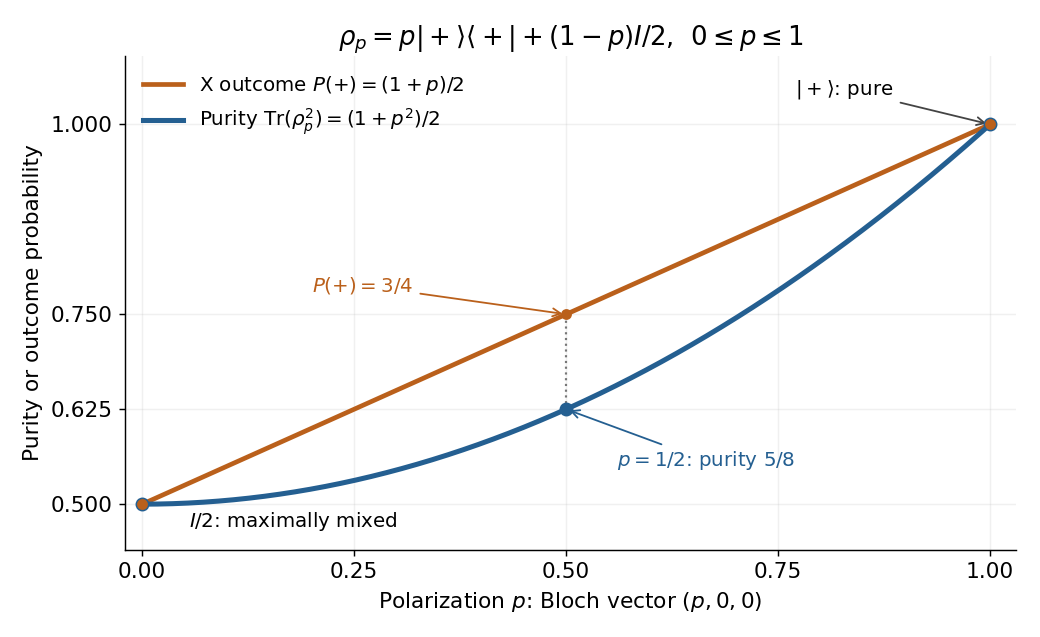
The Bloch vector length measures polarization: for any qubit density operator, . This connects the interior of the Bloch ball with mixed states and its boundary, the Bloch sphere, with pure states. [ref]
For a short proof of the general bound, use the spectral theorem: the nonnegative eigenvalues sum to one, so . ThenThe lower bound is attained only when all eigenvalues equal ; the upper bound is attained only when exactly one eigenvalue is nonzero, and hence equals one. Purity is therefore a simple quantitative test of mixedness, invariant under a unitary operator. It does not specify the entire density operator: even distinct pure states all have purity one. [ref]
If a weak interaction changes to a normalized state proportional to , tracing out either oscillator gives eigenvalues and .
The qubit density operators correspond exactly to the closed unit ball: their eigenvalues are , so positivity is equivalent to . The boundary is the Bloch sphere of pure states, and the centre is . A depolarizing channel scales this ball isotropically, possibly with a sign reversal in the larger completely positive parameter interval.
For a qubit density matrix with nonzero Bloch vector, and the multiplication rule for the Pauli matrices give these orthogonal rank-one spectral projectors, with eigenvalues . Their Bloch vectors are opposite unit vectors . At the state is maximally mixed and the direction is undefined; any orthonormal eigenbasis gives an antipodal pair, but no pair is distinguished by the state.
Choose a Hilbert-Schmidt inner product orthonormal Hermitian operator basis with final element . A density operator has real coefficients and fixed final coefficient . The remaining coefficients form its generalized Bloch vector. Positivity restricts these real vectors to a compact convex body; for this body is not the entire Euclidean ball allowed by a purity bound.
In a Hilbert-Schmidt orthonormal operator basis, the generator is represented on the traceless Hermitian subspace by a real skew-symmetric matrix. Its propagator is therefore in the special orthogonal group and preserves the purity of a density operator. For , these rotations form the adjoint image of the accessible unitary group, generally a proper subgroup of the full Euclidean rotation group; preservation of the full spectrum of the density operator imposes further constraints.
For a Hilbert-Schmidt orthonormal traceless Hermitian basis, the Generalized Bloch representation gives the displayed identity by orthogonality. Nonnegative eigenvalues of a density operator sum to one, so their squared sum is at most one, with equality precisely for a rank-one projector. For , the radius bound alone does not guarantee positivity: for a rank-one projector has trace one and squared norm one, but one negative eigenvalue.
A time-independent Lindblad equation becomes an affine linear equation for the Generalized Bloch representation. If , then and for traceless basis indices. The offset vanishes exactly when the dynamics are unital. Equilibria solve , and deviations evolve as .
Decay of the off-diagonal coherence of a two-level density operator. Population relaxation contributes half its total rate; additional dephasing contributes in the usual completely positive two-level model. Thus transverse relaxation should not automatically be identified with pure dephasing alone.
For a two-level density operator, rates from level one to two and in the reverse direction give . Their sum sets the longitudinal population relaxation rate, and their ratio fixes the stationary population imbalance. If both rates vanish, populations are conserved.
An arbitrary real affine equation has steady states exactly when . Its solution set is . For a finite-dimensional time-independent Lindblad equation, physical stationary states always exist by time averaging trajectories. If is invertible the steady state is unique. Conversely, a nonzero traceless Hermitian stationary direction can be decomposed into the difference of two equally weighted density operators; time averaging their trajectories yields two distinct stationary density operators. Thus singularity of the physical Bloch matrix also obstructs physical uniqueness.
The Bloch sphere is the unit sphere of Bloch vectors, corresponding to pure qubit states through . A local unitary change of qubit basis induces a rotation of this sphere, with its common phase physically irrelevant. Mixed states occupy the interior of the unit ball.
Write each pure density matrix as . The trace identities of the Pauli matrices, and , make the trace of their product equal to the displayed overlap. Antipodal unit vectors represent orthogonal states; vectors at right angles correspond to squared overlap one half. For mixed states the same trace formula gives Hilbert–Schmidt overlap, not in general quantum fidelity.
Articles were limited to the first 100 out of 102 total.
Articles by others on the same topic



A density matrix, also known as a density operator, is a mathematical representation used in quantum mechanics to describe the statistical state of a quantum system. It provides a way to capture both pure and mixed states of a quantum system, allowing for a more general formulation than the state vector (wavefunction) approach.