Magnetic neutron diffraction
ID: magnetic-neutron-diffraction

Magnetic neutron diffraction uses scattering of neutrons by ordered magnetic moments to infer magnetic order. Neutrons also scatter from atomic nuclei, so a pattern can contain nuclear and magnetic contributions. A Bragg scattering peak encodes periodicity; it is not a photograph of an individual spin.
A minimal original calculation makes the extra periodicity visible. Consider identical nuclear scatterers at positions , with equal neighboring separation , and ordered magnetic moments alternating between and . A two-site repeating block of length has nuclear and magnetic scattering amplitudes, apart from common geometric factors,Here is the common nuclear scattering coefficient and the component of the scattering wave vector along the row. The magnetic expression assumes equally scattering point magnetic moments perpendicular to the scattering wave vector; real magnetic scattering measures the perpendicular component and has a momentum-dependent amplitude. This one-dimensional calculation is a periodicity illustration, not a finite-temperature solution for a chain.
For even , and . For odd , and . Thus equivalent opposing magnetic sublattices, , cancel in forward scattering but reinforce at the odd positions of the doubled period. The intensity is proportional to the squared magnitude of the scattering amplitude, so changing an amplitude's sign does not make a negative intensity.
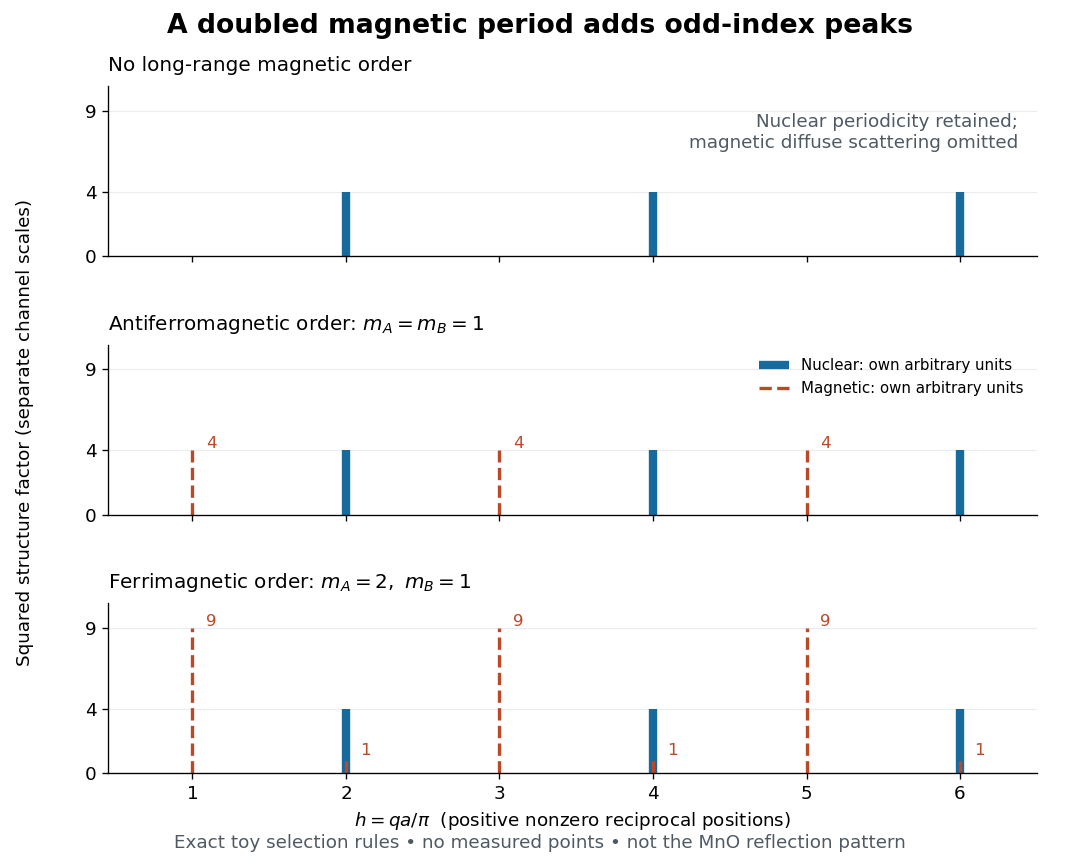

This calculation also exposes a useful difference between antiferromagnetism and ferrimagnetism: with and , magnetic squared amplitudes are at even and at odd . Extra magnetic peaks can therefore occur in a ferrimagnet too. Identifying a real magnetic structure needs the full crystal basis structure factor, multiple reflections, and the allowed moment orientations, rather than a single extra peak.
New to topics? Read the docs here!