
For a nonnegative random variable and threshold , Markov's inequality givesThe useful case has finite expected value; an infinite right side gives no finite information. The bound also holds if is nonnegative almost surely. Combining it with the elementary bound one gives . Nonnegativity is essential: negative values could otherwise cancel the contribution of large positive values to the expected value.
The idea is an average budget. Every outcome where contributes at least times its probability to , and the other outcomes contribute nonnegative amounts. Formally, the indicator function gives ; taking the expected value proves the bound. [ref]
https://ocw.mit.edu/courses/18-175-theory-of-probability-spring-2014/887e96172e82a615dac16fb26702d88b_MIT18_175S14_Lecture8.pdf. Sheffield, MIT 18.175, lecture 8: the expectation argument
.For example, let take , , , with respective probabilities , , , . Its expected value is . At , the tail probability is , while the bound is . At , the tail probability is , while the bound is . A different probability distribution with the same expected value, putting masses and at and , attains the bound exactly at .
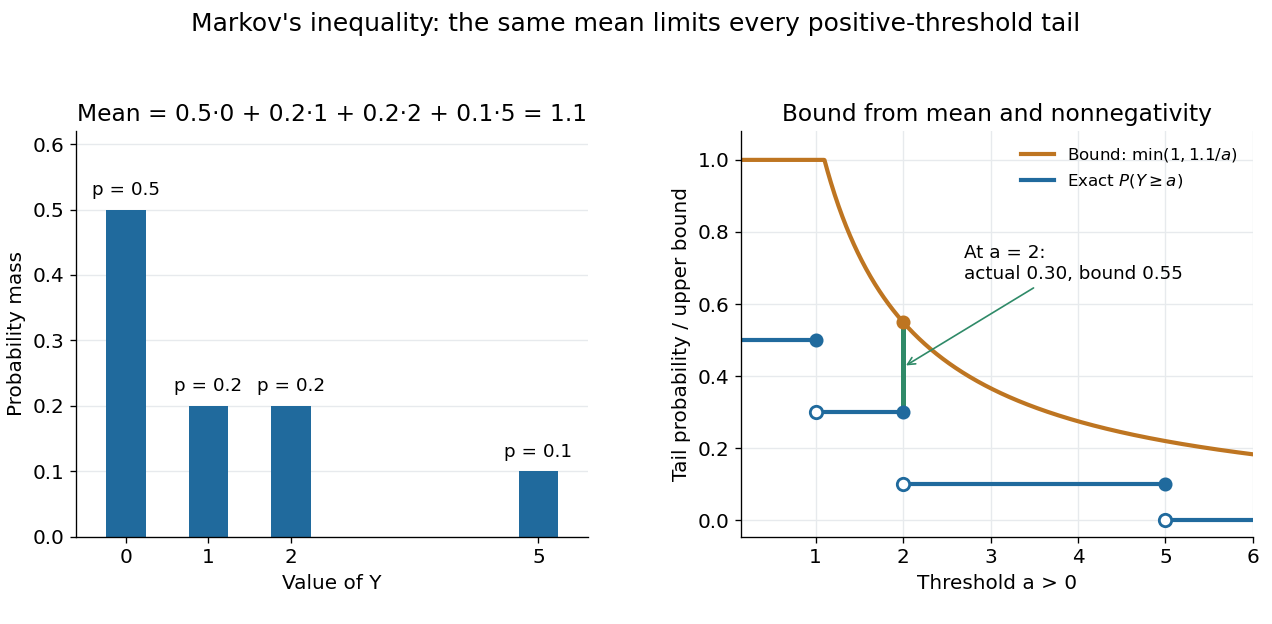
Markov's inequality is useful when a moment is easy to compute but a full probability distribution is difficult to determine. A nonnegative count with expected value less than one must have some positive probability of being zero, giving the first moment method. Applying the same bound to a squared centered random variable gives Chebyshev's inequality. Applying it to an exponential function of a random variable gives an exponential Markov bound, which can exploit more than a single moment.


New to topics? Read the docs here!