Matrix-chain cost model
ID: matrix-chain-cost-model

For matrix dimensions and , ordinary matrix multiplication computes matrix entries, each using scalar multiplications. Thus its cost is scalar multiplications, with additions if each sum starts from its first term. Here we minimize only the scalar multiplication count, using this dense matrix multiplication rule throughout. The counts describe arithmetic operations, rather than measured elapsed time; matrix multiplication methods that exploit structure or use faster formulas require a different cost rule.
Take matrices , , with matrix dimensions , , . Both groupings produce a matrix product, but their intermediate matrix dimensions differ:The second grouping first compresses into a matrix, avoiding the intermediate matrix . The saving is scalar multiplications, although both groupings use exactly two matrix multiplications. This is why counting only matrix multiplication operations hides the interesting choice.
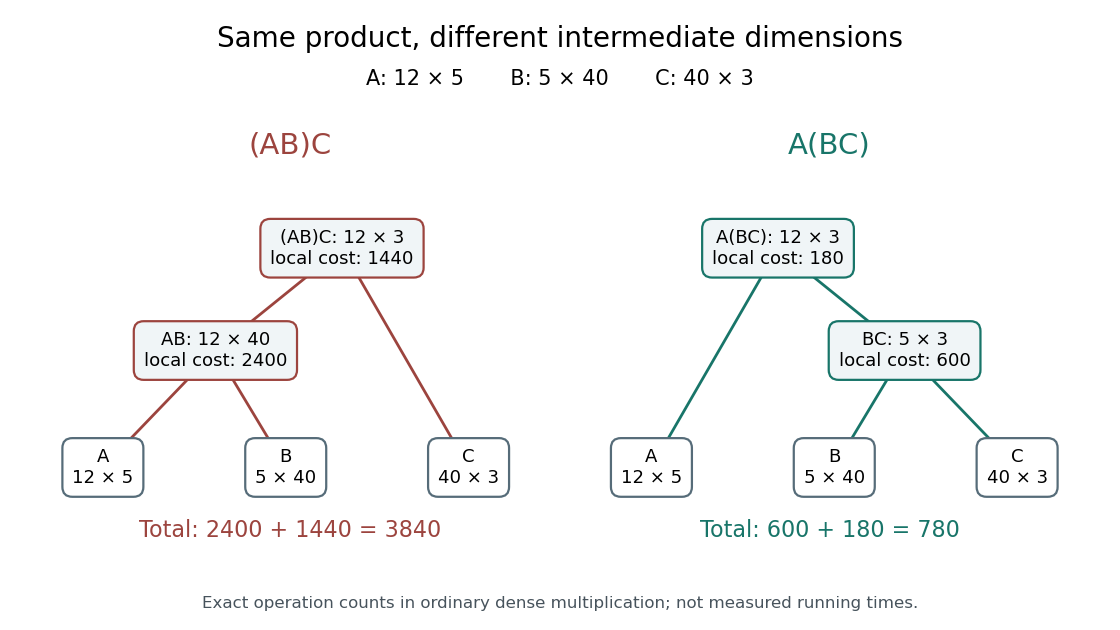
The same matrix product can require 3840 or 780 scalar multiplications
. Original binary trees for the three-matrix example. Leaves keep in the same order. Each internal node gives its resulting matrix dimensions and the local scalar multiplication cost; adding those costs gives the total. Details.
Associativity permits these regroupings in exact arithmetic; commutativity is neither assumed nor generally true for matrix multiplication. Swapping and here would even make their matrix product undefined. In floating-point arithmetic, round-off error can make the two groupings yield different computed matrix entries; the cost optimum alone does not guarantee the smallest numerical error.
New to topics? Read the docs here!