
Monodromy records how a germ of a holomorphic function changes after analytic continuation around a closed path. The source point returns to itself, but the continued germ of a holomorphic function need not. For , , starting with holomorphic square root value gives and hence ; starting with complex logarithm value gives and hence . After counterclockwise turns the values are and . Thus monodromy exchanges the two square-root branches of a multivalued function, whereas it shifts through infinitely many logarithm branches of a multivalued function. [ref]
Branch Points and Branch Cuts by Rodolfo R. Rosales. Rosales, Branch Points and Branch Cuts, section 1 and Example 2.4
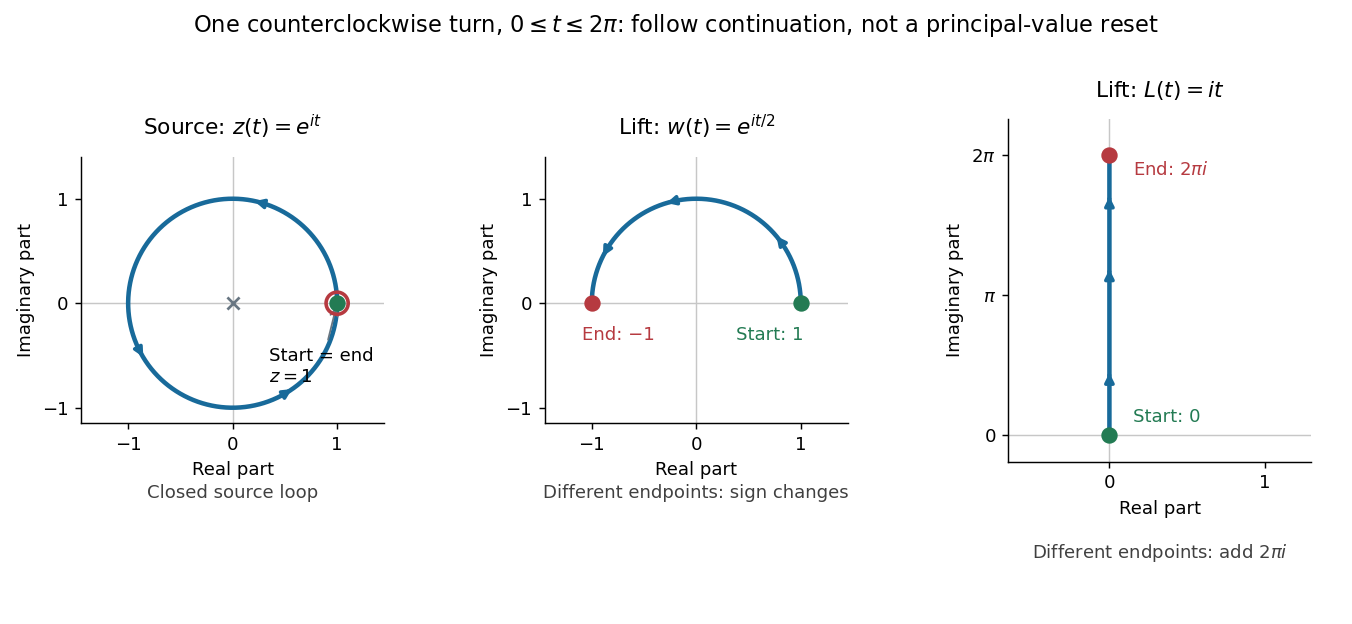
One closed loop in the source plane lifts to an open semicircle for the square root and an open vertical segment for the logarithm
. Details. The three panels use the same parameter . They show analytic continuation through local holomorphic patches, including across a chosen branch cut; repeatedly evaluating the principal logarithm would instead reset its imaginary part at the cut. Monodromy makes the obstruction to a global branch of a multivalued function visible and motivates the use of Riemann surfaces as domains on which continued values stay distinct.


Monodromy is a concept from algebraic geometry and differential geometry that describes how a mathematical object, such as a fiber bundle or a covering space, behaves when you move around a loop in a parameter space.
New to topics? Read the docs here!