A planar domain whose complement in the Riemann sphere has exactly two connected components. An annulus is the standard example. If neither complementary component is a single point, the domain is conformally equivalent to a circular annulus with finite positive conformal modulus of an annulus; punctured-disc and punctured-plane cases account for degenerate complementary components.
A Jordan domain together with four distinct boundary points in cyclic order, regarded up to a conformal map preserving those marked points. Such a domain maps to a rectangle with its marked points at the four corners. The opposite boundary-arc pairs specify two dual curve-joining problems whose extremal lengths are reciprocal.
Map a conformal quadrilateral to a rectangle of width and height , with the chosen opposite boundary arcs mapped to its vertical sides. Their extremal length is ; the other pair has extremal length . The constant conformal metric is extremal. For an arbitrary density, average horizontal joining lengths over height and apply the Cauchy-Schwarz inequality to obtain , proving the upper bound. Vertical joining segments prove the dual formula. Conformal invariance of extremal length transports both equalities back to the quadrilateral.
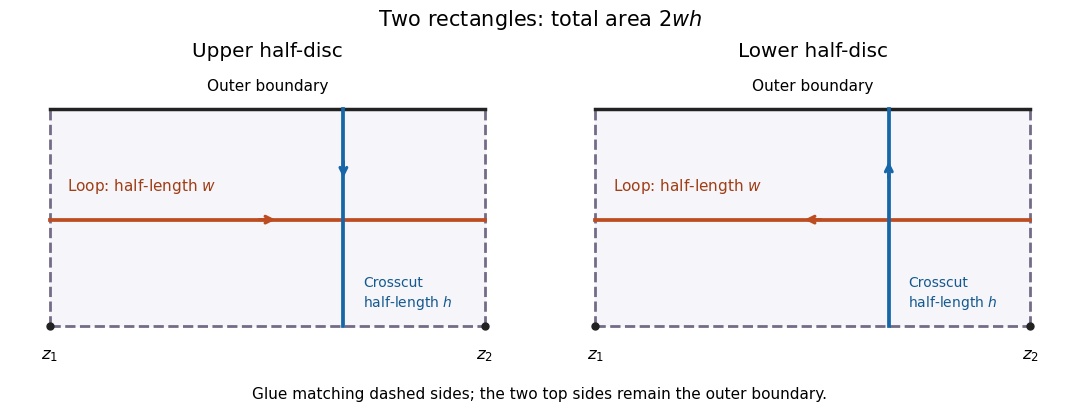
Glue two copies of along their left, bottom and right sides. Their unglued top sides form the outer boundary of a disk; the two bottom corners are marked interior points. Let be the loops surrounding both points, and the boundary-to-boundary crosscuts separating them. Then .
Each vertical seam joins a marked point to the outer boundary, so the Jordan curve theorem forces a loop surrounding both points to meet both seams. In the flat conformal metric, its total horizontal travel is therefore at least . Doubled horizontal segments attain this length. Each separating crosscut meets the bottom seam and starts and ends at height , so its total vertical travel is at least ; doubled vertical segments attain it. The total area is .
For an arbitrary density, integrate the lengths of the doubled horizontal segments over their height. The Cauchy-Schwarz inequality yields . Doubled vertical segments similarly give . These upper bounds equal the flat-metric ratios, proving both displayed formulas. Mapping the upper and lower halves of a disc to these rectangles gives the corresponding duality for a simply connected domain with two marked interior points.
A meromorphic differential is specified in each holomorphic chart by a meromorphic coefficient , with the coefficients transforming by the coordinate derivative so that the one-form agrees on overlaps. The derivative of a meromorphic function gives such a differential, and the ratio of two nonzero differentials is a meromorphic function. Orders of zeros and poles are independent of chart because coordinate derivatives are nonvanishing holomorphic factors. On a compact connected surface the sum of orders of a nonzero differential is , allowing its divisor to determine the genus.
A noncompact Riemann surface is hyperbolic in potential theory when its Green-function exhaustion has a finite limit, equivalently when it admits a positive Green function on a Riemann surface. This definition does not assume a disk uniformization. The unit disk is an example, since is its positive Green function with pole zero. For simply connected surfaces this is equivalent to being conformally equivalent to the disk. For general surfaces, potential-theoretic hyperbolicity should not be conflated with the condition that the universal cover is the disk: some surfaces with disk universal cover have no positive Green function.
A Riemann surface which is compact as a topological space. For a connected one of genus , the Riemann-Roch theorem gives independent holomorphic differential forms. The Riemann bilinear relations for a compact surface make their normalized periods a full lattice in , and the Abel-Jacobi map of a compact Riemann surface turns this lattice into a complex torus encoding divisor classes.
Integration of holomorphic differential forms along cycles embeds the first homology group as a full Euclidean lattice in . Fixing a base point, sum the path integrals to the points of an effective complex analytic divisor. Different path choices differ by that lattice. The Abel theorem for divisors identifies the fibres with linear equivalence of divisors.
A degree-zero complex analytic divisor on a compact Riemann surface is principal exactly when its Abel-Jacobi map of a compact Riemann surface is zero. Normalize a differential of the third kind with residues equal to the coefficients of . The Riemann bilinear relations for a compact surface express its -periods as times the Abel integrals. If those integrals are in the period lattice, subtract a suitable integral multiple of the normalized holomorphic differential forms; all periods then lie in , so exponentiation gives the required meromorphic function. Conversely, the logarithmic differential of a meromorphic function has integer residues and periods in , giving a zero Abel class by the same calculation.
A meromorphic one-form on a compact Riemann surface with only simple poles is a differential of the third kind. Prescribed residues can be realized exactly when their sum is zero: in the residue exact sequence for , the obstruction in is the sum of residues. Subtracting a holomorphic differential form normalizes its -periods. Integer residues and periods in make the exponential of its integral a single-valued meromorphic function with those orders of zeros and poles.
For a compact Riemann surface with a symplectic basis of its first homology group, cutting along that basis and integrating a primitive givesfor closed smooth one-forms. For a holomorphic differential form and a differential of the third kind , the corresponding boundary calculation givesThe paths and representatives of the cycles are chosen in the same cut surface. Normalized holomorphic differential forms consequently have a symmetric period matrix with positive definite imaginary part.
For a finite group generated by , glue sheets labeled by the group over the three-punctured Riemann sphere using left monodromy multiplication. Fill the punctures by the local power charts dictated by the orders of . Right multiplication by inverses defines the commuting deck action. Its nontrivial stabilizers are conjugates of the corresponding cyclic subgroups. The Riemann-Hurwitz formula gives the displayed Euler characteristic. A compatible metric can be averaged over the group; in genus at least two the invariant hyperbolic metric is canonical by the uniformization theorem.
For covers branched over three real points with a real base point, choose the two generating loops so complex conjugation reverses each. A sheet permutation satisfying the displayed identities lifts that conjugation to an anticonformal equivalence of the covers, including the filled branch points. For closed hyperbolic Riemann surfaces this is a Riemannian isometry. Such an isometry need not come from conjugating the subgroups inside the original deck group, so a Gassmann equivalent pair can be isometric despite nonconjugacy there.
An orientation-preserving homeomorphism with locally weak derivatives and essentially bounded infinitesimal distortion. In holomorphic coordinates, its Beltrami coefficient satisfies , and the maximal dilatation is .
The essential supremum of the ratio of the largest to the smallest infinitesimal singular value of a quasiconformal map. It equals in terms of the Beltrami coefficient.
For an orientation-preserving quasiconformal map, the almost-everywhere coefficient . It is a coordinate-dependent representative of a tensor; the modulus and the resulting maximal dilatation are coordinate-independent.
The equation prescribing the Beltrami coefficient of a quasiconformal map. Two homeomorphic solutions on the same source differ by a biholomorphism between their targets.
In a holomorphic coordinate, a length element . Smooth positive densities define ordinary Riemannian metrics; extremal length also permits nonnegative measurable densities with finite positive area .
A surface with an atlas outside finitely many cone points whose changes of coordinate are translations. On a compact surface it is equivalent to a nonzero holomorphic one-form. A zero of order has cone angle .
Cut equal straight slits in two translation surfaces of genus one and cross-glue their banks by translation. The connected sum of oriented manifolds has genus two and two cone points of angle , hence two simple zeros of its holomorphic one-form. Choosing one torus of side and a slit of length creates a flat-small handle without forcing its generator to have small extremal length.
The study of deformations and markings of Riemann surfaces, using quasiconformal maps, holomorphic quadratic differentials, extremal length and the mapping class group.
A quasiconformal map whose Beltrami coefficient is for an integrable nonzero holomorphic quadratic differential and constant . In a flat coordinate for , it stretches the horizontal and vertical directions with ratio . Positive multiples of define the same coefficient.
On a closed genus-at-least-two Riemann surface, a Teichmüller map uniquely minimizes maximal dilatation in its homotopy class among maps to the same target. The Reich–Strebel inequality forces equality of Beltrami coefficients for an extremal competitor; their conformal difference is homotopic to the identity and hence is the identity. In genus one, translations must be factored out.
On closed Riemann surfaces of genus at least two, if a Teichmüller map has unit-area source differential and dilatation , any quasiconformal map in the same homotopy class satisfies . The plus sign corresponds to a Teichmüller map with and . This fundamental inequality yields Teichmüller's uniqueness theorem by the pointwise triangle inequality and its equality case. See Gardiner and Hu, §5, equation (11).
For a path family on a Riemann surface, take the supremum of over measurable conformal metrics of finite positive area. This is unchanged under conformal equivalence, and a quasiconformal map of maximal dilatation changes it by a factor between and .
If a conformal map or anticonformal map is an involution preserving a curve family, its extremal length can be computed using invariant conformal metrics. Replace any density by . Every curve and its image have length at least , hence . Convexity of the square and change of variables give , proving the assertion. For reflection in the real axis, invariant means .[ref]
Conformal Maps and Geometry by Dmitry Beliaev (2015 lecture notes). Proposition 4.3.8, printed pages 52–53: restriction of the supremum to symmetric metrics
For a conformal map and a conformal metric on its image, the pullback density is . The change of variables formula preserves its metric area, and the chain rule preserves the length of each corresponding curve. Applying this to and its inverse proves the title equality. This allows extremal length computations on rectangles, discs and annuli to be transported to other domains.
Let be a real closed differential form on a Riemann surface, of finite positive conformal energy . If its period on a loop homotopy class is , then . Indeed the conformal metric has area and each loop in the class has length at least . Energy is independent of the auxiliary smooth conformal metric used to compute the pointwise norm: the inverse scaling of the squared norm cancels the area scaling.
The height divided by circumference in a conformal Euclidean cylinder model of an annulus. For , it is . The extremal length of winding-one core curves is , whereas that of curves joining the two boundary components is .
For an inner circle of real center and radius lying strictly inside the unit circle, choose the real root of . When , take . The automorphism of the unit disk sends the inner circle to a concentric circle. Indeed it sends the two real endpoints to opposite real numbers; preservation of circles and reflection symmetry then give an image centered at zero. Its radius is .
The conformal invariance of harmonic measure and harmonic measure of an annulus give outer-boundary measure . For , the quadratic gives and , an explicit eccentric-annulus example.
The quotient of a horizontal strip by a horizontal translation. The model has conformal modulus of an annulus . Averaging horizontal loop lengths and applying Cauchy-Schwarz inequality proves that the core-loop extremal length equals .
For nonzero holomorphic one-forms and holomorphic quadratic differentials, apply to every flat coordinate. Translation and sign transition maps remain of the same type, defining a new complex structure and differential. Composition gives a group action, zero orders persist and area is preserved. The zero section has no such atlas; fixing it gives only a set-theoretic extension that is generally discontinuous.
For a fixed closed oriented surface , a point is a marked Riemann surface , modulo biholomorphisms intertwining the markings up to homotopy. For , Fenchel–Nielsen coordinates give real dimension .
A local coordinate at a point of a Riemann surface is a biholomorphism from a neighbourhood of to an open subset of . After translating the image, one may require that the coordinate sends to zero.
A map between Riemann surfaces is holomorphic when its expression in every pair of local complex coordinates is a holomorphic function.
A biholomorphism is a bijective holomorphic map whose inverse is holomorphic. A degree-one nonconstant holomorphic map between compact connected Riemann surfaces is a biholomorphism.
A germ at is an equivalence class of holomorphic functions defined near , where two representatives are equivalent when they agree on some neighbourhood of .
A function element is a pair consisting of a nonempty disk and a holomorphic function on that disk. Its local value determines a germ of a holomorphic function. Elements agreeing on an overlapping neighborhood continue one another; chains of such continuations produce the complete analytic function generated by an element. An algebraic identity holding in one element persists along any continuation chain by the identity theorem.
The space of germs over a domain has basic open sheetsfor holomorphic on open . The projection restricts to a homeomorphism on each sheet, and these projections form holomorphic coordinate charts.
The projection is a local biholomorphism for the sheet topology on the space of germs of holomorphic functions. It need not be a topological covering map: branches may end at singularities even when another branch remains over that base point.
The inverse germs of over form the connected surface . Its projection is surjective and locally biholomorphic, but the fibres have three points generically and one point at each critical value , so it is not an evenly covered topological covering.
The evaluation map is holomorphic. On the sheet associated with , its coordinate expression is exactly the holomorphic function .
Over , the two-valued square root is represented byThe maps and identify this unbranched double cover analytically with the corresponding component of the space of germs.
If is a covering of a Riemann surface, compose every chart on an evenly covered open set with each local inverse sheet of . The resulting transition maps are those of , so they define a unique complex structure making a local biholomorphism.
Every simply connected Riemann surface is biholomorphic to the Riemann sphere, the complex plane, or the unit disc.
The level-two principal congruence subgroup consists of integer determinant-one matrices congruent to the identity modulo two, modulo the scalar sign. It acts freely and properly discontinuously on the complex upper half-plane. An ideal quadrilateral with vertices has its paired sides identified by and . The quotient has genus zero and three punctures, so it is conformally the sphere with three points removed. The invariant metric descends to its curvature-minus-one hyperbolic metric.
// Destination: analysis.bigb
Exhaust a simply connected hyperbolic Riemann surface in potential theory by compact bordered Jordan domains . Their Green functions on a Riemann surface have logarithmic poles and zero boundary values. Exponentiating their harmonic conjugates produces proper degree-one maps with . If , normalize . Domain monotonicity and a global positive Green function bound increasingly from above. Thus Montel theorem gives a nonconstant limit , which is injective by the locally uniform limit of univalent functions theorem. The Schwarz lemma makes extremal among normalized disk-valued maps. If omitted , taking a global holomorphic square root of a disk automorphism applied to , then renormalizing at , would multiply its derivative by . Thus is onto and gives the desired biholomorphism.
Every nonempty simply connected proper open subset of the complex plane is conformally equivalent to the unit disc.
For a univalent function with , suppose is omitted. Apply the disk automorphism so the resulting image omits zero, take a holomorphic square root, then apply the disk automorphism taking the value at to zero. If is a simply connected domain, the root exists. The resulting normalized univalent map has derivative magnitude multiplied by , since . Thus a map maximizing the derivative cannot omit an interior disk point.
For a bounded simply connected domain and a conformal bijection , extends continuously to the closed disc if and only if is a locally connected space. A Jordan boundary gives a homeomorphism of closed discs, but local connectedness alone need not give injectivity on the boundary: a slit has two boundary approaches. The same statement applies on the sphere to unbounded domains after a suitable change of coordinates. This boundary theorem is different from the Caratheodory extension theorem for measures.
The Koebe distortion theorem gives universal upper and lower bounds on a univalent function and its derivative in terms of the distance to the boundary. In particular, derivatives at two points whose hyperbolic distance is bounded differ by at most a universal multiplicative factor.
For a normalized univalent function on the unit disc, put . The displayed sharp two-sided bounds hold. Rotations of the Koebe function attain the bounds along suitable radial directions. In particular, bounding the modulus controls the radius of a disk containing each smaller image .
If is a univalent function on the unit disc, then . The constant is sharp, as shown by the Koebe function. This gives useful comparisons between the derivative of a conformal map, its conformal radius, and its distance to the domain boundary.
For a conformal bijection between proper planar domains, put and . Apply the Koebe quarter theorem to on the unit disc to obtain . Apply it again to to get the opposite bound. Thus . The domains need not be simply connected domains. For the whole plane, the boundary distances are infinite and these ratios are undefined.
The sphere has the Möbius group , the plane has the affine maps with , and the disc has the maps with .
The quotients of by free properly discontinuous conformal actions are , , and the complex tori . The translation group has respectively rank zero, one, or two.
Every plane domain whose complement contains at least two points is uniformized by the unit disc. A plane universal cover would give a nonconstant entire function omitting two values, contrary to the Little Picard theorem.
Let be a compact Riemann surface of genus , and remove distinct points. The punctured surface is uniformized by the unit disc exactly when . It is uniformized by the complex plane exactly when is or , corresponding respectively to , and to or a complex torus. The sole spherical case is .
If embeds holomorphically in a compact Riemann surface , the embedding extends across zero and infinity to a degree-one holomorphic map from the Riemann sphere to . Hence is conformally the sphere.
Two holomorphic functions on a connected Riemann surface that agree on a set with an accumulation point agree everywhere. Local charts reduce the proof to isolated zeros of a one-variable holomorphic function.
A real-valued function on a Riemann surface is harmonic when its expression in every holomorphic coordinate chart has vanishing planar Laplacian.
A covering is regular when its deck group acts transitively on each fibre, equivalently when its fundamental-group subgroup is normal.
A complete analytic function is the collection of all continuations of a germ. Its Riemann surface consists of these germs, with projection to their base points.
For a nonconstant analytic map between compact connected Riemann surfaces, there is an integer such that for every ,
The degree counts sheets with multiplicity of the associated branched covering.
If a nonconstant holomorphic map has local-coordinate expressionthen is its local degree, multiplicity, or ramification index at .
For a nonconstant holomorphic map between compact connected Riemann surfaces, its degree isThe valency theorem says that this integer is independent of .
For , the power map has distinct preimages of every nonzero finite regular value, all with positive local degree of a map between oriented manifolds. Integrating the pullback of a differential form of gives the same answer, since and . For use the constant extension at infinity; its degree of a map between oriented manifolds is zero.
After cancelling common factors, the rational map on the Riemann sphere has degree . It is an analytic isomorphism exactly when this degree is one, equivalently when it is a Möbius transformation.
For a nonconstant rational function of degree , its derivative has degree between and . A finite pole of order becomes one of order . If infinity is a pole of order , it contributes to the derivative's pole count, where are the degrees of coprime numerator and denominator. This proves the lower bound; the quotient rule denominator proves the upper bound. The functions and attain the bounds.
Let a nonconstant rational function have degree , let be its number of distinct finite poles, and let be its pole order at infinity, taken as zero when infinity is not a pole. Differentiation raises each finite pole order by one and changes a pole of order at infinity into one of order . HenceIn particular, .
The degree of a nonconstant elliptic function is the sum of the orders of its poles in a fundamental parallelogram. Equivalently, it is the degree of the induced holomorphic map from its complex torus to the Riemann sphere.
If an elliptic function has degree and distinct poles in a fundamental parallelogram, then each pole order increases by one under differentiation, soBecause , this gives .
The rotation group of the octahedron has order . Its vertex, face-centre, and edge-centre stabilizers have orders , giving exceptional orbit sizes ; every other orbit has size .
Let a finite group of order act analytically on a compact Riemann surface, and let an invariant analytic map have degree . At a point with stabilizer of order , invariance forces the local multiplicity of to be at least . Its orbit has points, so it already contributes at least to the fibre multiplicity. The valency theorem forces equality and shows that every fibre is exactly one orbit.
Let be a nonconstant holomorphic map between compact Riemann surfaces that are connected spaces, without boundary. Write for their genera and for the degree of a holomorphic map. With analytic ramification index at each , the formula isHere is the Euler characteristic. Only finitely many ramification points contribute. The holomorphic map is automatically surjective; the valency theorem gives even at a branch value of a holomorphic map. Constant maps are excluded.[ref]
The useful interpretation is that total ramification of a holomorphic map measures how much the source Euler characteristic falls short of copies of the target. The ramification of a power map of the Riemann sphere spends that entire correction at two points; the double cover of the sphere with four branch values spends it at four points and produces a genus-one surface.
Count ramification points upstairs in , weighted by , rather than counting distinct branch values of a holomorphic map downstairs in . Grouping by fibres givesThe cardinality counts distinct points; the degree of a holomorphic map counts them with their analytic ramification indices. Thus each summand is the number of missing distinct preimages in that fibre.[ref]
Riemann Surfaces by Constantin Teleman (Lent Term 2003). Lecture 5, Definition 5.16, printed p. 19: total branching index as the sum of fibre deficits
The phrase branch point varies across conventions: to keep the two surfaces distinct, use ramification point for and branch value of a holomorphic map for . The existing name branch point of a holomorphic map here denotes the latter. Several ramification points can share one branch value of a holomorphic map.
For an integer , extend to a holomorphic map from the Riemann sphere to itself with . A nonzero finite regular value has distinct preimages, so the degree of a holomorphic map is . At zero the analytic ramification index is . At infinity, use local coordinates upstairs and downstairs: the same holomorphic map becomes , so too. Everywhere else the derivative is nonzero.
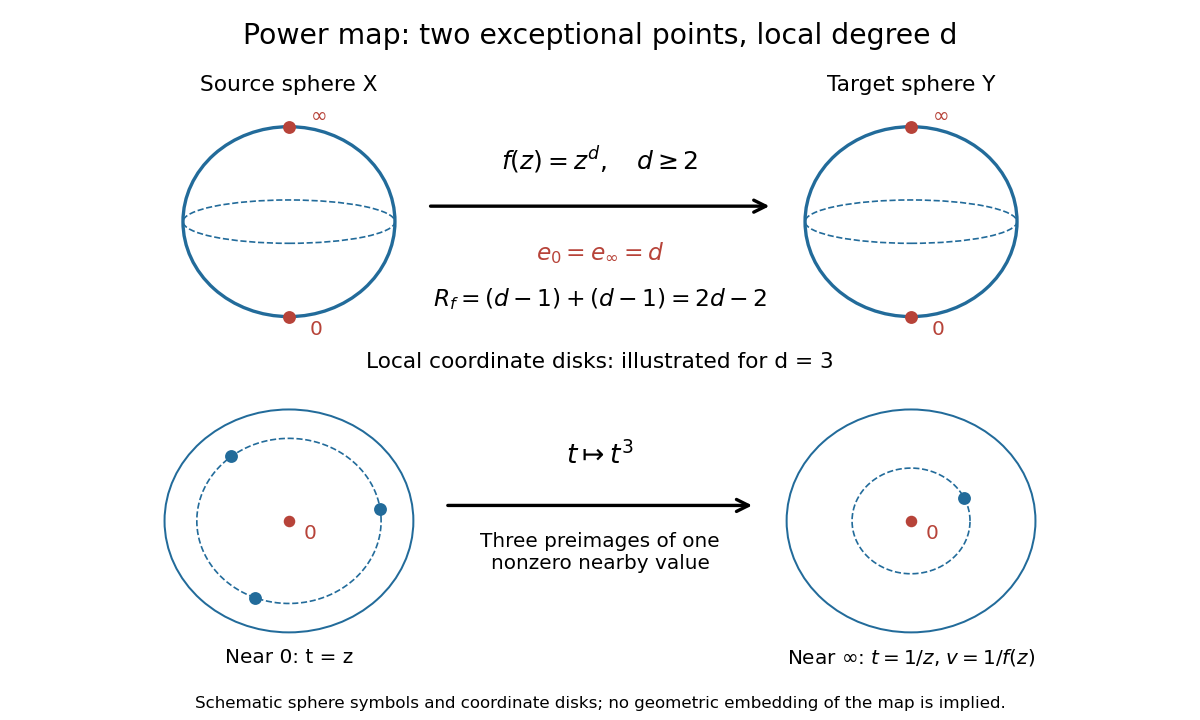
Schematic of the sphere power map and its local degree: zero and infinity both have ramification index d
. Details. There are two distinct ramification points and two distinct branch values of a holomorphic map, butFor , the total ramification of a holomorphic map is four, not two. The local-circle panel shows three nearby preimages converging to the single ramification point. For the holomorphic map is the identity and neither zero nor infinity is ramified.
Suppose a nonconstant holomorphic map from a connected compact Riemann surface has degree of a holomorphic map two and exactly four distinct branch values of a holomorphic map. The valency theorem forces each of their fibres to contain one ramification point with , a simple ramification point of a holomorphic map. HenceThis determines the genus without recognizing a torus in a drawing.
A concrete realization is the compact Riemann surface obtained by adding the two points at infinity to the even-degree hyperelliptic model given by the algebraic curveProjection to has degree of a holomorphic map two. At a simple zero of , is a local coordinate and , so . At infinity set and : then . There are two points with , , each unramified since is a local coordinate. The four finite roots are therefore all the branch values of a holomorphic map.[ref]
Geometry of Surfaces by Nigel Hitchin (B3a course 2013). Section 3.3, printed pp. 41-43: local coordinates at simple roots, two points at infinity for even polynomial degree, and ramification count
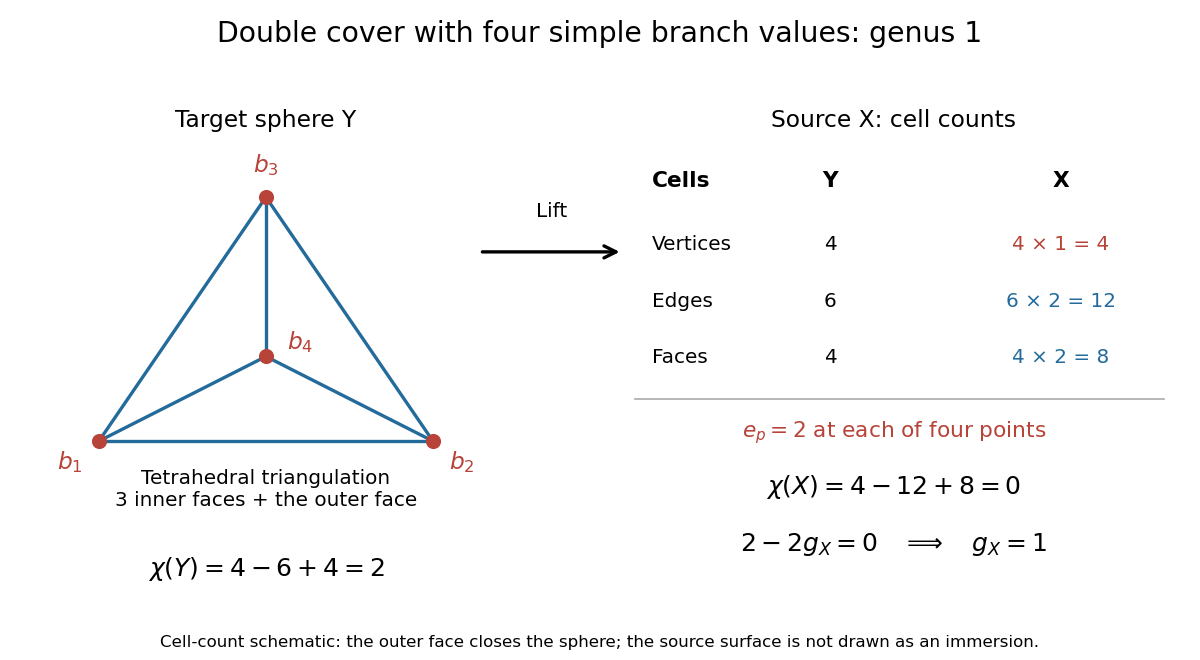
Cell-count schematic for a double cover of the sphere with four simple branch values: four vertices, twelve edges and eight faces upstairs
. Details. Choose a triangulation of a surface on the Riemann sphere with these four branch values of a holomorphic map as vertices, combinatorially the boundary of a tetrahedron. Its counts are . Upstairs, each vertex has one preimage and each open edge and face has two lifts: , giving Euler characteristic . This is a cell schematic, not a geometric immersion of . The Triangulation proof of the Riemann-Hurwitz formula applies the same counting idea after refining a general triangulation of a surface around the branch values of a holomorphic map.[ref]
Geometry of Surfaces by Nigel Hitchin (B3a course 2013). Section 3.2, Theorem 3.2 and its triangulation proof, printed pp. 38-39
For a nonconstant holomorphic map of Riemann surfaces, choose local coordinates centred at and . The map has the formThe positive integer is its ramification index. The point is ramified exactly when and contributes to the ramification divisor.
A ramification point is simple when its analytic ramification index is two. Its contribution to total ramification of a holomorphic map is one. In suitable local coordinates, the holomorphic map is ; two nearby preimages merge there. A ramification point with contributes two even though it is just one point.
For a nonconstant rational map, choose local source and target coordinates centred at and . If the local expression is with , its local degree is , and is critical exactly when . This definition covers poles and infinity; a simple pole is not critical merely because the usual finite-coordinate expression is unbounded. Coordinate changes have nonzero first derivatives and leave unchanged.
A critical orbit is the forward sequence starting at a critical point of a rational map. The postcritical set records the forward images, usually from the first iterate onward, of all critical points; a single critical orbit and the union of all such images are distinct notions. For quadratic polynomials there is one finite critical point, zero, and its orbit controls connectedness of the filled Julia set and membership in the Mandelbrot set. A bounded orbit can be preperiodic to a repelling cycle, as for ; boundedness then does not imply Fatou membership.
Local degrees multiply under composition: , directly by substituting the two local power-series expansions. ConsequentlyIn particular every critical point of remains critical for each positive iterate, and every critical point of an iterate reaches a critical point of in fewer than steps. This covers infinity as well as finite points. For polynomials at finite points the same conclusion follows from .
At a point of local degree , the critical multiplicity is . At an ordinary finite point this is the order of vanishing of the derivative. The invariant local-coordinate definition also works at poles and infinity. For , zero and infinity both have multiplicity , so a critical-point count must count multiplicities: there are two distinct critical points but total multiplicity .
A degree- rational map has total critical multiplicity . Here is an algebraic proof. Critical points are isolated zeros of local derivatives and are finite in number by compactness. Change domain and range Möbius coordinates so that the poles are simple finite poles and infinity is a regular point with a finite image. Write , with , and , . Then has degree exactly , since . At a pole, . Thus the roots of are precisely the critical points and their zero orders are the critical multiplicities. The fundamental theorem of algebra gives the count; the coordinate changes preserve it.
A branch value is the image of a ramification point of a holomorphic map. Away from all branch values, a proper holomorphic map is an ordinary unramified covering.
In the compactified Riemann surface of , a positive circuit enclosing the simple finite zeros sends the sheet label to modulo . This permutation has cycles of length . Each cycle fills in one point over infinity, with ramification index . Hence infinity is unramified exactly when divides . Each finite zero has ramification index , so the base sphere has exactly branch values in that case and otherwise.
Triangulate the target with all branch values among its vertices. For a degree- map, every edge and face has lifts. Above a target vertex , the number of lifted vertices isbecause . Thuswhich is equivalent to the Riemann-Hurwitz formula.
Up to invertible affine changes in source and target, every complex cubic polynomial is exactly one ofThe extension to the Riemann sphere has two finite units of ramification. A single finite critical point has ramification index three and gives the first form; two distinct simple critical points can be moved to , after which integration gives the second.
The extra point completes the complex plane into a compact Riemann surface. It is one point shared by every direction of escape: , and all tend to as . A basis of neighbourhoods at isThis is the one-point compactification of the complex plane; convergence to means that the modulus tends to infinity.[ref]
Complex Analysis Lecture Notes by Dan Romik. Complex Analysis Lecture Notes, section 9, item 84, printed p. 33, topological definition
For a concrete picture, use the unit sphereand identify with in its equatorial plane. The north pole represents and the south pole represents . The stereographic projection below gives the identification. This convention fixes the scale: the equator corresponds to .[ref]
Why add this point? The Möbius transformation then exchanges and and becomes a holomorphic map everywhere on the Riemann sphere. Its apparent blow-up at zero disappears when its output is expressed in the reciprocal chart at infinity: . This is a concrete instance of a meromorphic function as a holomorphic map to the Riemann sphere. The additional point makes the complex plane compact, while its second manifold chart lets us do ordinary complex analysis near infinity.
The chordal metric on the Riemann sphere is for finite points, with . It is half the Euclidean chord distance between stereographic images on the unit sphere, so the triangle inequality follows from the Euclidean one. If is round spherical geodesic distance, then and . These inequalities transfer uniform-continuity estimates between spherical and chordal distances, including at poles of meromorphic functions.
A rational map is smooth as a map between compact round spheres, including at its poles in reciprocal coordinates. Its spherical differential norm therefore has a finite supremum . Integrating along a shortest spherical geodesic gives . Since , we obtain . In finite coordinates the differential norm is , extending continuously to the whole sphere. This uniform bound is useful for passing equicontinuity through compositions.
Stereographic projection identifies a sphere minus one pole with the plane and supplies the standard charts of the Riemann sphere.
In the equatorial-plane convention of the Riemann sphere, draw the straight line through and a point on the unit sphere. Its intersection with the plane has complex coordinateThe inverse function, for and , isHere positive gives positive , and positive gives positive . Thus and lie on the positive and ends of the equator. The omitted north pole is assigned .[ref]
Topic 2 Notes. Complex Variables with Applications, MIT 18.04, Spring 2018; Topic 2 Notes, section 2.5.2, printed p. 7, projection formula and north pole
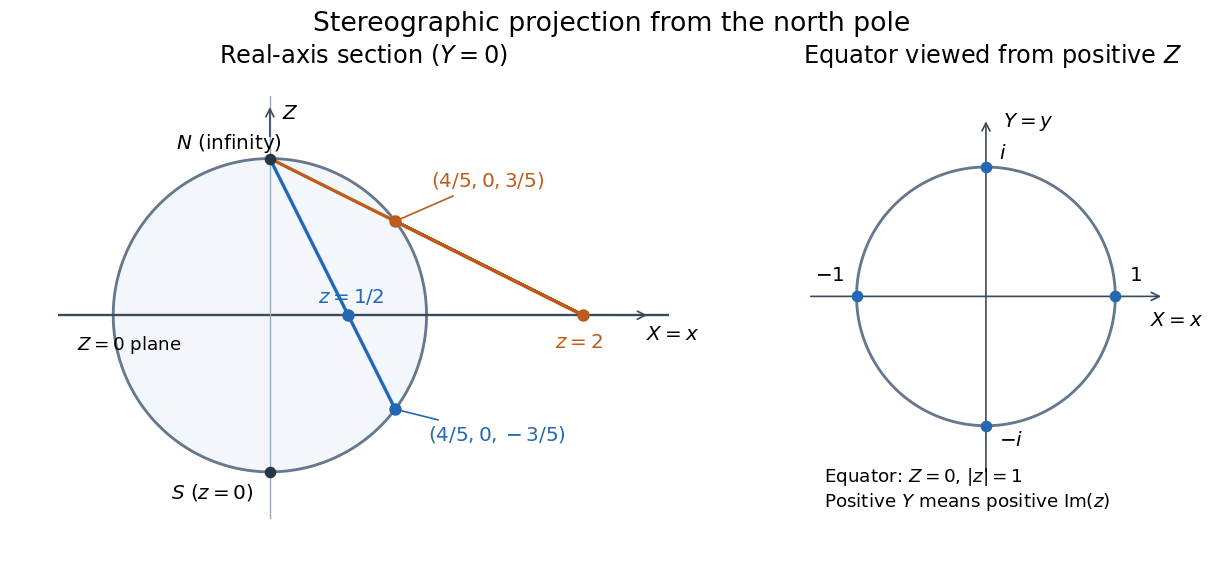
North-pole projection onto the equatorial plane: two real points and the positive complex-axis convention
. Details. For original worked points, the real numbers and lift to points with the same coordinate but opposite coordinates:Projecting back gives and . A point off the real axis checks the other sign:The coordinates satisfy , as a point on the unit sphere must. Also , and .
A short derivation starts with the line . Setting its last coordinate to zero gives , hence the projection formula. Conversely the line from to is . Substitution in the unit sphere equation givesThe root is ; the other root gives . These line intersections establish both the formula and its bijection property without guessing the inverse.
The same algebra explains how large planar distances become small spherical ones:Consequently brings to independently of direction. The last expression is twice the chordal metric distance . A whole unbounded exterior in the complex plane therefore becomes a small cap on the unit sphere.
For north-pole stereographic projection on the unit sphere, substitute into a planar circle equation. The displayed plane equation follows, and its intersection with the sphere is a circle. The plane contains the sphere's centre exactly when , giving a great circle.
A planar circle other than the unit circle lifts to a great circle exactly when it meets the unit circle at two opposite points. A great circle other than the equator intersects the equator in an antipodal pair. Conversely the plane containing a lifted circle and an antipodal pair contains their midpoint, the sphere's centre. Algebraically, adding the equations and with gives the displayed condition.
For north-pole stereographic projection on the unit sphere, the antipodal pair point has coordinate . Since , this gives when both coordinates are finite. On the whole Riemann sphere, write , pairing zero with infinity. The two axis endpoints fixed by a sphere rotation obey this relation.
Use the north-pole stereographic projection and the cross-ratio convention . Antipodes have coordinates . Rotate the first point to the south pole, whose coordinate is zero: its antipode becomes infinity, while a point at spherical distance has projected modulus . Möbius invariance of the cross-ratio then gives the displayed identity. Antipodal endpoints require the extended-value interpretation.
On the unit sphere, use away from the north pole and away from the south pole. Their overlap relation is a holomorphic map, giving a holomorphic atlas for the Riemann sphere. The opposite sign of in the second manifold chart ensures a holomorphic rather than antiholomorphic transition.
Writing the sphere coordinates as avoids confusing their height with the complex coordinate . The two manifold charts cover the whole unit sphere:On their overlap, givesThe coordinate transformation and its inverse are holomorphic, so these manifold charts make the sphere a Riemann surface. The sign in is essential. Geometric projection from the south pole with the same planar axis labels would give . The complex conjugation in that transition prevents it from being holomorphic. For , the correct second coordinate is : positive corresponds to negative imaginary part in this manifold chart.
Articles were limited to the first 100 out of 113 total.
Articles by others on the same topic



Riemann surfaces are a fundamental concept in complex analysis and algebraic geometry, named after the mathematician Bernhard Riemann. They can be thought of as one-dimensional complex manifolds, which allow us to study multi-valued functions (like the complex logarithm or square root) in a way that is locally similar to the complex plane.