
The Mycielski construction replaces a graph with a graph having one shadow vertex for each original vertex and one further vertex adjacent to every shadow. It satisfiesand preserves triangle-freeness. Iterating it from the five-cycle gives triangle-free graphs of arbitrarily large chromatic number.
Here is a finite simple graph with at least one vertex; it need not have an edge. The Mycielskian separates two ways of needing many colours: a large clique forces distinct colours immediately, but a triangle-free graph can impose incompatible choices through its whole pattern of graph adjacency. The Mycielski construction increases that global constraint while preserving the absence of triangles in a graph.
Write the vertex set of as , with . Keep these vertices, add distinct Mycielski shadow vertices , and add a Mycielski apex . The vertex set and complete list of edges areThere are no other edges: the Mycielski shadow vertices form an independent set, has no original vertex as a neighbour, and is not adjacent to . Each Mycielski shadow vertex copies its original vertex's graph neighbourhood within the original vertex set, not its position in the drawing. This is the construction in the inspected research paper.[ref]
For original vertices and original edges, direct counting gives vertices and edges. The original vertices induce a copy of , so no original graph adjacency is lost. A drawing crossing is not an extra vertex.
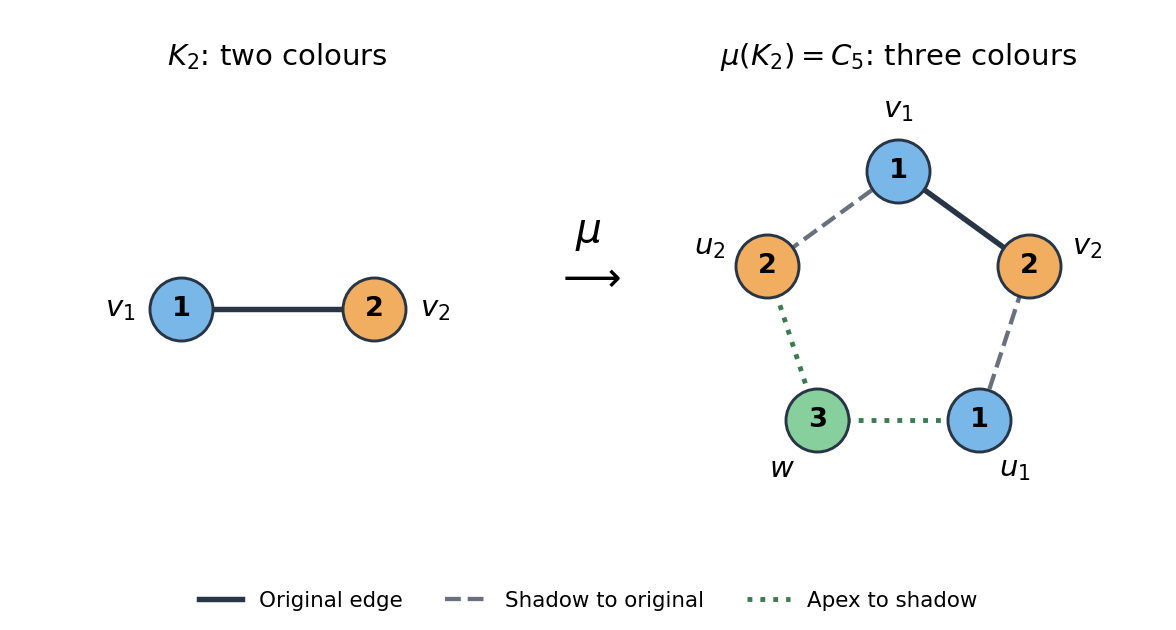
Start with the complete graph , whose only edge is , abbreviating . Its Mycielskian has exactly the edges . Reading them as gives the cycle graph . A proper vertex colouring gives colour 1, colour 2, and colour 3. Two colours cannot close an odd cycle, so its chromatic number is exactly three.


In mathematics and graph theory, a Mycielski graph, or Mycielski construction, is a method for constructing new graphs from existing ones. The Mycielski construction is used primarily to create triangle-free graphs, which are graphs that do not contain any cycles of length three (triangles). The construction works as follows: 1. **Start with a graph \( G \)**: This can be any simple graph.
New to topics? Read the docs here!