The Mycielski construction replaces a graph with a graph having one shadow vertex for each original vertex and one further vertex adjacent to every shadow. It satisfiesand preserves triangle-freeness. Iterating it from the five-cycle gives triangle-free graphs of arbitrarily large chromatic number.
Here is a finite simple graph with at least one vertex; it need not have an edge. The Mycielskian separates two ways of needing many colours: a large clique forces distinct colours immediately, but a triangle-free graph can impose incompatible choices through its whole pattern of graph adjacency. The Mycielski construction increases that global constraint while preserving the absence of triangles in a graph.
Write the vertex set of as , with . Keep these vertices, add distinct Mycielski shadow vertices , and add a Mycielski apex . The vertex set and complete list of edges areThere are no other edges: the Mycielski shadow vertices form an independent set, has no original vertex as a neighbour, and is not adjacent to . Each Mycielski shadow vertex copies its original vertex's graph neighbourhood within the original vertex set, not its position in the drawing. This is the construction in the inspected research paper.[ref]
For original vertices and original edges, direct counting gives vertices and edges. The original vertices induce a copy of , so no original graph adjacency is lost. A drawing crossing is not an extra vertex.
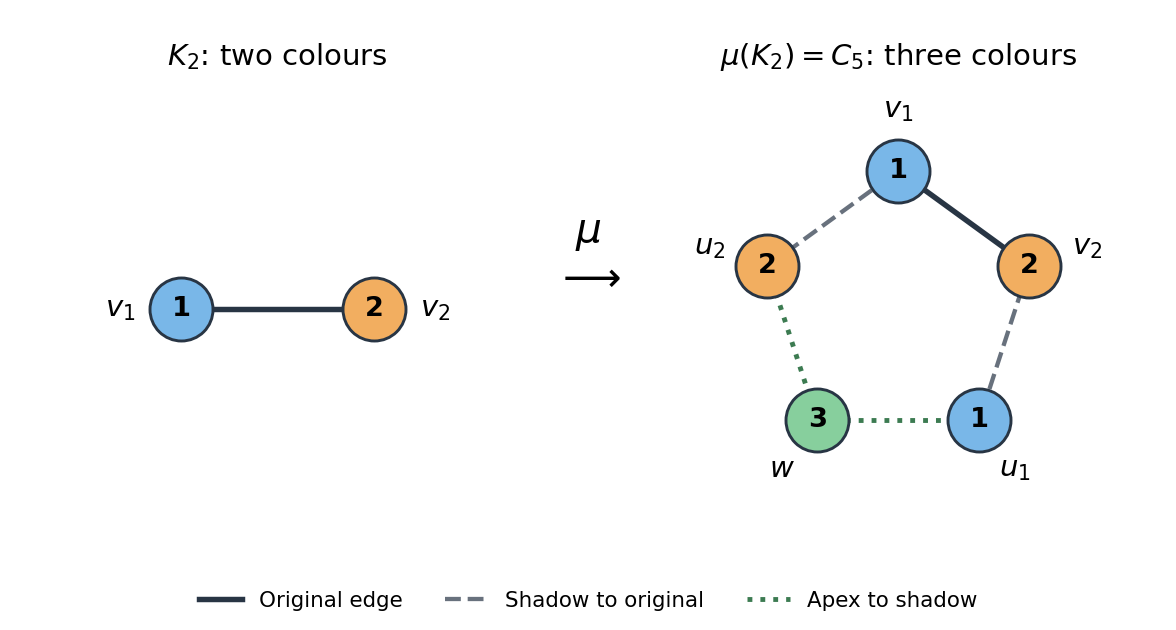
Start with the complete graph , whose only edge is , abbreviating . Its Mycielskian has exactly the edges . Reading them as gives the cycle graph . A proper vertex colouring gives colour 1, colour 2, and colour 3. Two colours cannot close an odd cycle, so its chromatic number is exactly three.
The Grötzsch graph is the Mycielskian of the five-vertex cycle graph. Take original edges , with indices interpreted modulo five; add and for every . There are eleven vertices and twenty edges: five original, ten between originals and Mycielski shadow vertices, and five from the Mycielski apex.
Give colours , give each the colour of , and give colour 4. This is a proper vertex colouring. The Mycielskian chromatic increase proves that three colours are impossible, so the chromatic number is exactly four. The Mycielskian triangle preservation proves that this is a triangle-free graph. In particular its clique number is only two, even though its chromatic number is four.
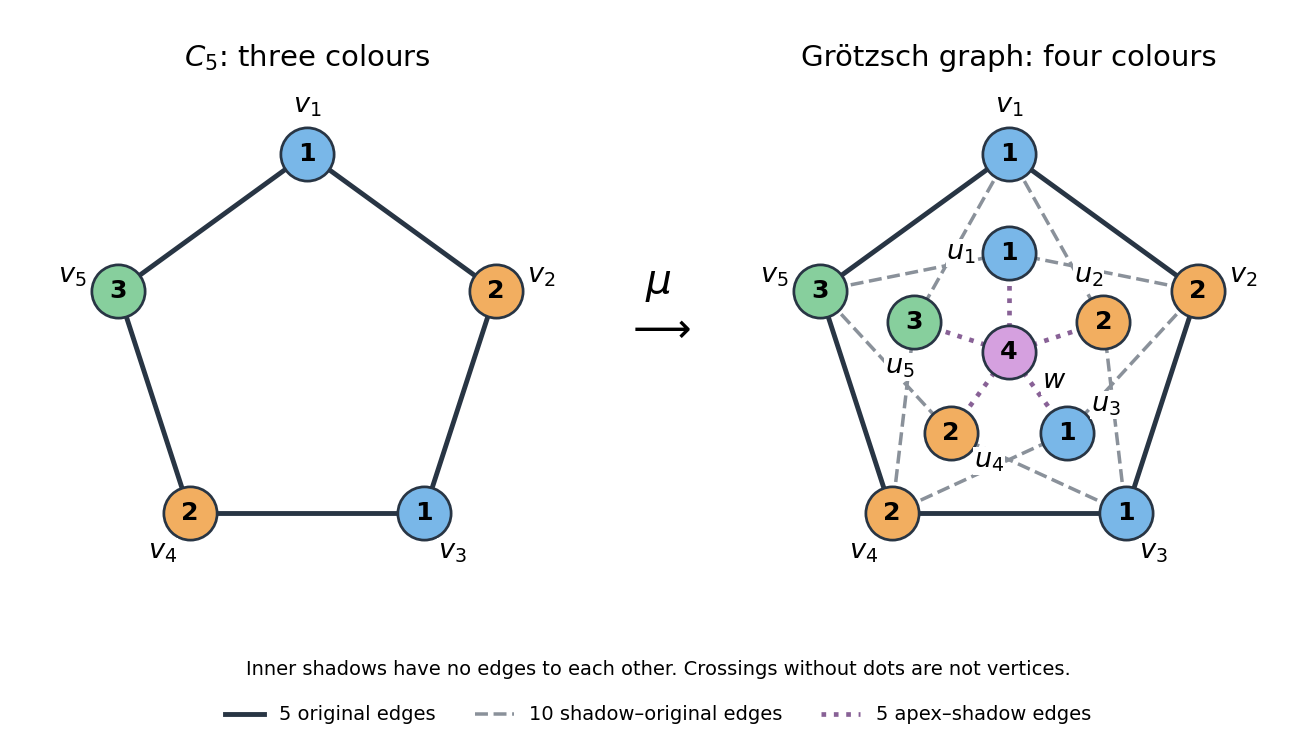
The Mycielski apex has an independent set as its graph neighbourhood, yet all three old colours are needed there in any three-colour proper vertex colouring of the subgraph obtained by deleting it. Thus a locally easy group of mutually nonadjacent neighbours can carry globally incompatible colour requirements. Absence of triangles in a graph alone cannot bound the chromatic number.
A Mycielski shadow vertex has graph neighbourhood in . Its neighbours other than the Mycielski apex are original vertices. All Mycielski shadow vertices form an independent set.
The Mycielski apex is the added vertex adjacent to every Mycielski shadow vertex and to no original vertex. Its graph neighbourhood is precisely .
For a nonempty finite simple graph, the upper bound copies an optimal proper vertex colouring to its Mycielski shadow vertices and gives the Mycielski apex a fresh colour. For the lower bound, suppose uses colours, with coloured . Shadows avoid . Replace colour at each original by 's colour. Changed originals form an independent set; unchanged neighbours differ because is an edge. This proper vertex colouring of uses colours, contradicting its chromatic number.[ref]
Mycielski graphs and PR proofs by Emre Yolcu and others. §4.1, Proposition 1 and proof, manuscript pp. 6–7
The nonempty condition means , not . An edgeless -vertex graph with has chromatic number one; its Mycielskian is a star graph on together with isolated vertices, and needs two colours. If has no vertices, is a single vertex, so the same formula also holds with the convention .
A finite simple graph is a triangle-free graph if and only if its Mycielskian is a triangle-free graph. No triangle in a graph can contain the Mycielski apex, whose neighbours are an independent set, or two Mycielski shadow vertices. A triangle in a graph containing one shadow and two originals requires all three original edges , hence an original triangle in a graph. Conversely every original triangle in a graph remains. In fact each original triangle in a graph gives four in : itself and the three choices of replacing one of its vertices by its shadow. Thus triangle-freeness is preserved, but a positive triangle count is multiplied by four.
Define and for . By the Mycielskian chromatic increase and Mycielskian triangle preservation, each is a finite triangle-free graph with chromatic number . The first steps are , the Grötzsch graph, and then a 23-vertex graph needing five colours. The vertex recurrence gives . These explicit examples show how arbitrarily strong graph coloring constraints can accumulate without any three-vertex clique.
Articles by others on the same topic



In mathematics and graph theory, a Mycielski graph, or Mycielski construction, is a method for constructing new graphs from existing ones. The Mycielski construction is used primarily to create triangle-free graphs, which are graphs that do not contain any cycles of length three (triangles). The construction works as follows: 1. **Start with a graph \( G \)**: This can be any simple graph.