Neutrino-flux sensitivity inversion
ID: neutrino-flux-sensitivity-inversion

Why compare inferred neutrino fluxes rather than raw event counts? For channel , exposure time , target population , cross section , and detection efficiency including reconstruction and selection, a forward model isHere is expected background; on the left counts events, while counts targets. Distinct cross sections, target numbers, thresholds and detection efficiencies prevent a direct CC/NC count ratio from being an electron neutrino fraction. Channel populations themselves can be correlated estimates from overlapping event patterns.
An original reduced linear algebra model isolates the inference. Assume specified spectral shapes and divide each background-corrected channel rate by its own calibrated electron neutrino response. Put and let be the spectrum- and response-weighted non-electron/electron ES sensitivity ratio. ThenThe equal and responses determine their sum, not their separate neutrino fluxes. Changing the assumed spectra generally changes the integrated coefficients; with arbitrary unknown spectra this small matrix is insufficient.
Choose illustrative inputs, not historical measurements: , and , with every neutrino flux in the same arbitrary unit. The forward prediction is . CC and NC independently invert to , ; substituting into ES returns . Alternatively, CC and ES give . Thus the third channel tests the response model and the inferred mixture.
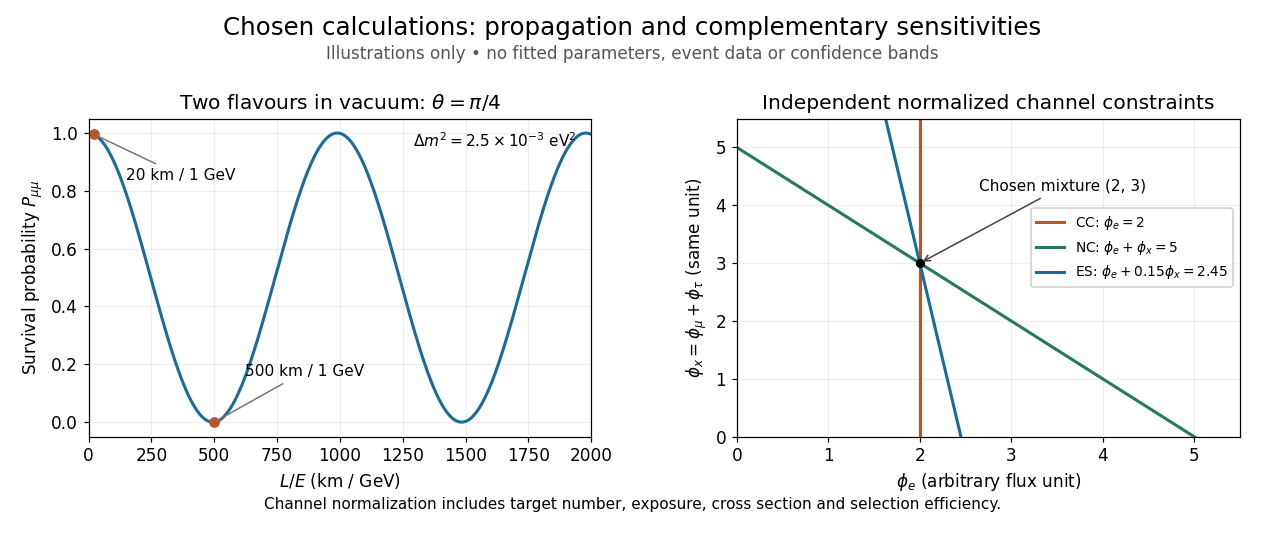

CC alone admits any nonnegative . CC and ES lose the second independent constraint when ; for small positive , an ES-minus-CC error is amplified by . With chosen independent errors , their propagated standard deviation is . If CC and NC instead have those independent errors, the difference has standard deviation . Actual analyses must retain covariances, including those introduced by statistical channel separation. Complementarity supplies information; calibration establishes what information each channel carries.
New to topics? Read the docs here!