Observed radiative flux
ID: observed-radiative-flux

For a steady point-like astronomical source with isotropy of emission, in transparent space with negligible relativistic or cosmological effects, conservation of energy spreads its luminosity over a sphere of surface area . Its bolometric observed radiative flux isThis inverse-square law reflects geometric dilution: the same emitted power crosses increasingly large spheres. It does not require light to lose energy on the journey. For a fixed luminosity, doubling Euclidean distance quarters the observed radiative flux. [ref].
With and parsecs, the result is . At parsecs, the same source gives . An ideal collecting area of at parsecs intercepts approximately , before detector losses.
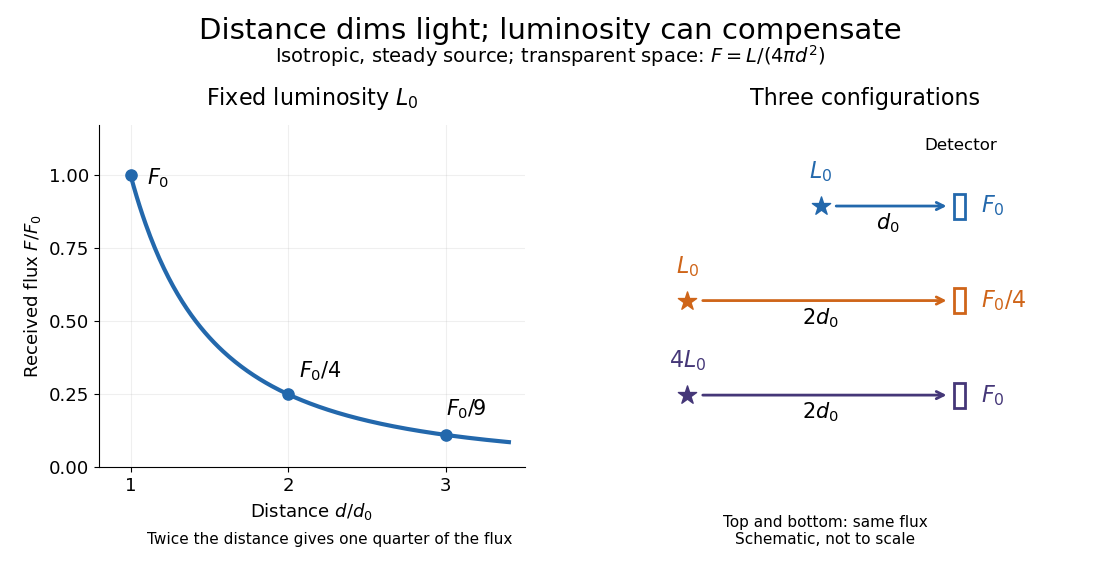
Fixed luminosity gives inverse-square dimming; different luminosities can give equal observed flux; configuration diagram schematic, not to scale
. Details. 
New to topics? Read the docs here!