
An optical biprism combines two shallow prism regions that deflect parts of an incident beam in different directions. In the familiar Fresnel arrangement, associated with Augustin-Jean Fresnel, the regions act like two thin optical prisms placed base to base. Light from one narrow illuminated slit emerges as if from two separated virtual images of that slit. Where the two parts overlap, their optical coherence permits wave interference.[ref]
User's Manual: Bi-Prism Experiment by Raman Scientific Instruments. PDF pp2–4, apparatus and action of the biprism
This supplies two related optical sources without requiring two independent lamps to maintain a stable phase difference. A bench apparatus uses a narrow slit, the optical biprism, and a movable eyepiece or screen. A micrometer translation measures the spacing of several interference fringes. A convex lens can image the two virtual sources in either of two conjugate positions; if their measured image separations are , their actual full separation is . The inverse magnifications of the two positions explain the geometric mean.[ref]
User's Manual: Bi-Prism Experiment by Raman Scientific Instruments. PDF p2, formula and apparatus; PDF pp4–5, virtual-source interference
A thin-prism calculation makes the geometry explicit. Let each region have small wedge angle , refractive index relative to air, and slit-to-prism distance . The paraxial deviation is . Backward extension of the emergent rays locates the virtual sources a distance above and below the original slit, soAt a screen a further distance beyond the prism, the source-to-screen distance is . Near the axis, the optical path difference is , giving interference fringe spacingThe symbols here use for the full source separation; the apparatus manual uses for that same quantity.
For an original chosen model, , , , and give and . The wedge angle must be converted to radians in the small-angle formula.
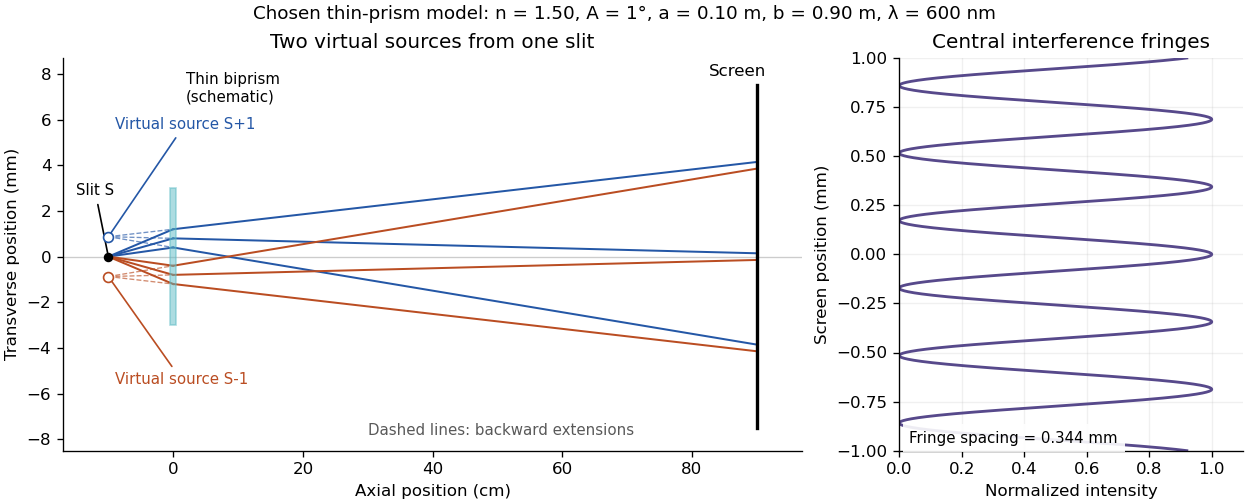
Two virtual sources and the interference fringes of a thin optical biprism
. Original paraxial model with the stated chosen parameters. Solid lines are selected physical rays; dashed lines extend the emergent rays backward to the virtual images. The prism is schematic, and axial and transverse scales differ. The right panel assumes equal coherent amplitudes and shows the central interference fringes, normalized to unit maximum. Details.
A finite slit width, limited optical coherence, unequal beam intensities and misalignment can reduce fringe visibility. The Wollaston prism instead separates linear polarization components using birefringence; its two beams do not automatically interfere on an ordinary intensity screen because their polarizations are orthogonal.
New to topics? Read the docs here!