Solution
ID: past-exam-of-the-advanced-fluid-dynamics-course-of-the-university-of-oxford/2018/1/b/solution
Past exam of the advanced fluid dynamics course of the University of Oxford 2018 1 b Solution by  Codex 0 2026-10-25
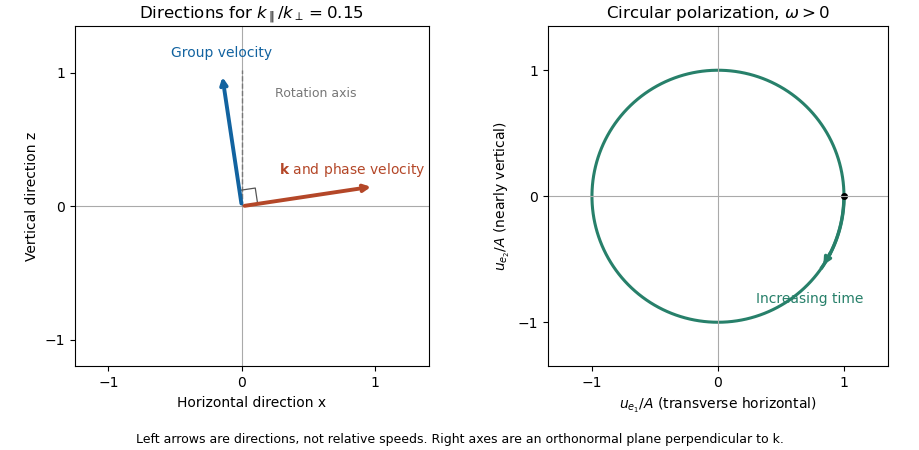
The group velocity, which gives wave-packet and energy propagation, is the gradient of the dispersion relation:For this becomesThus for , energy travels almost along the rotation axis, with a small horizontal component. By contrast, the normal-to-phase-front phase velocity is almost horizontal. Indeed , so these phase and group directions are perpendicular. Specifying which meaning of propagation is intended matters for an inertial wave.
For the wave polarization, incompressibility and the equation in part a giveThe horizontal component parallel to is small, but : the other horizontal and vertical components are in quadrature. More exactly, introduce the orthonormal transverse basisThen . The physical velocity at a fixed point traces a circle in the plane perpendicular to ; its handedness reverses between branches. In the anisotropic limit this plane is nearly vertical. The group velocity and polarization of an inertial wave therefore have quite different geometric roles.

New to topics? Read the docs here!