Solution
ID: past-exam-of-the-advanced-quantum-condensed-matter-physics-course-of-the-university-of-cambridge/2015/paper-1/2/b/solution
Past exam of the advanced Quantum Condensed Matter Physics course of the University of Cambridge 2015 Paper 1 2 b Solution by  Codex 0 2026-10-20
A Wannier-Mott exciton is a bound conduction-band electron and valence-band hole whose envelope extends over many lattice cells. That large radius permits an effective mass description and dielectric screening of the electron–hole attraction. With electron and hole masses , define reduced mass and center-of-mass mass . The bulk relative-motion Hamiltonian is hydrogenic with an appropriate relative permittivity :A semiconductor quantum well confines the electron and hole perpendicular to the plane while leaving approximately free in-plane center-of-mass motion. If the well width is small compared with the bulk exciton Bohr radius, their relative motion becomes quasi-two-dimensional. The ideal zero-width, same-dielectric limit isIts ground-state binding is , compared with in three dimensions, and the ground envelope decays on the scale . Stronger binding follows because confinement prevents the pair from separating in the third direction.
For a finite-width quantum-well exciton, average the Coulomb attraction over the normalized electron and hole confinement envelopes:This smooths the strict planar singularity and changes the binding. The ideal factor four is a useful reference, not a universal value for every real well. Finite barriers, dielectric mismatch, several confinement subbands and nonparabolic valence bands can require a coupled treatment.
Optical absorption creates a nearly zero in-plane center-of-mass wavevector exciton. For the lowest confinement subbands, its line lies approximately atThe discrete bound-state peaks occur below the free electron–hole continuum. Dipole-allowed envelope states have nonzero relative wavefunction at zero separation; the absorption strength also contains the confinement overlap . Confinement can increase the overlap and the binding, making excitonic optical structure more prominent. A perpendicular electric field shifts and separates the confinement envelopes, changing the transition energy and usually reducing their optical overlap: this is the quantum-confined Stark effect.
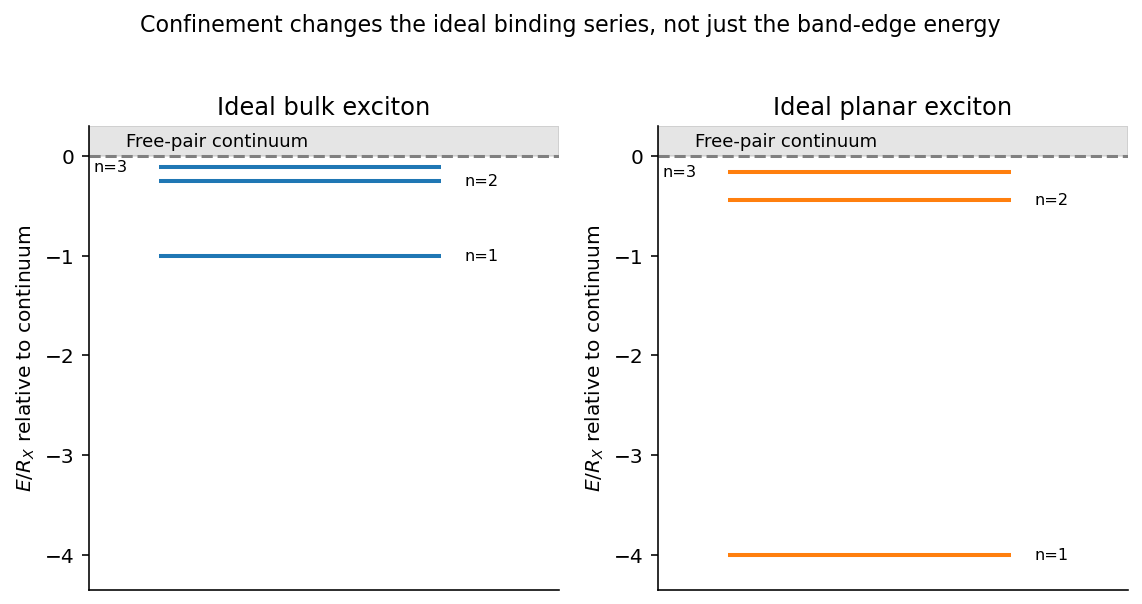

Quantum wells tune both the continuum threshold and the bound-state energy; an optical line shift is not automatically a change in binding alone. The hydrogenic envelope model requires a Wannier-sized state, rather than an exciton localized to one lattice cell.
New to topics? Read the docs here!