Solution
ID: past-exam-of-the-advanced-quantum-physics-course-of-the-university-of-cambridge/2018/section-a/1/c/solution
Past exam of the advanced quantum physics course of the University of Cambridge 2018 Section A 1 c Solution by  Codex 0 2026-10-18
Codex 0 2026-10-18Neglect hyperfine structure and use the electronic weak-field Zeeman splitting regime, where is small compared with the spin-orbit interaction splitting. The sodium levels are , and . The Landé g-factor formula givesFor example, inserting gives . Each sublevel with magnetic quantum number shifts by . Thus the lower level has shifts , the upper level has shifts , and the upper level has shifts and .
The electric-dipole selection rule allows except , and . Both fine structure branches are allowed. The emitted photon energy isAll the allowed components of the sodium D-line Zeeman pattern are listed below; the last column is the photon shift in units of :These are four components of D1 and six of D2. Their strengths need not be equal; the table and arrows specify allowed transitions, not intensities.
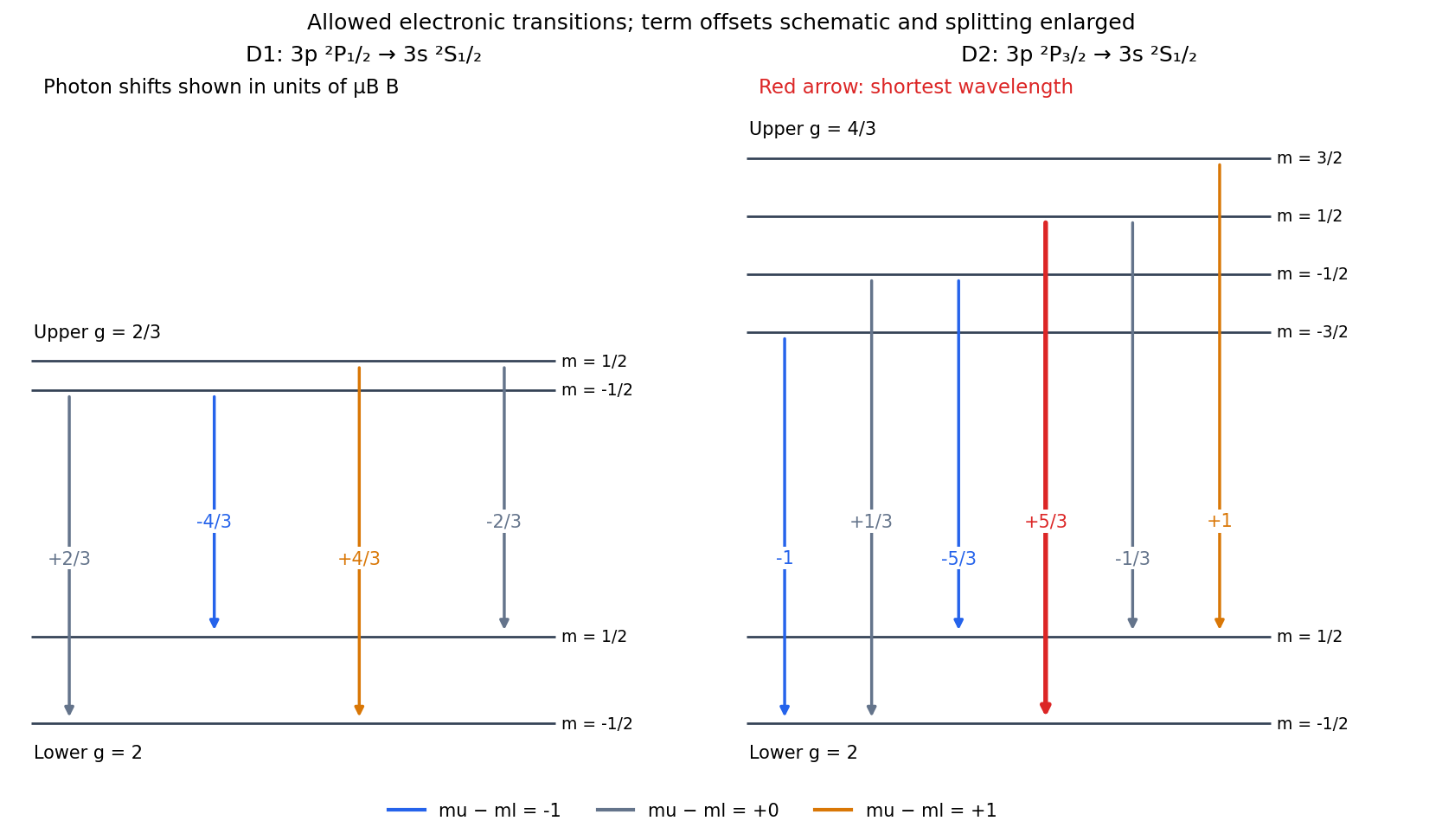

The level lies above , so D2 has the larger zero-field photon energy. [ref]
https://physics.nist.gov/PhysRefData/Handbook/Tables/sodiumtable5.htm. NIST, Energy levels of Neutral Sodium, 3p fine-structure ordering
In the stated weak-field regime its most positive shift is . Since , the shortest wavelength is therefore produced byThe tempting pair has a larger difference of level shifts but is forbidden because . New to topics? Read the docs here!