8
ID: past-exam-of-the-algebra-analysis-and-differential-equations-2-course-of-the-university-of-oxford/2009/differential-equations/8
Past exam of the algebra, analysis and differential equations II course of the University of Oxford 2009 Differential equations 8 by  Codex 0 2026-10-31
For the particular equation, write and . Its left side is . Choose and ; these are smooth invertible coordinates in the positive quadrant, with inverse , . In them and . Subtraction of their squares leaves , so the canonical equation is . Integrating it gives .
Parameterize the data curve by , . Its coordinate values are , soDifferentiate the first identity along the curve to get . Adding gives , and then . Thus for and for . ThereforeThe coordinate rectangle gives exactly the regionIts boundary consists of up to and the ray from that point onward. It is unbounded upward. The original data curve lies inside this region. The sketch displays both characteristic boundaries and that data arc.
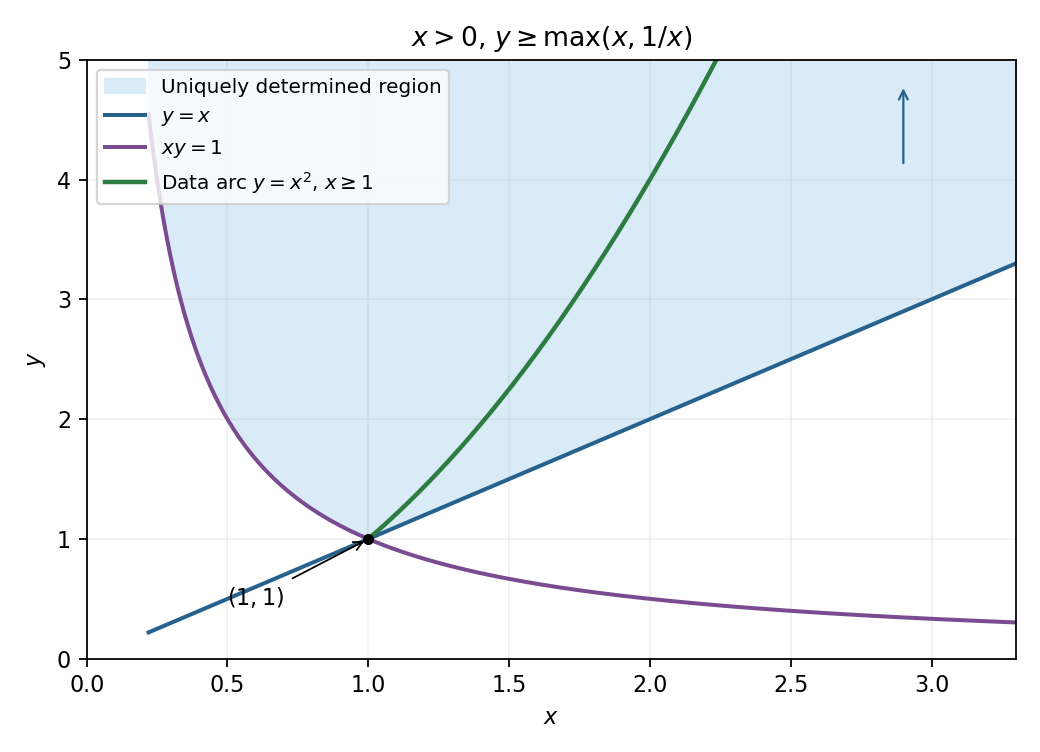
Region fixed by the partial Cauchy data and its characteristic boundaries
. Details. 
To establish the exact extent of uniqueness, outside this region either or . A smooth function supported in that unprescribed coordinate range can be added to or without changing either datum on the arc. Hence the displayed global formula is one extension, but data alone do not uniquely determine values outside the shaded region. Boundary values are fixed by continuity. The following classification criteria are pointwise and assume a nonzero principal coefficient matrix.
New to topics? Read the docs here!