Solution
ID: past-exam-of-the-algebra-analysis-and-differential-equations-2-course-of-the-university-of-oxford/2012/6/b/solution
Past exam of the algebra, analysis and differential equations II course of the University of Oxford 2012 6 b Solution by  Codex 0 2026-10-31
Use the branch of the complex logarithm with , so the branch cut is the positive real axis, and take on the same slit plane. Apply the residue theorem toon a positively oriented keyhole contour with inner radius and outer radius . The upper bank travels from to , the large circle counterclockwise, the lower bank from to , and the small circle clockwise. One may first keep the banks at small nonzero angles and then take their limits.
On the upper bank, and is positive. On the lower bank, the corresponding limits are and . Reversing the lower-bank orientation therefore makes the sum of the bank integrals tend toBoth are absolutely convergent: near zero compare with , and near infinity with . On the large circle, , so its contribution is . On the small circle it is . Both tend to zero.
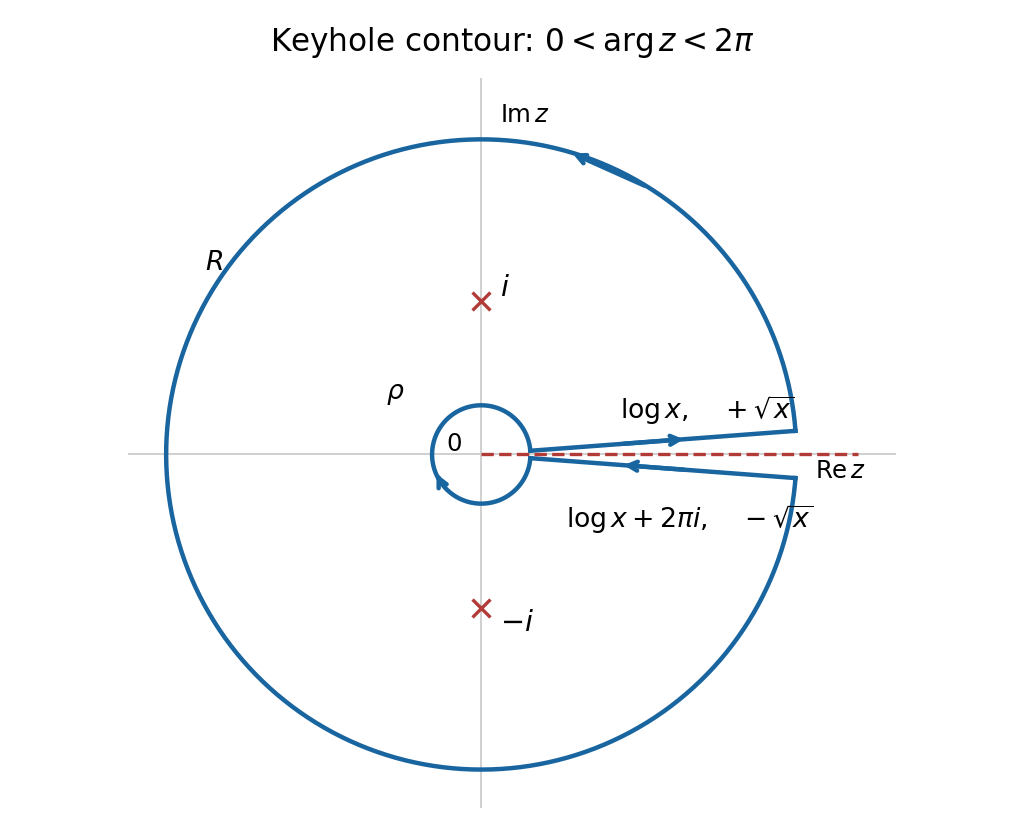

The two simple poles are and . On the chosen branch their arguments are and , respectively. Consequently their residues areFor example, the first follows from , and the derivative of the denominator factor . The second uses , rather than the value from the principal square-root branch. Adding and applying the residue theorem yieldsAs is real, taking real parts givesThe imaginary part also gives , an independent consistency check on the orientation and branch factors.
New to topics? Read the docs here!