Solution
ID: past-exam-of-the-astrophysics-course-of-the-university-of-oxford/2015/5/i/solution
Past exam of the astrophysics course of the University of Oxford 2015 5 i Solution by  Codex 0 2026-10-25
A planetary nebula combines a hot post-asymptotic-giant-branch stellar core, its ionized expelled envelope, neutral/molecular material and interstellar dust. Its ultraviolet-to-infrared spectral energy distribution is therefore not a single-temperature blackbody. The principal components are:
- Central-star continuum. A hot stellar photosphere emits strongly in the ultraviolet, especially the ionizing extreme ultraviolet, with its longer-wavelength tail extending through the optical and near infrared. Stellar-atmosphere absorption features and wind lines can be superposed. A companion can add a distinct cool stellar continuum.
- Nebular continuum. Thermal bremsstrahlung, nebular free-bound continuum emission and hydrogen two-photon emission produce a broad continuum. Free-bound edges, especially the Balmer discontinuity at 364.6 nm and the Paschen discontinuity near 820 nm, can be apparent. Hydrogen two-photon decay redistributes the Ly-alpha transition energy into a continuum of pairs rather than one 121.6-nm photon.
- Gas emission lines. Hydrogen and helium recombination lines include H-alpha, H-beta and He II 468.6 nm. Collisionally excited lines of metal ions can dominate individual bands: examples include optical [O III] 495.9/500.7 nm and [N II] 654.8/658.3 nm, ultraviolet C III] near 190.9 nm, and infrared fine-structure transitions such as [Ne II] 12.8 micrometres. A broad-band photometric peak may therefore be a line rather than continuum.
- Dust emission and solid-state structure. Grains absorb stellar/nebular radiation and reradiate it as a broad infrared continuum, often from a distribution of temperatures of order tens to hundreds of kelvin; compact hot dust can add near-infrared emission. Carbon-rich material may show aromatic bands around 3.3, 6.2, 7.7, 8.6 and 11.3 micrometres, while oxygen-rich material may show silicate features near 9.7 and 18 micrometres. These are compositional alternatives, not mandatory features of every nebula.
- Neutral and molecular emission. Surviving molecular material in dense clumps or a photodissociation region can contribute infrared rotational/rovibrational lines, notably molecular-hydrogen emission such as the 2.12-micrometre line. Shocks as well as ultraviolet pumping can excite it. Colder dust continues into the far infrared, and low-lying CO rotational lines extend the overall spectrum into the submillimetre/millimetre range.
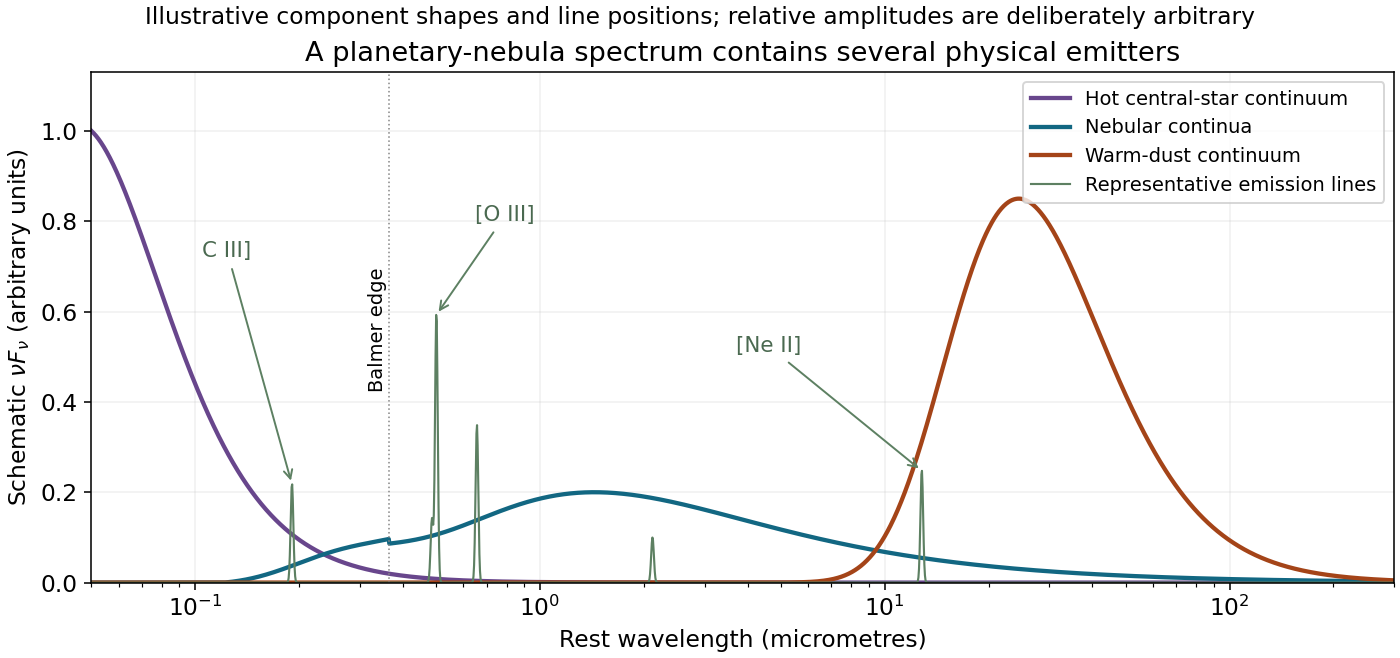
Schematic stellar, nebular and dust components of a planetary-nebula spectrum; arbitrary relative normalizations
. Details. 
The observed mixture also contains attenuation by internal and foreground interstellar extinction. A spectrum containing all these components need not spatially coincide: stellar light, ionized gas, dusty clumps and the molecular envelope sample different regions.
New to topics? Read the docs here!