Solution
ID: past-exam-of-the-biological-physics-course-of-the-university-of-oxford/2018/2/c/solution
Past exam of the biological physics course of the University of Oxford 2018 2 c Solution by  Codex 0 2026-10-25
The coefficient in the linear force law isStretching suppresses the many disordered orientations available to the chain. The Gaussian chain free energy cost has gradient equal to this restoring force. This is entropic elasticity; individual covalent bonds need not stretch to produce the weak-force spring.
At moderate force, even an ideal FJC becomes nonlinear as its orientations align, so failure of a linear fit alone need not imply nonideal chemistry. But failure of the full FJC curve can reflect backbone spring constant and correlated segment angles, nonuniform effective links, remaining folded contacts, force-induced conformational changes, energetic bond compliance, or tether/calibration effects. An extensible FJC or an appropriate semiflexible model includes some of these effects; their parameters require independent justification. The stated inextensible polymer contour length already excludes a literal extension.
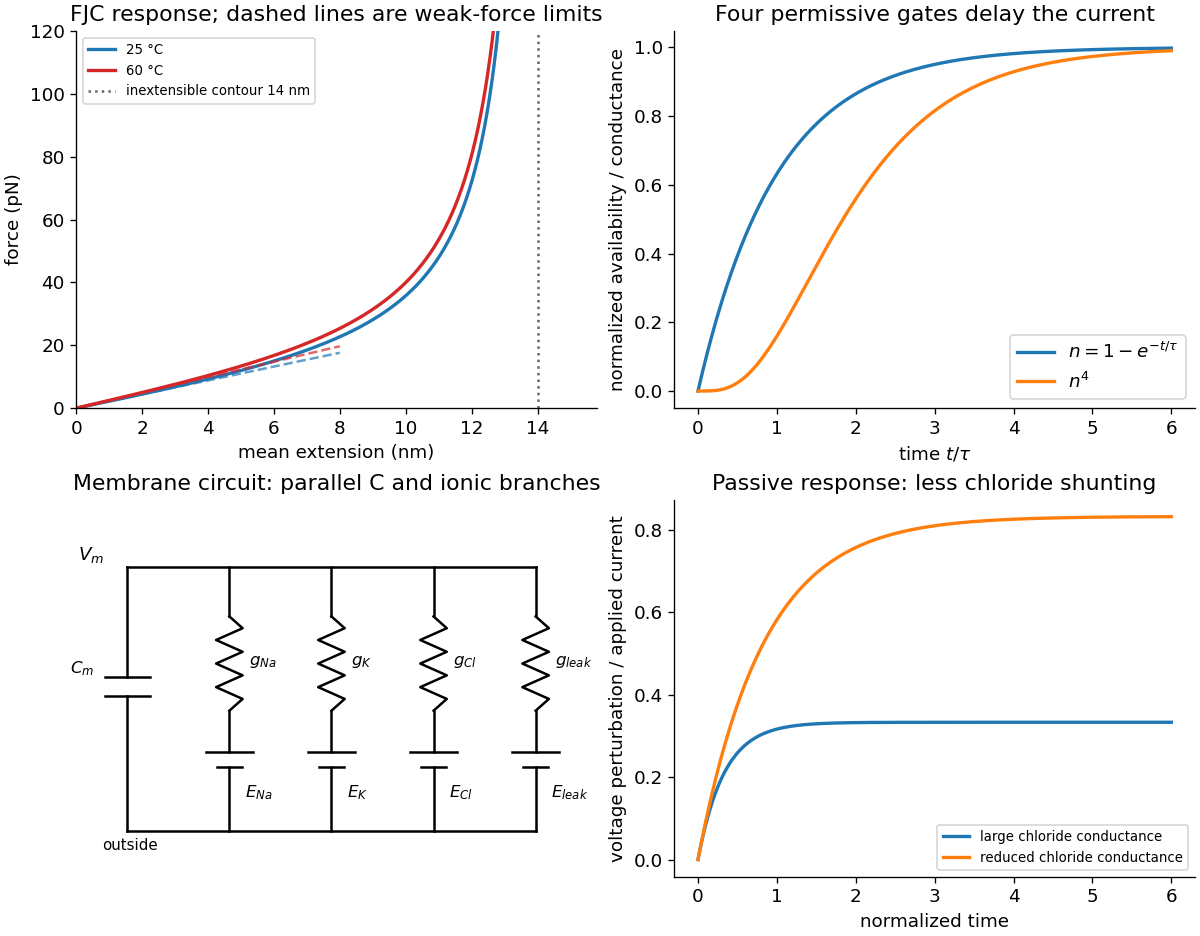
The first panel of the original model figure below shows the full orientational response and weak-force tangents without tracing the experimental data.

New to topics? Read the docs here!