A covalent bond joins chemical atoms through shared Electrons. In the familiar two-centre description, one bond pair contributes to a connection between two atomic nuclei. Sharing means that the Electrons belong to the combined arrangement and interact with both atomic nuclei; it does not mean that identifiable dots shuttle along drawn paths. The [ref] emphasizes the concentration of Electrons between atomic nuclei and the resulting attraction and characteristic separation. The pair picture is especially useful for simple molecules, but is not a universal description of every covalent bond.
A Lewis structure turns this picture into practical bookkeeping. Count the valence electrons, indicate which chemical atoms are connected, and allocate two Electrons to each line. A bond pair is shared; a lone pair is assigned to one chemical atom without connecting it to another. A double line represents two bond pairs. Dots and lines record allocations, rather than positions, trajectories, or a measured three-dimensional arrangement. [ref]
https://openstax.org/books/chemistry-2e/pages/7-3-lewis-symbols-and-structures. Flowers et al., Chemistry 2e, Lewis symbols and structures
For molecular hydrogen, , each neutral hydrogen chemical atom supplies one valence electron. Thus valence electrons make one bond pair, represented by , with no lone pairs. Each hydrogen counts the same shared pair when checking its two-electron arrangement. The molecule still contains two Electrons, not four: counting a pair around both endpoints does not create extra Electrons.
For water, , neutral oxygen supplies six valence electrons and the two hydrogen chemical atoms supply one each: . Two O–H connections consume four Electrons as two bond pairs. The remaining Electrons form two lone pairs on oxygen. Around oxygen, the two bond pairs and two lone pairs count as eight Electrons; each hydrogen counts two. The whole water molecule has ten Electrons, because two additional oxygen Electrons are omitted from this valence electron drawing.
For ammonia, , the total is valence electrons: five from nitrogen and three from hydrogen. Three N–H connections use six Electrons as three bond pairs, leaving two Electrons as one lone pair on nitrogen. Thus water and ammonia have the same total of eight valence electrons but different allocations: two plus two pairs versus three plus one. This small calculation already distinguishes their connectivity without a detailed quantum mechanics calculation.
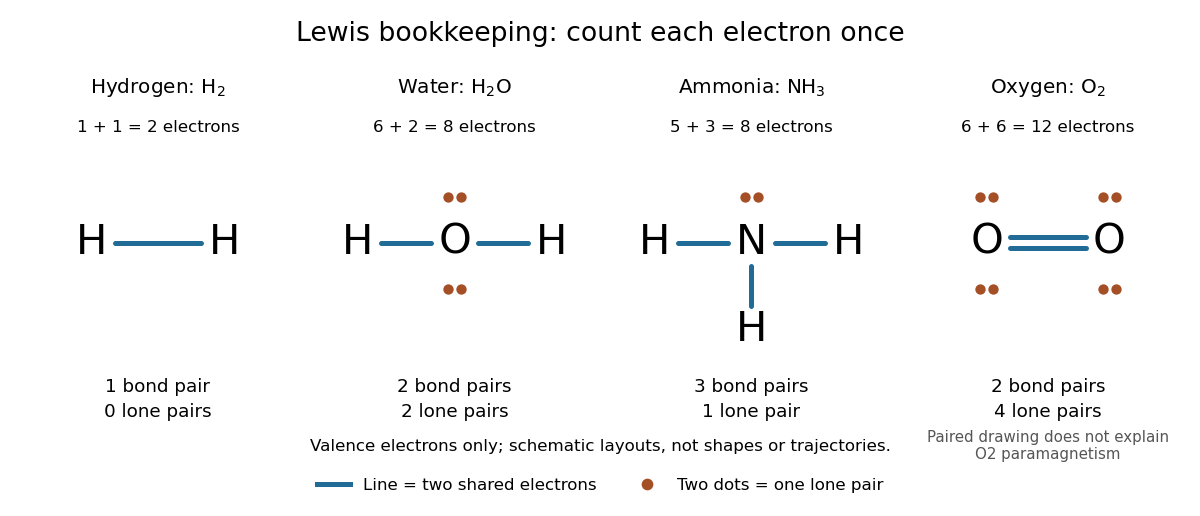
Lewis structures count bond pairs and lone pairs in molecular hydrogen, water, ammonia, and molecular oxygen; schematic layouts do not specify molecular shapes
. Details. For molecular oxygen, , valence electrons give the conventional Lewis structure. Its two bond pairs use four Electrons, leaving eight as four lone pairs, two on each oxygen. Each oxygen consequently counts eight Electrons locally. However, actual molecular oxygen has two unpaired Electrons and exhibits paramagnetism: it is attracted into a stronger magnetic field. The all-paired Lewis structure cannot capture this observation. Molecular orbital theory describes the unpaired Electrons; the successful counting diagram alone is insufficient. [ref]
Why does sharing produce a stable separation? For molecular hydrogen, the electronic arrangement responds as the atomic nuclei approach. Their interactions can lower the energy, but pushing them too close raises it. A curve of potential energy against separation therefore has a local minimum, rather than falling forever. Attraction and repulsion balance there. This is a statement about the combined system, not a claim that stationary Electrons sit between otherwise motionless atomic nuclei. [ref]
The following Morse potential makes those features calculable. Set , where is separation and its equilibrium value, and let be the well depth. With the self-chosen parameter , define the dimensionless quantitiesHere is the net separating force, obtained from the derivative of the potential energy. Positive pushes the chemical atoms apart; negative draws them together. These are illustrative curves with in chosen units, not measured molecular hydrogen data or fitted parameters.
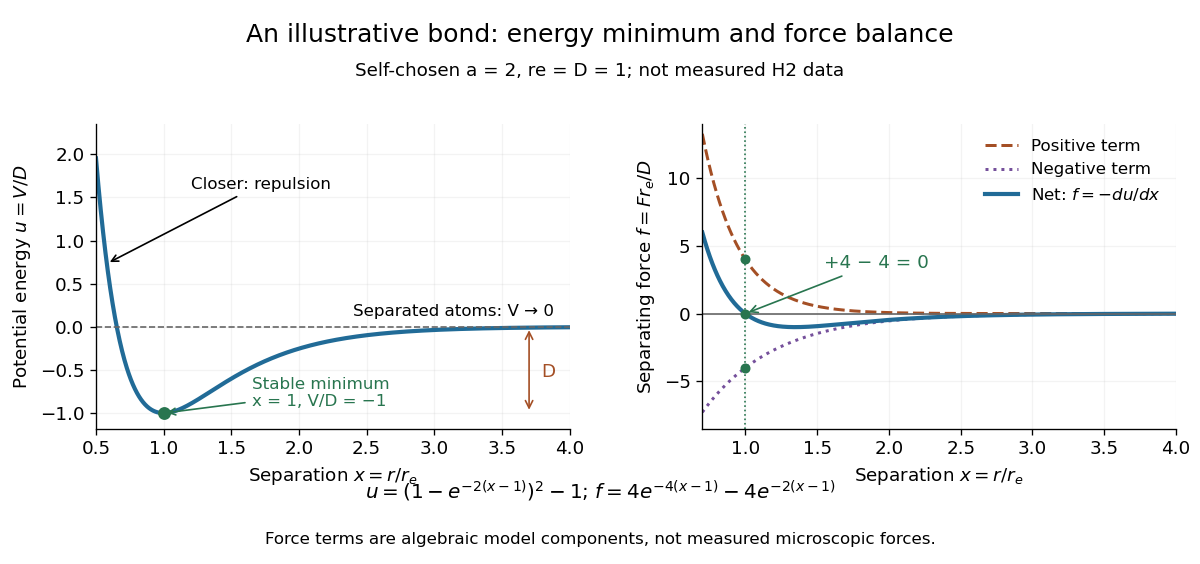
Illustrative dimensionless Morse potential and its force: a stable local minimum, short-distance repulsion, and separation toward zero potential energy
. Details. At , and . The second derivative is , confirming a local minimum. At , ; at , . As increases without bound, approaches zero from below. Thus moving from the well bottom to separated chemical atoms requires an increase of in this model's potential energy. An actual quantum mechanics dissociation threshold also depends on the initial motion of the atomic nuclei, so the well depth alone is not every measured dissociation energy.
The force panel separates into a positive term and a negative term . At they are and , cancelling exactly; nearer separations favour the positive term. These are algebraic components of the chosen Morse potential, not separately measured microscopic forces. Their usefulness is to show how a balance arises from the slope of one energy curve.
The beauty of the pair picture is its economy: a few marks summarize connectivity and constrain what a proposed molecule can contain. Its historical anchor is Gilbert N. Lewis's 1916 paper [ref]
https://doi.org/10.1021/ja02261a002. The Atom and the Molecule, Journal of the American Chemical Society 38, 762–785
, also available as an [ref]https://zenodo.org/records/1429068. archived original paper
. Lewis structures remain useful because they answer counting questions quickly; quantum mechanics supplies the richer account when energy, shape, or unpaired Electrons matter. Articles by others on the same topic

A covalent bond is a type of chemical bond that involves the sharing of electron pairs between atoms. This sharing allows each atom to attain the electron configuration of a noble gas, resulting in greater stability for the bonded atoms. Covalent bonds typically form between nonmetal atoms, where the difference in electronegativity is not significant enough to create ionic bonds. In a covalent bond, each shared pair of electrons constitutes one bond: - A single bond involves one pair of shared electrons (e.


