Solution
ID: past-exam-of-the-chemistry-a-course-of-the-university-of-cambridge/2025/paper-2/a10/c/solution
Past exam of the chemistry A course of the University of Cambridge 2025 Paper 2 A10 c Solution by  Codex 0 2026-10-20
At equilibrium, electrons initially diffuse from the n side and holes from the p side. Recombination leaves ionized donors and acceptors in a depletion region, producing an internal electric field and band bending. The Fermi level is constant across the equilibrium p-n junction. With p material on the left, both band edges lie higher on the p side, as in the left panel.
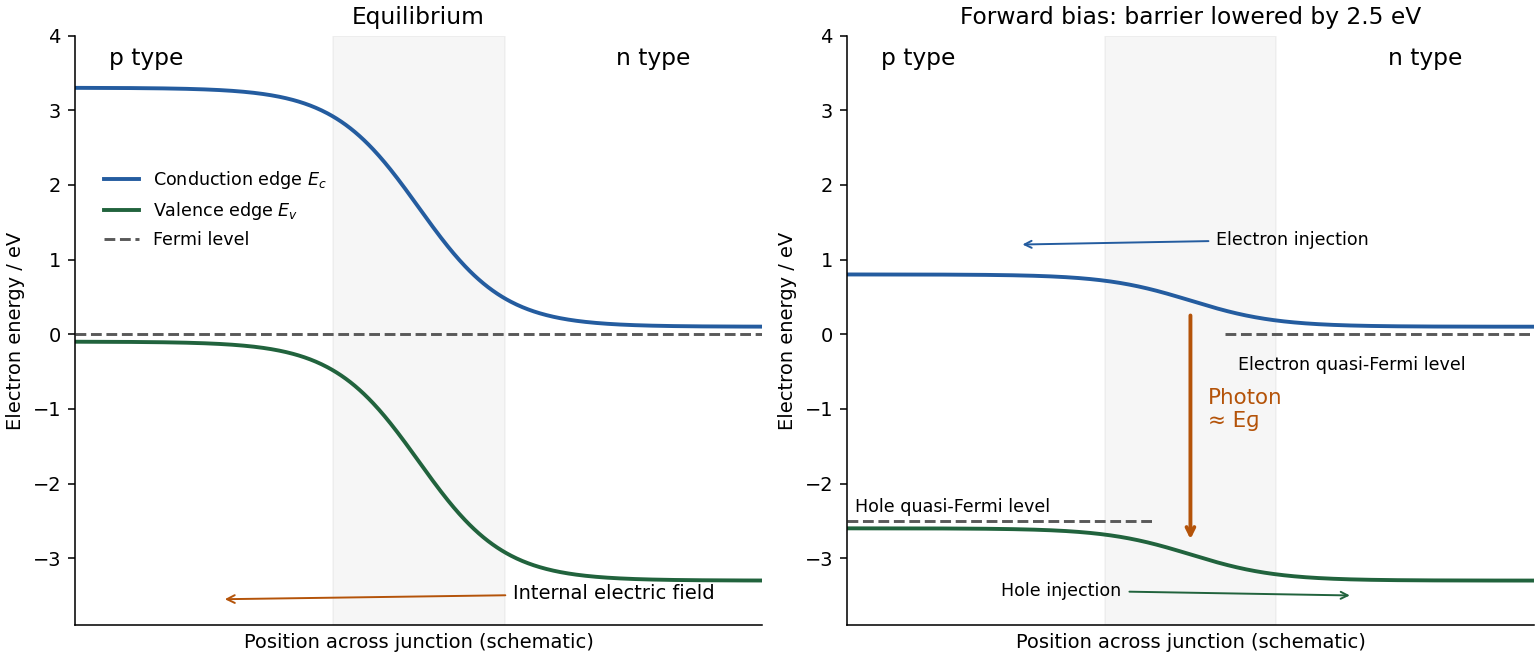
Equilibrium and forward-biased direct-gap p-n junction energy bands, with injection and photon emission
. Details. 
Forward bias, with the p side positive relative to n, reduces the injection barrier. Electrons and holes enter the junction region and can recombine radiatively, emitting photons with energy close to the band gap. Under bias, separate electron and hole quasi-Fermi levels replace a single equilibrium Fermi level.
Both GaN polymorphs have a direct band gap, so a conduction-band electron and valence-band hole can recombine without a large crystal-momentum change. Silicon and germanium have indirect band gaps, requiring phonon assistance for near-edge radiative recombination, which makes efficient band-edge light emission much harder. A direct gap enables the process; defects, carrier confinement and competing nonradiative channels still determine device efficiency.
New to topics? Read the docs here!