Solution
ID: past-exam-of-the-chemistry-b-course-of-the-university-of-cambridge/2021/paper-1/b2/d/solution
Past exam of the chemistry B course of the University of Cambridge 2021 Paper 1 B2 d Solution by  Codex 0 2026-10-20
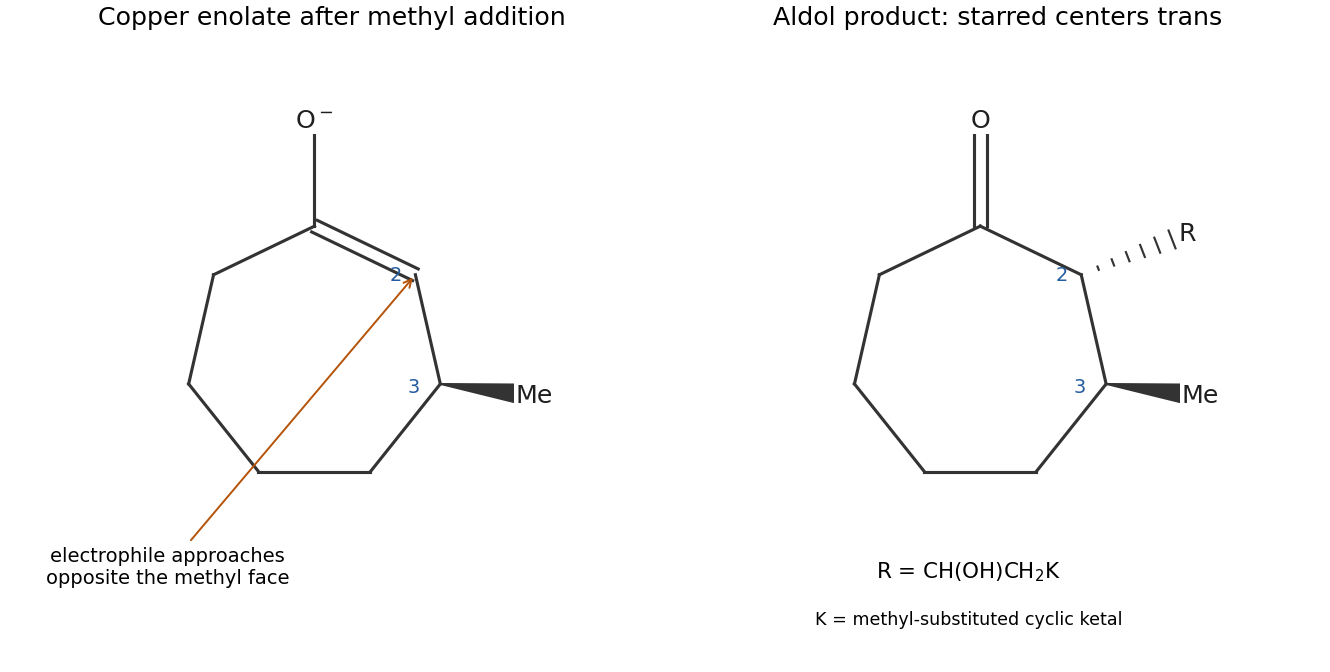
copper(I) converts the methyl grignard reagent into a softer organocopper nucleophile. Methyl undergoes 1,4 addition to the beta carbon of the cycloheptenone, giving a metal enolate rather than direct 1,2 addition to the ketone carbonyl.
The carbon nucleophilic site of this enolate, at the alpha carbon, attacks the aldehyde carbonyl in the second reagent. Its C=O electrons move to oxygen; protonation of the resulting alkoxide gives the beta-hydroxy ketone side chain. The cyclic acetal is a protected ketone and survives these nucleophilic conditions.
The beta methyl group shields one face of the cyclic enolate. Aldol bond formation from the less crowded opposite face places the new alpha side chain trans to the beta methyl group. Thus the two starred ring centers have an anti relationship; the two mirror-related products are possible from achiral starting materials and reagents. This argument does not assign the separate, unstarred alcohol center, for which the question gives no specified configuration.

New to topics? Read the docs here!