Solution
ID: past-exam-of-the-chemistry-b-course-of-the-university-of-cambridge/2022/paper-1/b1/a/ii/solution
Past exam of the chemistry B course of the University of Cambridge 2022 Paper 1 B1 a ii Solution by  Codex 0 2026-10-20
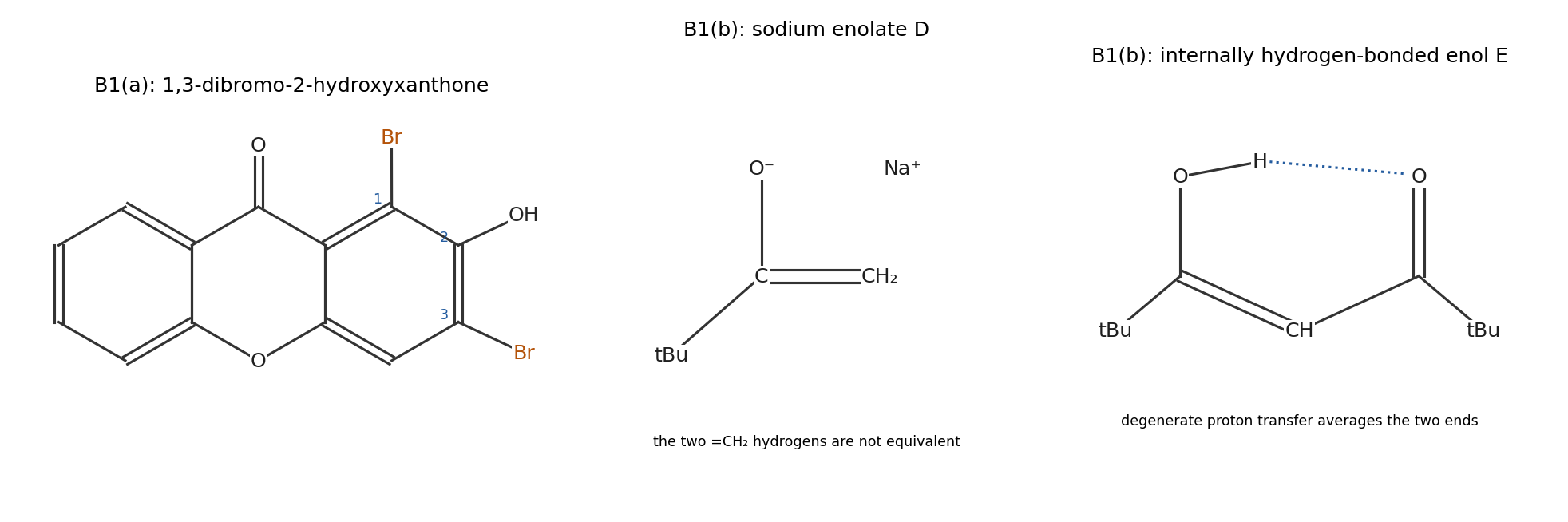
B is 1,3-dibromo-2-hydroxyxanthone: both bromines are on the hydroxy-substituted outer ring, at its two available positions ortho to OH. Define C2 as the OH-bearing carbon; C1 lies between it and the carbonyl-side ring junction, and C3 lies on its other side. These labels specify the substitution independently of the orientation of the printed drawing.
Phenolic lone pair donation strongly activates its ortho and para positions towards electrophilic substitution. The para position is a fused junction and has no replaceable hydrogen, leaving C1 and C3 as the two directly activated sites. C1 also benefits from the conjugative influence of the ring ether oxygen. Although other positions receive some activation from that oxygen, they lack the stronger local phenolic activation of the selected pair. Excess bromine can therefore replace both ortho hydrogens. Replacing two hydrogens in gives , consistent with the stated composition. Addition across an outer-ring double bond would sacrifice aromaticity and would not account for the hydrogen loss.

New to topics? Read the docs here!