Solution
ID: past-exam-of-the-chemistry-b-course-of-the-university-of-cambridge/2023/paper-1/b4/a/i/solution
Past exam of the chemistry B course of the University of Cambridge 2023 Paper 1 B4 a i Solution by  Codex 0 2026-10-20
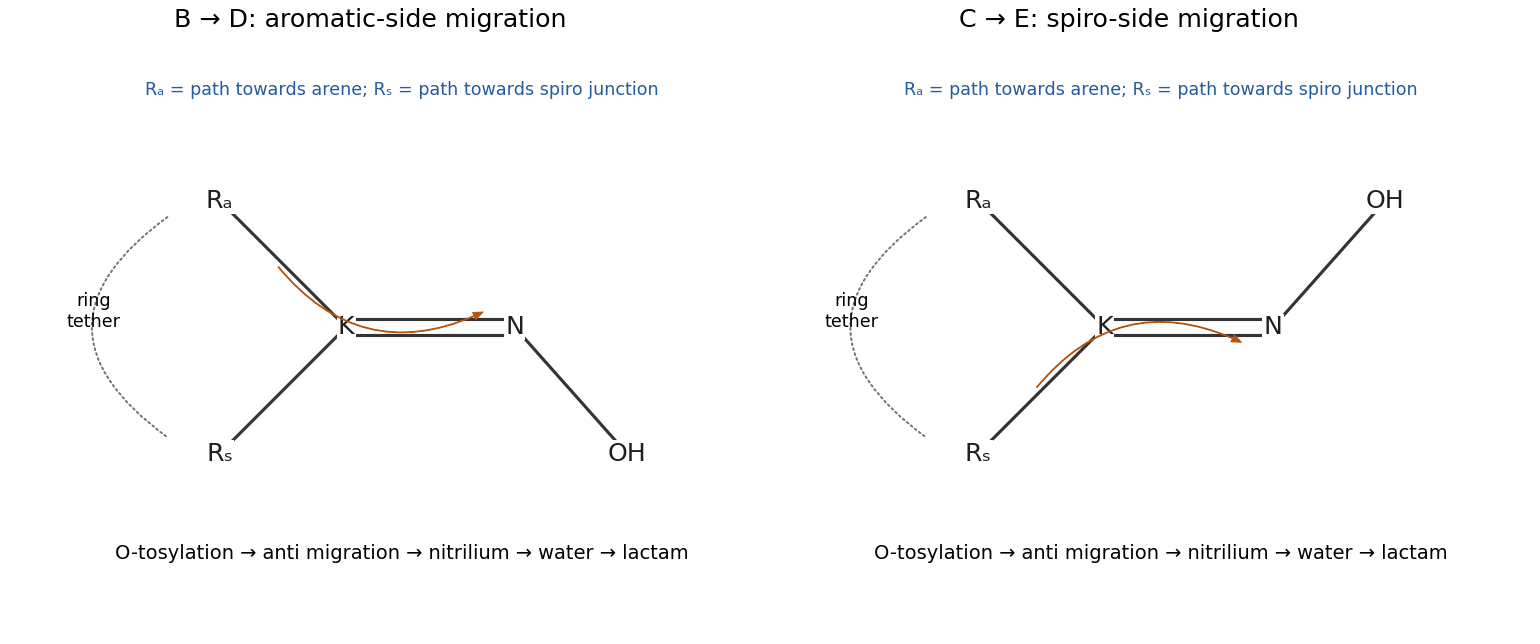
B and C are the two geometrical ketoxime isomers, formed by replacing the reactive ring C=O with C=N–OH. The separate spiroacetal remains intact. Define as the original ketone carbon, as the adjacent ring path towards the aromatic ring, and as the adjacent path towards the spiroacetal-bearing junction. These are the two carbon substituents directly bonded to , not detachable independent fragments.
In B, N–OH is anti to the bond across C=N; in C, N–OH is anti to . Those geometries predict exactly the respective nitrogen insertions in D and E. Both products have formula : condensation adds NH2OH to and removes H2O. An alternative ring regioisomer or reaction at the protected ketone would not represent the pair of oxime geometrical isomers.

New to topics? Read the docs here!