Solution
ID: past-exam-of-the-chemistry-b-course-of-the-university-of-cambridge/2024/paper-1/b2/b/i/solution
Past exam of the chemistry B course of the University of Cambridge 2024 Paper 1 B2 b i Solution by  Codex 0 2026-10-20
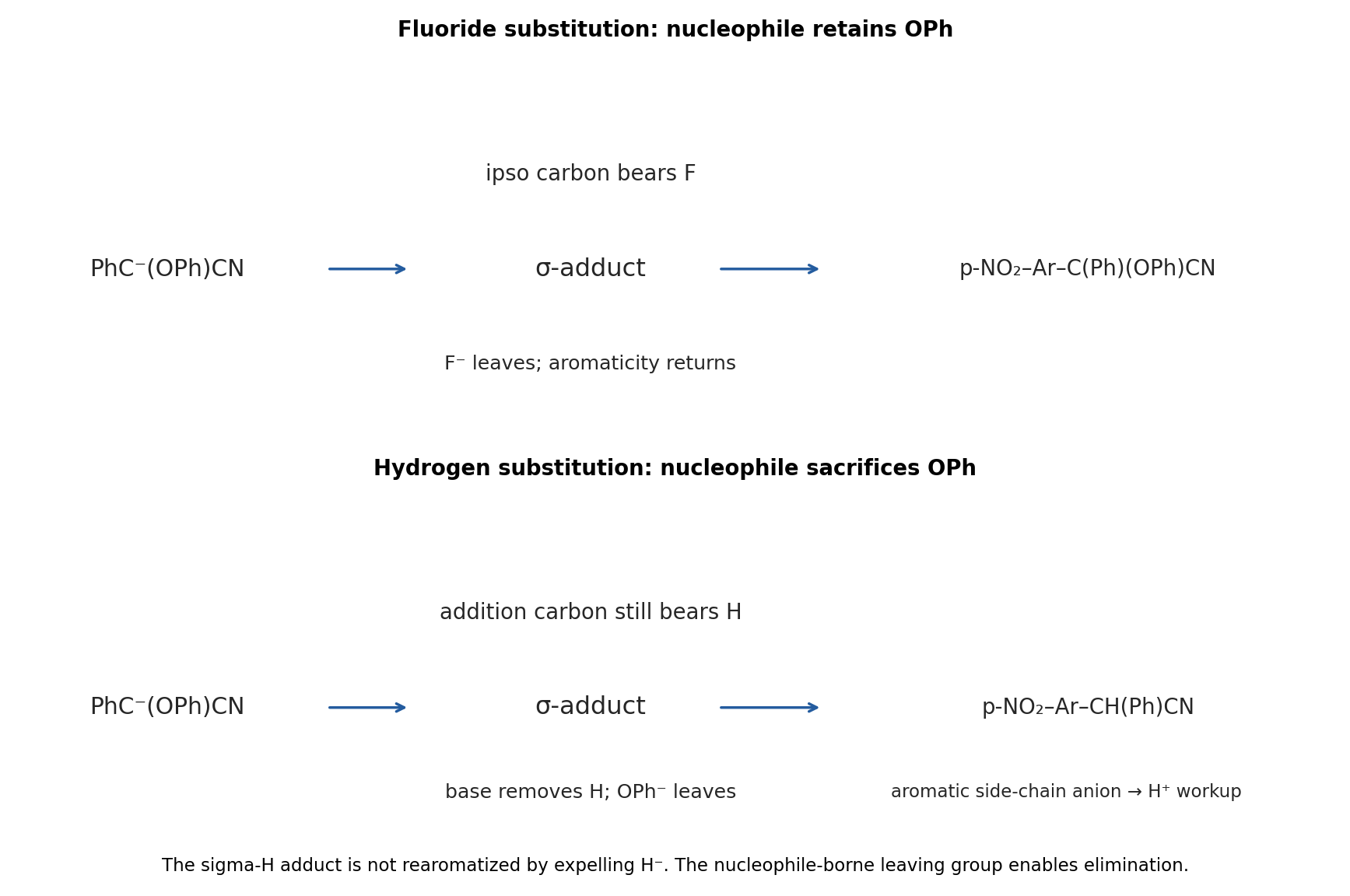
tert-Butoxide removes the acidic hydrogen from . The resulting carbon anion is stabilized by the nitrile group and the phenyl substituent. It attacks the aromatic carbon bearing fluorine, giving a Meisenheimer addition intermediate. Ring pi bonds shift toward the para nitro group, where the negative charge can be delocalized onto oxygen.
Loss of fluoride restores aromaticity and gives . This is an addition–elimination nucleophilic aromatic substitution. The phenoxy group remains attached to the incoming carbon. The ipso aromatic carbon already has a leaving group, so rearomatization can occur by fluoride departure without removing phenoxide. Acid workup neutralizes residual anions; it is not a separate step that replaces the aryl fluoride.

New to topics? Read the docs here!