Solution
ID: past-exam-of-the-chemistry-course-of-the-year-3-of-the-natural-sciences-course-of-the-university-of-cambridge/2022/paper-2b/section-b/33/c/ii/solution
Past exam of the chemistry course of the year 3 of the natural sciences course of the University of Cambridge 2022 Paper 2B Section B 33 c ii Solution by  Codex 0 2026-10-20
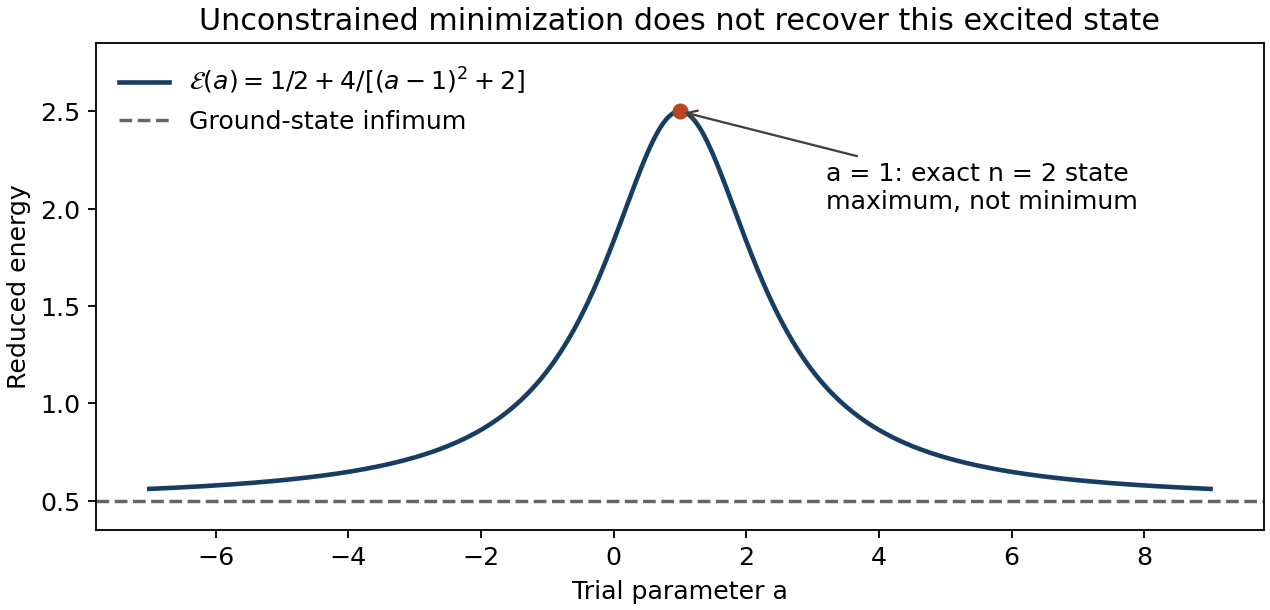
Direct evaluation of the Rayleigh quotient exposes a problem with the requested minimization. Using the supplied Gaussian integrals,ThusThe eigenfunction value is a maximum, not a minimum. Indeed , whereas is already lower. There is no finite minimizing in this family: its infimum is , approached as , when the normalized trial wavefunction approaches the ground state. This is consistent with the quantum variational principle. The original printed instruction in this subpart is therefore inconsistent as an unconstrained minimization; a stationary Rayleigh quotient need not be a minimum.
The intended excited state can instead be obtained by imposing an excited-state variational constraint. Orthogonality to the ground state requireswhich fixes . Every member of the family is even, so it is already orthogonal to the odd state. With the ground state excluded, the lowest allowed oscillator energy is therefore . In the exact oscillator basis, is proportional to , making both the maximum and the orthogonality correction transparent.

New to topics? Read the docs here!