Solution
ID: past-exam-of-the-chemistry-course-of-the-year-3-of-the-natural-sciences-course-of-the-university-of-cambridge/2022/paper-3/43/c/solution
Past exam of the chemistry course of the year 3 of the natural sciences course of the University of Cambridge 2022 Paper 3 43 c Solution by  Codex 0 2026-10-20
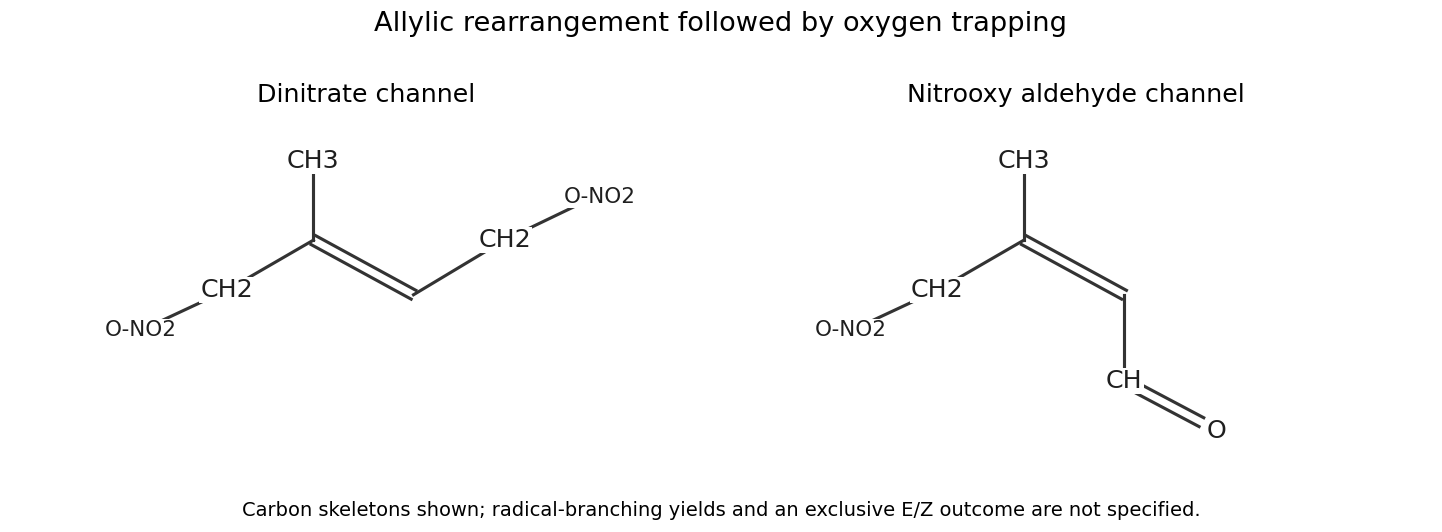
At night, nitrate radical addition and ozone attack are relevant oxidations of isoprene; direct daytime photochemistry is absent, though small OH sources can still exist. The nitrate-containing products identify the NO-addition route. Add NO to the terminal carbon next to the methyl-substituted alkene carbon, producing a nitrooxy substituent and an allylic radical. Resonance moves the radical to the far terminal carbon while shifting the double bond. Oxygen trapping gives a peroxy radical with the carbon skeletonA nitrate-forming termination branch, for example the organic-nitrate branch of reaction with NO, replaces the terminal peroxyl group by a nitrate ester, giving . An alternative branch forms an alkoxy radical, such as peroxy-radical reaction with NO producing RO, NO and O. Reaction of the terminal CHO group with O then gives an aldehyde plus HO, producing . These are covalent O–NO ester groups, not C–NO nitro groups. The delocalized radical can be trapped after conformational change, so this mechanism does not require one universal alkene geometry for both product channels. Product structures alone do not fix a unique branching ratio.

New to topics? Read the docs here!