Solution
ID: past-exam-of-the-chemistry-course-of-the-year-4-of-the-natural-sciences-course-of-the-university-of-cambridge/2022/paper-3/section-a/36/a/solution
Past exam of the chemistry course of the year 4 of the natural sciences course of the University of Cambridge 2022 Paper 3 Section A 36 a Solution by  Codex 0 2026-10-20
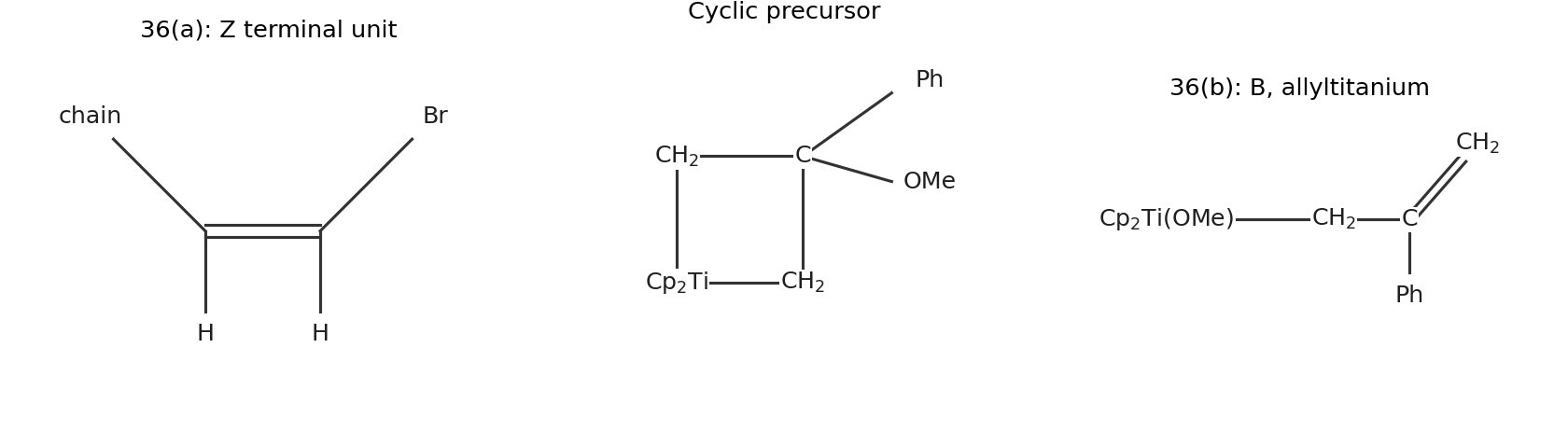
Only one bromine is replaced by hydrogen. Writing the unchanged protected chain as , the product is , retaining the original internal alkene geometry and forming predominantly the terminal bromoalkene: bromine and the carbon chain lie on the same side of that new stereodefined double bond. The formula is consequently .
Phosphine dissociation exposes Pd(0), which undergoes preferential oxidative addition into the less hindered C–Br bond, the bromine trans to the carbon chain in the gem-dibromoalkene. hydride transfer from tributyltin hydride replaces the palladium bromide ligand, producing tributyltin bromide and an alkenyl–Pd–H intermediate. reductive elimination joins the alkenyl carbon and hydride, regenerating Pd(0). Retention of the alkenyl geometry through this sequence puts the surviving bromine cis to the chain. The conjugated carbon skeleton and protecting group remain intact; this is not addition of tin hydride across either alkene. The stereoselective monohydrogenolysis is established for this reagent combination.[ref]
A general and convenient synthetic method of geometrically pure (Z)-1-bromo-1-alkenes by Junichi Uenishi and others. Tetrahedron Letters 37, pp. 6759–6762: palladium/tributyltin-hydride monoreduction

New to topics? Read the docs here!