Solution
ID: past-exam-of-the-chemistry-course-of-the-year-4-of-the-natural-sciences-course-of-the-university-of-cambridge/2022/paper-3/section-g/49/d/solution
Past exam of the chemistry course of the year 4 of the natural sciences course of the University of Cambridge 2022 Paper 3 Section G 49 d Solution by  Codex 0 2026-10-20
The secondary hydroxylamine condenses with formaldehyde. nitrogen attacks the carbonyl carbon, giving a carbinolamine; proton transfer and loss of water generate the tethered nitrone , where is the entire bicyclic substituent attached to nitrogen in D. Molecular sieves remove water, favouring this condensation.
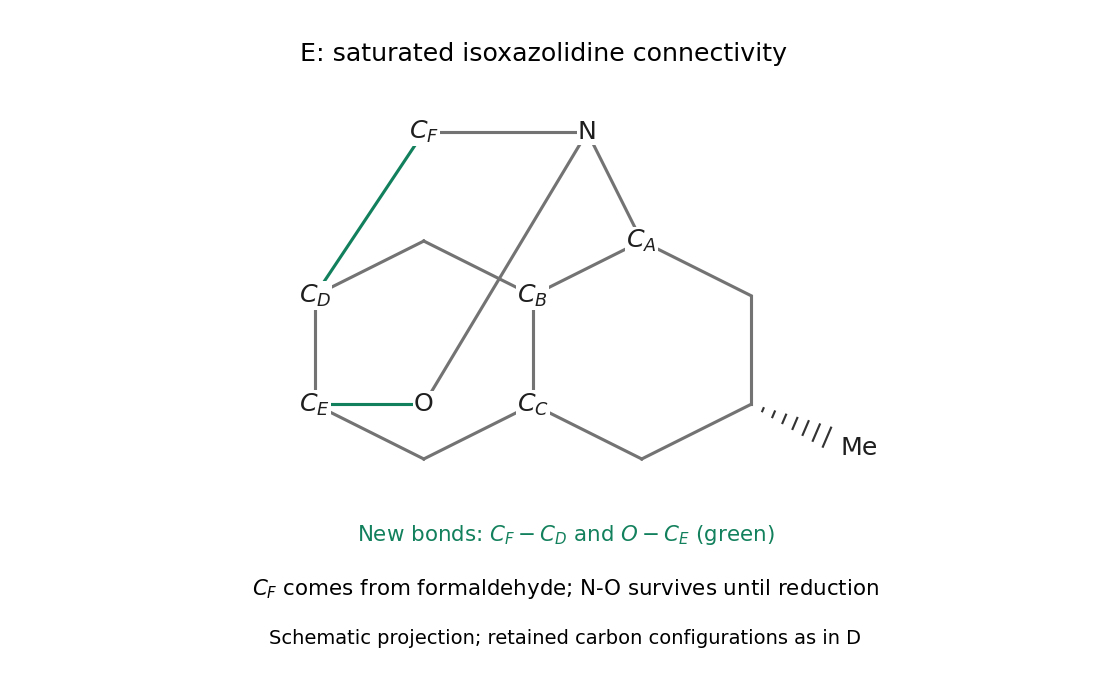
The nitrone undergoes an intramolecular 1,3-dipolar cycloaddition with the retained cyclohexene double bond. To define E precisely, label the former oxime carbon , the adjacent upper ring junction , the other junction , and the alkene carbons and such that the chain from to the more remote alkene terminus is . Let be the new formaldehyde-derived nitrone methylene. The cycloaddition forms and O–, retains N–O and N–, and changes N= and into single bonds. The new five-membered heterocycle is N––––O. These connections, together with the original bicycle, specify the bridged isoxazolidine E.
The inwardly tethered cycloaddition is suprafacial at the alkene and preserves the existing carbon stereocentres; the C–C and C–O additions occur on the same accessible alkene face. The pre-existing N-substituent orientation restricts which fold can bring both reacting ends together without crossing the bridge. This is a genuine two-new-bond cycloaddition, not a Mannich reaction followed by unrelated oxygenation.

New to topics? Read the docs here!