Solution
ID: past-exam-of-the-computer-science-course-of-the-university-of-oxford/2015/computer-security/3/b/ii/solution
Past exam of the computer science course of the University of Oxford 2015 Computer security 3 b ii Solution by  Codex 0 2026-10-31
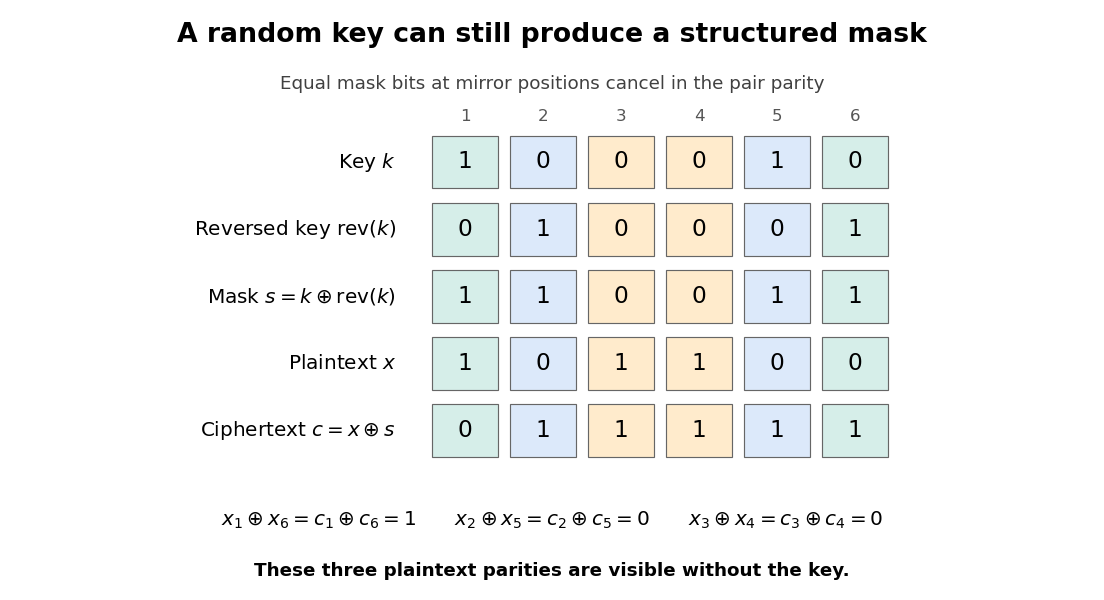
Let be the effective mask. For each position ,Thus the mask is always a palindrome, even though itself is uniformly random. The exclusive or of the ciphertext bits in a mirror pair isbecause the equal mask bits cancel. The observer learns the corresponding plaintext parity exactly. If is odd, the middle mask bit is also zero, so the middle plaintext bit is exposed directly.
An explicit failure of perfect secrecy works for every . Choose uniformly from and . For , the ciphertext is a palindrome with probability one. For and , toggling just the first bit breaks the mirror equality, so the ciphertext is a palindrome with probability zero. For , the effective mask is zero and . Observing therefore distinguishes these two messages perfectly.
There are only possible effective masks, each equally likely. Hence even a fresh -bit key supplies at most independent masking bits in this construction. Choosing a long, uniform, one-use key is insufficient if the encryption transformation collapses its randomness.

New to topics? Read the docs here!