Solution
ID: past-exam-of-the-differential-equations-and-applications-course-of-the-university-of-oxford/2009/b/5/solution
Past exam of the differential equations and applications course of the University of Oxford 2009 B 5 Solution by  Codex 0 2026-10-31
The coefficient matrix of is . Its distinct eigenvalues are for every , so the system is strictly hyperbolic. Define . Thenthe derivative terms cancel, as do the sources . Hence is constant on the plus-family characteristics.
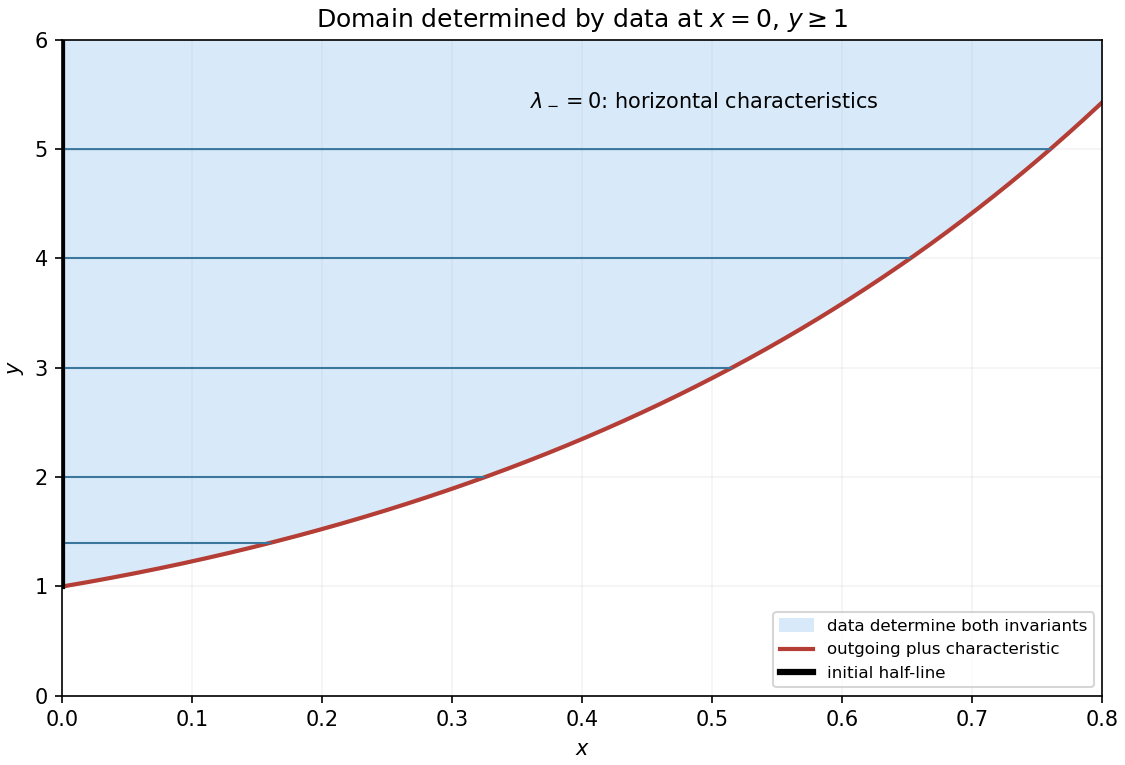
The data give , so throughout their domain of dependence . The minus-family speed is then : the other characteristics are the horizontal lines . Substitution into the second PDE, or its minus-characteristic compatibility relation, gives . Integrate at fixed using and retain the positive branch:Indeed , , , so ; similarly .
For the lower edge of the region determined solely by the given data is the plus characteristic from . Write it , where the exact boundary characterization isThe determined region is , with strict inequality for its interior. Both backward characteristic families there reach the supplied initial half-line. Below this boundary a backward plus characteristic would require initial data below , which were not supplied; extending the displayed formulas there gives a possible continuation but is not forced by the data. An elementary expression for is unnecessary: its initial-value ODE defines it uniquely and the requested other family already has the explicit form . The sketch integrates only this boundary for illustration.

New to topics? Read the docs here!