The domain of dependence of a solution value consists of the initial and boundary locations whose data can influence it. For on the whole line, , so its initial-data domain of dependence is the foot of the characteristic. For a finite-difference scheme, repeated stencil dependencies determine a numerical domain of dependence. The Courant–Friedrichs–Lewy condition requires the numerical domain to cover the physical one for convergence; it is necessary under its usual hyperbolic hypotheses, but not in general sufficient for stability.
For Noncharacteristic Cauchy data parameterized by , the method of characteristics produces a surface . The part uniquely fixed as a classical graph through the data must retain both the allowed footpoint range and a nonsingular branch of the projected map. On a branch where inversion gives , require , together with the branch condition and a nonzero Jacobian determinant. The strict inequality describes its open interior; the endpoint characteristic supplies a boundary trace. A fold caustic can supply another boundary.
An algebraic formula obtained by eliminating can extend beyond this domain of dependence. Its values there need not be selected by the original data, because their characteristic footpoints can lie on the unprescribed half of the data curve. Tracking the parameter range is therefore part of the uniqueness argument, separately from selecting a real square-root branch.
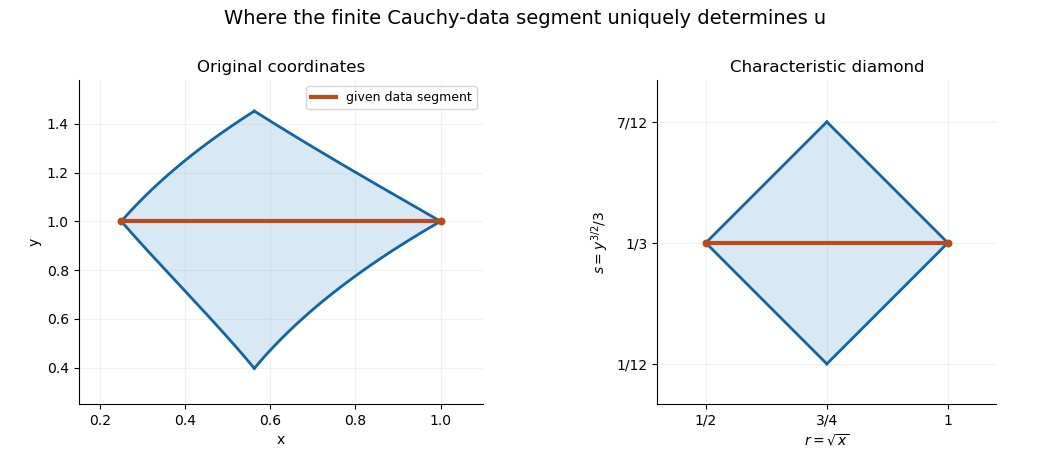
For the one-dimensional wave equation with Cauchy data on , , the solution is determined where both characteristic footpoints lie in . This is the diamond displayed in the title, or . In characteristic coordinates, it is a rectangle of known arguments for the two travelling-wave functions. A smooth invertible coordinate transformation maps it to a region bounded by the original equation's characteristic curves; it need not remain a Euclidean diamond. Both forward and backward determination can be described this way. Outside the region, changing an unspecified part of one travelling-wave function can change the solution without changing the supplied finite data segment.
For , and data on , , the transformed segment is , , . The known characteristic arguments lie in and . The corresponding original region has curved boundaries despite being a rectangle in characteristic coordinates and a diamond in coordinates.

Articles by others on the same topic
There are currently no matching articles.