Solution
ID: past-exam-of-the-flows-fluctuations-and-complexity-course-of-the-university-of-oxford/2016/3/d/solution
Past exam of the flows, fluctuations and complexity course of the University of Oxford 2016 3 d Solution by  Codex 0 2026-10-25
The fixed-point conditions are and . They give and . The Jacobian matrix isAt its eigenvalues are ; at they are . Both equilibria are saddle equilibria. At the origin the eigenvalues are . This linear calculation alone does not distinguish a nonlinear center from a weak focus.
To settle the origin and the global connections, setUsing , direct differentiation gives . Hence each parabola is invariant and, away from them, the following is a first integral:The two parabolas intersect precisely at the saddle equilibria. Their arcs between and enclose the lensInside it , . The origin is a critical point of with negative-definite Hessian times the identity. It is therefore a strict local maximum of this first integral, proving a nonlinear center equilibrium. The regular interior levels are closed periodic orbits, circulating anticlockwise. In fact the only critical point of inside the lens is the origin, so these levels fill the lens up to its boundary.
On , , so the interior arc runs from the upper saddle equilibrium to the lower. On it runs from the lower to the upper. Together they form a heteroclinic cycle. Their outer branches supply the remaining stable and unstable separatrices.
For the full exterior portrait, the two invariant parabolas partition the rest of the plane into four regions. Where both , everywhere; where both are negative, . In the region above both saddle equilibria, and ; in the corresponding lower region, and . These exterior trajectories are unbounded and cannot cross the separatrices. The nullclines are for and for .
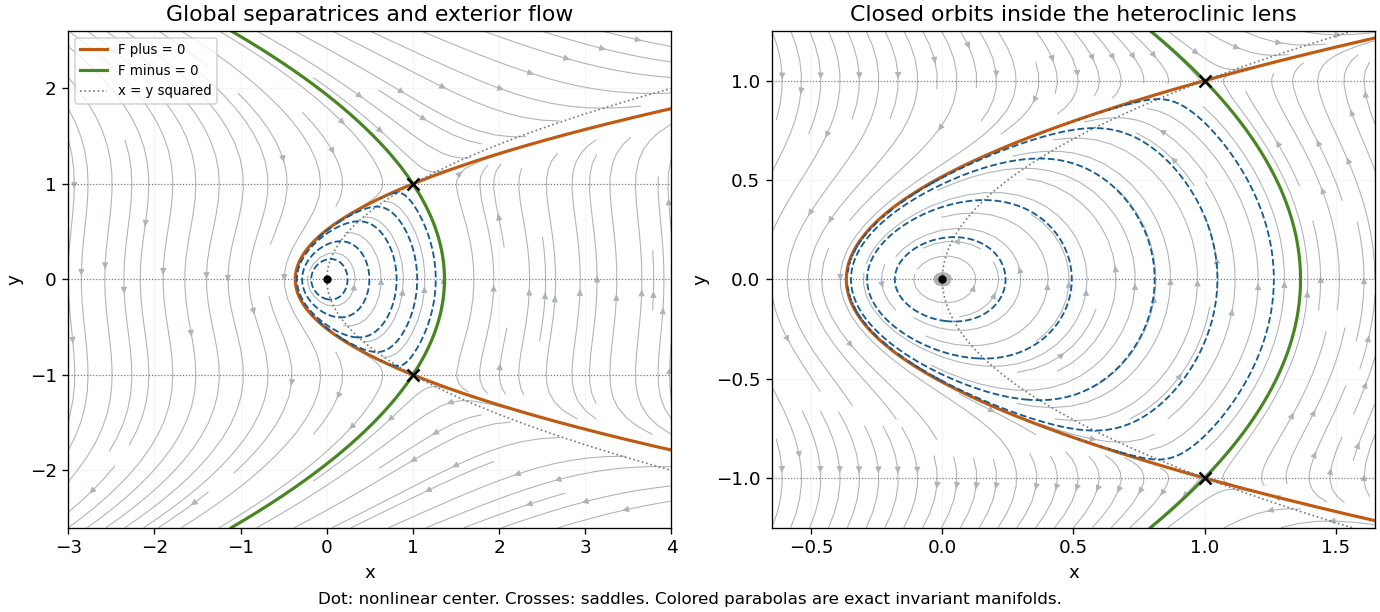
Full cubic-quadratic phase portrait and a central zoom: an anticlockwise family of periodic orbits inside a heteroclinic lens, two saddles, and unbounded exterior trajectories
. Details. 
New to topics? Read the docs here!