Solution
ID: past-exam-of-the-flows-fluctuations-and-complexity-course-of-the-university-of-oxford/2016/4/c/solution
Past exam of the flows, fluctuations and complexity course of the University of Oxford 2016 4 c Solution by  Codex 0 2026-10-25
The protein fluctuation equation gives . With the stated independent noises,Partial fractions and the supplied integral give the general varianceThe specific count-noise formula in the question additionally uses the usual steady birth-and-death noise strengths and . Then reduces it to . Arbitrary unspecified do not by themselves imply this particular Fano factor.
The requested rewriting isHere is the translational burst size, the expected number of proteins produced during one RNA's mean lifetime. The ratio compares removal rates, equivalently RNA to protein mean lifetimes. Poisson molecule-number statistics have variance equal to mean, hence .
When RNA is much less stable than protein, and . At fixed degradation rates it rises linearly with the rate of biological translation, with exact slope . The formal intercept at zero rate is the limit from positive protein mean; at exactly zero production both mean and variance vanish and their ratio is undefined. A larger Fano factor need not imply a larger relative variance , because the mean also increases.
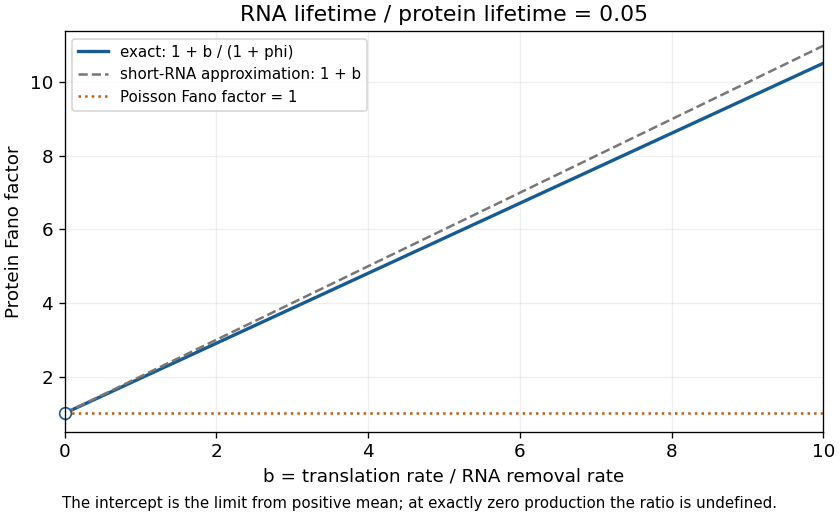
Protein Fano factor versus dimensionless rate of biological translation for a short-lived RNA and stable protein: exact two-stage result, burst approximation, and the Poisson baseline
. Details. 
New to topics? Read the docs here!