Solution
ID: past-exam-of-the-fluids-and-waves-course-of-the-university-of-oxford/2014/2/e/solution
Past exam of the fluids and waves course of the University of Oxford 2014 2 e Solution by  Codex 0 2026-10-31
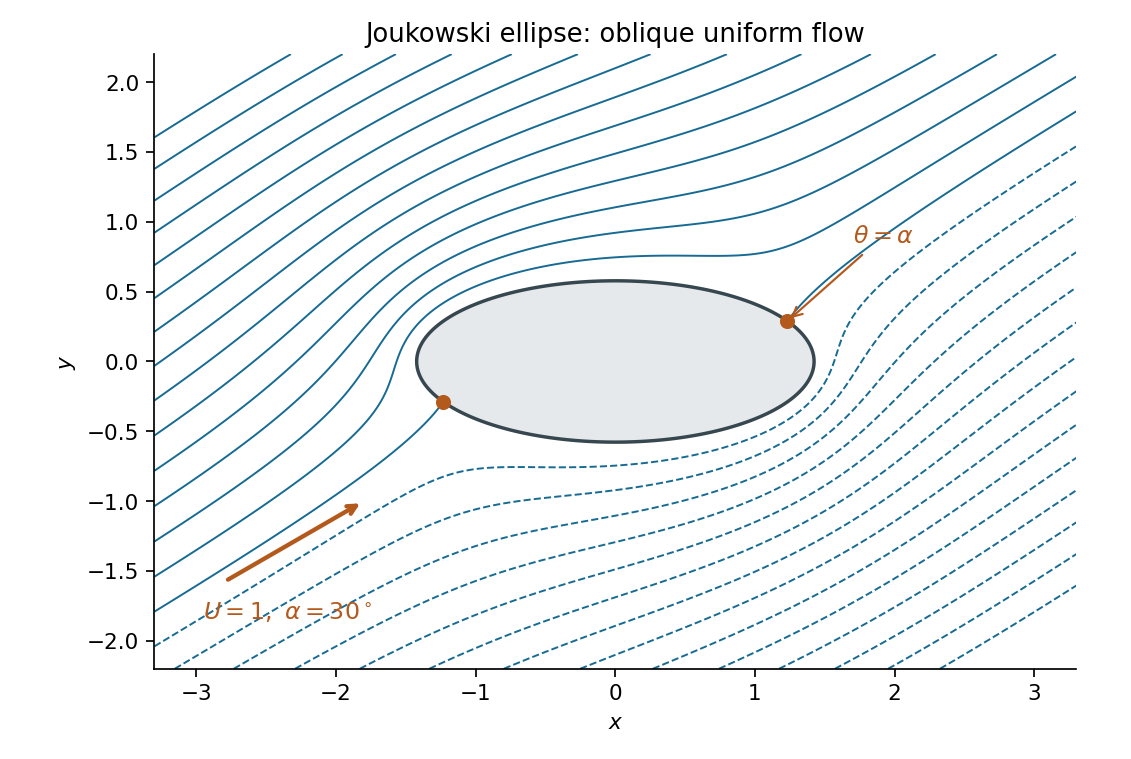
The complex velocity vanishes where , provided its denominator is nonzero. Thus . Both lie on the unit circle, and since . Mapping these points into the physical plane givesEquivalently, the two stagnation points are the opposite points and on the ellipse. The conformal map preserves the zeros of the complex velocity here because its derivative is finite and nonzero on the boundary.

New to topics? Read the docs here!