
A streamline at a specified instant is a curve whose tangent line follows the velocity field at that same frozen instant everywhere along the curve. One convenient integral curve parameterization isHere is an auxiliary curve parameter, with units of seconds in this convention; advancing does not advance physical time. Any regular reparameterization preserves the tangent geometry. Where , a planar streamline satisfies evaluated at time . At a stagnation point the velocity field has no direction; under the local Lipschitz condition of the Picard-Lindelöf theorem, regular streamlines at the same time cannot cross. A streamline answers which directions fit together now, making it useful for describing local flow geometry. [ref]
In the analytical velocity field introduced under pathline, the streamline through the origin at time isAt this is when both coordinates are expressed in metres. At its height is , whereas the earlier pathline of the origin's first released fluid element has height . Its instantaneous streamline at the final position is instead : the pathline is tangent to that streamline at its current endpoint, although its recorded history does not lie along it.
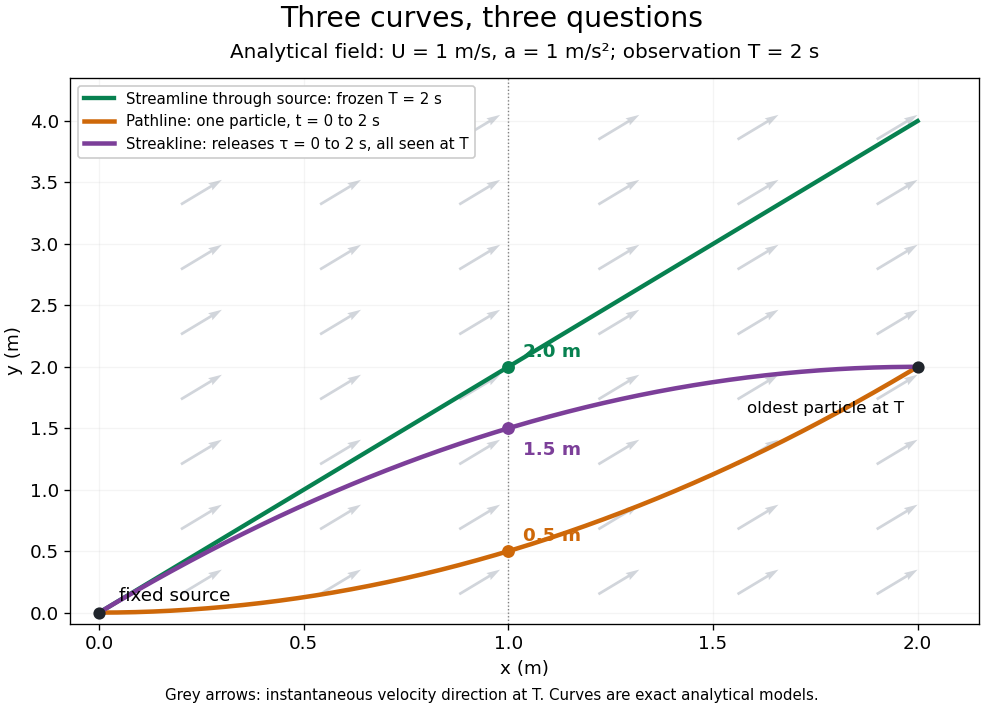

The green streamline uses the velocity field at throughout; the orange pathline uses times ; the purple streakline uses different release times at the single observation time . The grey arrows all show the instantaneous velocity direction at . These are exact analytical curves with chosen units, not measured dye shapes.
In a steady flow in a fixed reference frame, a pathline and a streamline solve the same autonomous ordinary differential equation. Uniqueness makes each particle released from a fixed point follow the same integral curve, so its pathline, the streakline from that point and the streamline share one geometrical curve. Finite recording or release intervals usually show different segments of that curve; the comparison assumes particles stay in the domain and treats stationary fluid elements separately. Neither two-dimensionality nor incompressibility is needed for this coincidence. Steadiness is sufficient, but is not necessary: with smooth changes speed while preserving the same integral curves. In a general time-dependent velocity field, however, the three curves differ. Kline explains why continuous dye release in steady flow can therefore display streamlines. [ref]
For two-dimensional incompressible flow, the convention gives , so regular streamlines are level sets of the stream function at each frozen time. In time-dependent incompressible flow, that does not force a pathline to stay on one numerical value of : its material derivative is . The distinction is the difference between a geometric snapshot and a parcel's history.
New to topics? Read the docs here!