Solution
ID: past-exam-of-the-fluids-and-waves-course-of-the-university-of-oxford/2014/3/c/solution
Past exam of the fluids and waves course of the University of Oxford 2014 3 c Solution by  Codex 0 2026-10-31
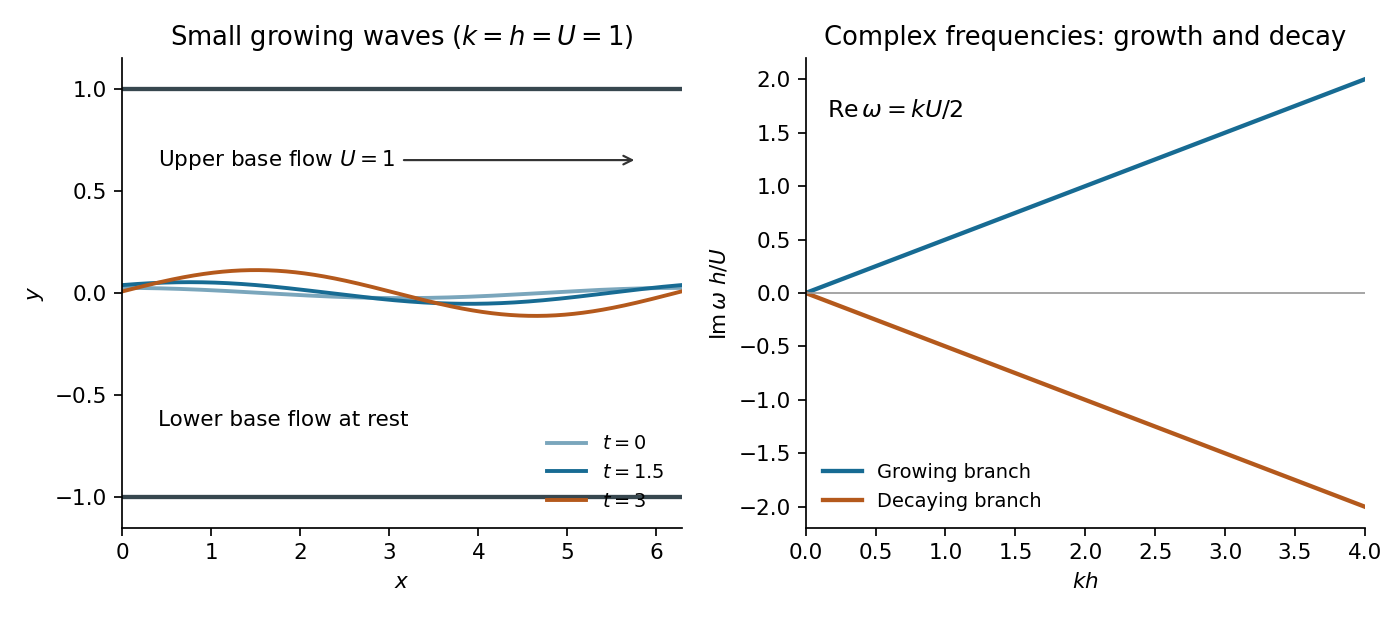
Use complex normal modes and take their real parts at the end. Write , with . The Laplace equation and the wall Neumann boundary conditions give the vertical formsAt , the two kinematic boundary conditions becomeThusThe dynamic condition isSubstituting the two amplitudes and cancelling the common nonzero depth factor gives the dispersion relation for a vortex sheet in a symmetric rigid channel:Equivalently,For the specified , the plus sign gives positive temporal growth rate in the convention . A real growing interface displacement is thereforeThe other branch decays at the same rate. Consequently the interface is linearly unstable, exhibiting Kelvin-Helmholtz instability. There is no nonzero-amplitude mode with a purely real temporal frequency for and ; the paper's sinusoidal notation must allow a complex frequency, with the physical displacement obtained by a real part.
The wave pattern is advected at speed , the mean of the two base velocities. The growth rate is independent of here because both layers have the same mass density and the same depth, making their factors cancel. In an asymmetric channel those inertia factors would differ. In the zero-shear limit , the two roots merge at zero and there is no exponential growth.

New to topics? Read the docs here!