Solution
ID: past-exam-of-the-fluids-course-of-the-university-of-oxford/2022/3/c/solution
Past exam of the fluids course of the University of Oxford 2022 3 c Solution by  Codex 0 2026-10-25
For an inviscid flow, the force per unit volume is . The gravitational acceleration has zero curl. Using the curl product rule,The supplied two-dimensional vorticity equation therefore becomesThe out-of-plane vorticity has no stretching term in this two-dimensional setting. The source is baroclinic vorticity generation: differently directed mass density and pressure gradients generate rotation even from zero initial vorticity.
For an explicit sign check, set , with upward. A thin smoothed interface has , with . If denotes the total pressure evaluated on the interface, then within the thin layer andIntegrating through that layer and taking its thickness to zero gives the vortex sheet strength and its linear evolution:For a growing Fourier mode, the potentials from the preceding calculation with replaced by giveThus the right-hand descending slope of a light-fluid crest produces positive , while the left-hand ascending slope produces negative . Their induced velocity raises the light-fluid crest and lowers the heavy-fluid trough, increasing the slope and generating more vorticity. This is the positive feedback underlying Rayleigh-Taylor instability.
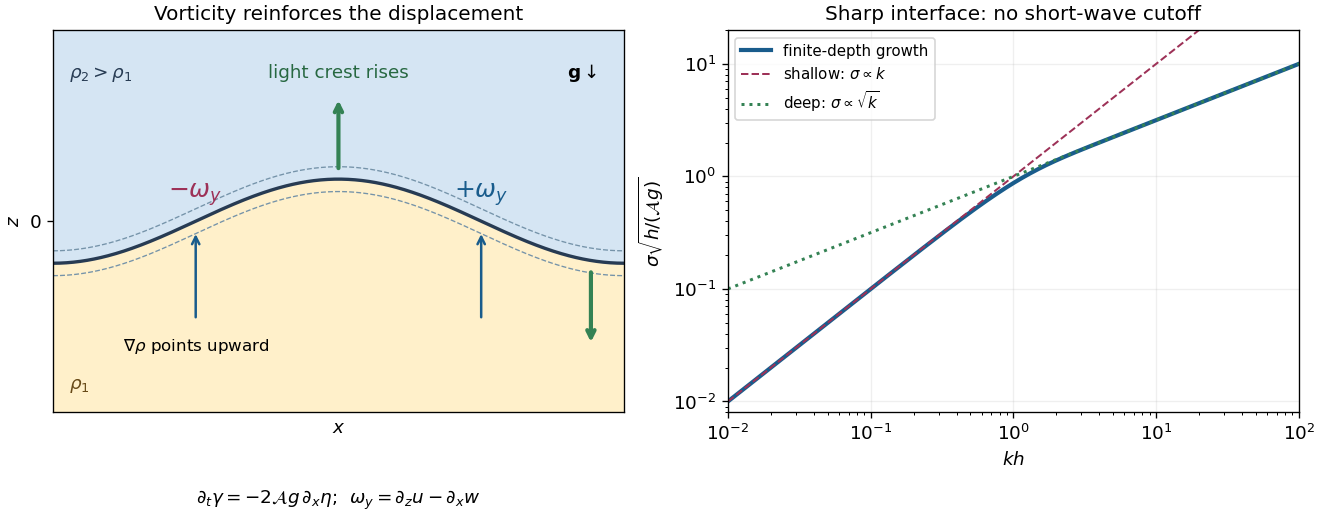

One can close this mechanism quantitatively. For , the kinematic boundary conditions give . Combining with the sheet-generation equation givesFor , the lids confine motion throughout both layers and horizontal redistribution is slow, yielding . For , motion is localized within depth on each side. Less fluid must accelerate at shorter wavelength, giving . Since , the ideal growth rate increases with with no short-wave cutoff.
The sharp-interface result requires for the smoothed layer. When becomes order one, it no longer applies. A smooth adverse mass density gradient has a local overturning time of order rather than the unbounded sharp-interface rate. Finite molecular diffusion also relaxes small-scale mass density perturbations on a time of order , and viscosity, if included, damps small-scale velocity. Weak diffusion motivates the thin-layer picture; it does not justify extrapolating the discontinuous dispersion relation to arbitrary .
New to topics? Read the docs here!