Solution
ID: past-exam-of-the-formation-of-structure-in-the-universe-course-of-the-university-of-cambridge/2014/paper-1/1/solution
Past exam of the formation of Structure in the Universe course of the University of Cambridge 2014 Paper 1 1 Solution by  Codex 0 2026-10-20
virial pressure-radius curve with uniform-sphere binding energy. Put . Isothermality makes , so the virial theorem givesThe curve crosses zero at , rises to its maximum atthen decreases toward zero at large radius. Since , a cloud displaced outward at fixed external pressure has a restoring pressure deficit only on the descending branch. Thus the homologous, isothermal radial mode is stable for , unstable for , and marginal at . The negative-pressure branch is not a physical equilibrium with a positive confining pressure. This conclusion uses the stipulated gravitational-energy approximation, not the exact isothermal density profile.
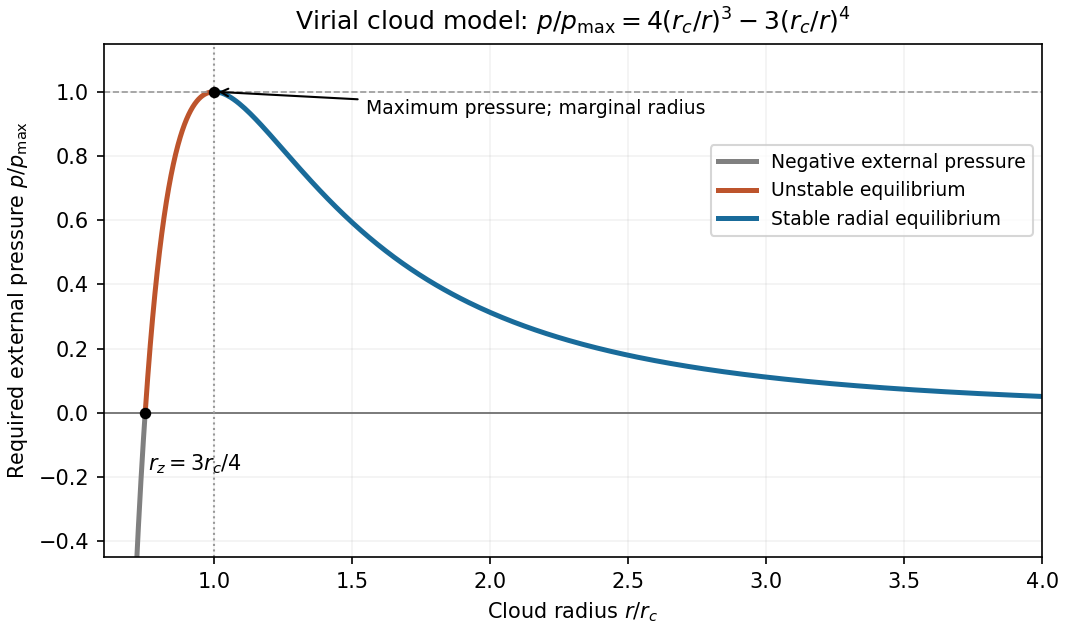
Original pressure-radius curve and stable versus unstable branches of the stipulated virial cloud model
. Details. 
critical mass from a virial pressure turning point. At the turning point, ; henceUsing the cloud's mean density , the condition becomesUsing the boundary density instead changes the numerical coefficient, not this scaling. The coefficient should not be identified with the exact Bonnor-Ebert sphere threshold because the assumed potential energy is different.
mass and luminosity weighting of a stellar initial mass function. Impose finite birth-mass cutoffs . The stellar birth mass and main-sequence luminosity scale asFor a broad mass interval, the low-mass end controls the first integral and the high-mass end the second. Per logarithmic mass interval the weights are respectively and . Finite lifetimes remove massive stars from an aging population, so the luminosity conclusion applies while those stars remain on the main sequence.
exponential closed-box gas consumption. The gross formation rate is , but the permanent locking rate is . The instantaneous recycling approximation and mass conservation give , . ThereforeHere means surviving locked stellar mass in the galactic gas fraction, not the cumulative gross mass that has passed through star formation.
locked-mass and returned-mass yield conventions. Pre-existing metals are locked at rate ; the stipulated newly produced metal source is . ThusFor and initially pristine gas,The effective yield is per unit permanently locked mass; it is not the source parameter . For , and the direct time equation gives . For , the explicitly stipulated metal source vanishes, so this particular enrichment model gives . Constant yield is a trace-enrichment approximation; the formal logarithmic divergence as gas is exhausted must not be interpreted as a physical metal fraction exceeding one.
backward extrapolation of exponential closed-box star formation. Denote the present age of the universe by . With the last paragraph's ,TODO: a present age of the universe or cosmology is needed for a unique numerical estimate. For the explicitly illustrative choice , this is about , requiring of gas at that epoch in the same model. This is an extreme history for a present Milky-Way-like system, although intense high-redshift star formation by itself is not forbidden.
The extrapolation forces a fixed gas reservoir to decline exponentially over many gas-depletion times. Gas accretion, outflows, evolving gas density and star-formation efficiency, delayed recycling, and galaxy assembly break that assumption. The empirical disk-averaged relation is not a universal constant-efficiency law for all gas: the original measurements combined Balmer series H-alpha, atomic gas, carbon monoxide and infrared data, with tracer calibration and dust corrections entering the inference.[ref]
The Global Schmidt Law in Star Forming Galaxies by Robert C. Kennicutt Jr.. Abstract: observed tracers, sample, and fitted index
Cosmological calculations explicitly support continuing cold-gas supply to rapidly forming high-redshift galaxies, providing a physical alternative to this closed-box backward extrapolation.[ref]Cold streams in early massive hot haloes as the main mode of galaxy formation by Avishai Dekel and others. Abstract: stream-fed galaxies and comparison with observed abundance
New to topics? Read the docs here!