Solution
ID: past-exam-of-the-formation-of-structure-in-the-universe-course-of-the-university-of-cambridge/2015/paper-1/2/e/solution
Past exam of the formation of Structure in the Universe course of the University of Cambridge 2015 Paper 1 2 e Solution by  Codex 0 2026-10-20
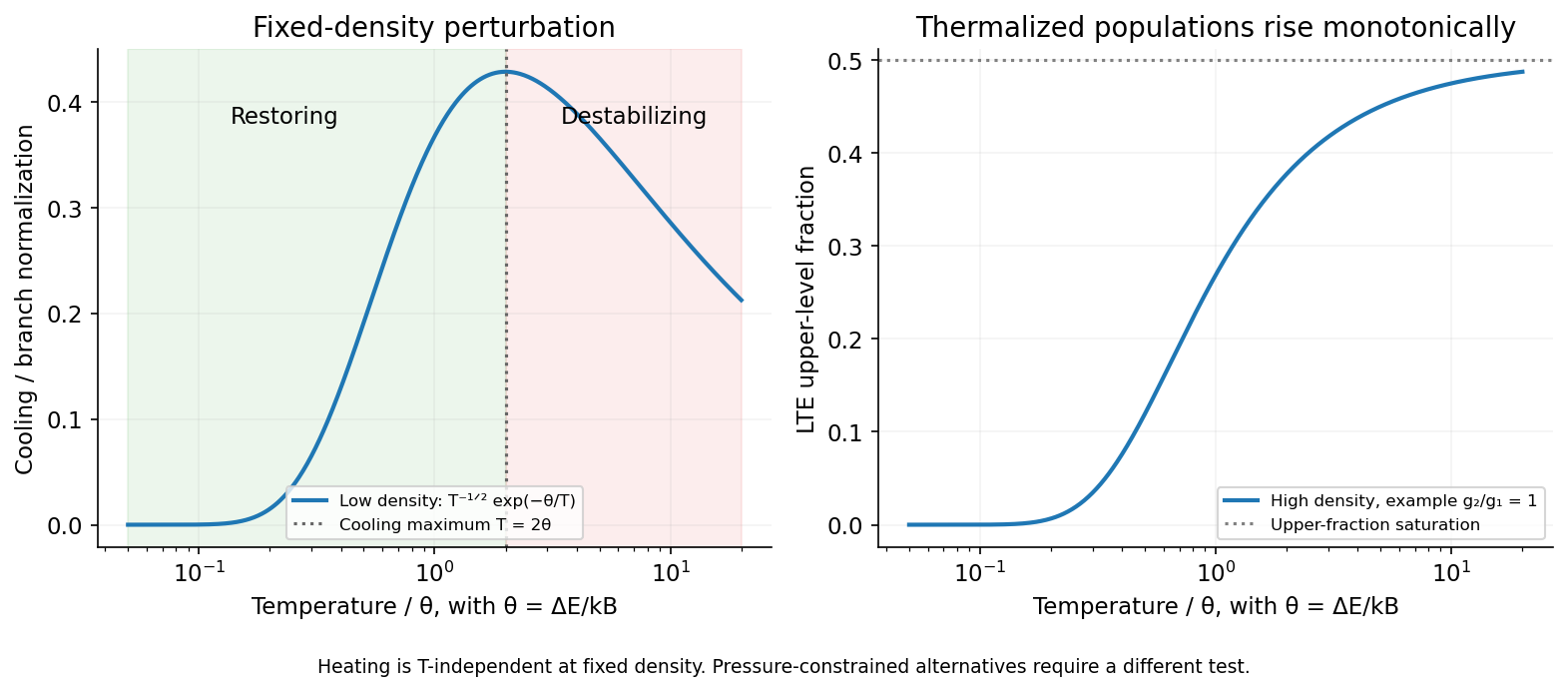
First specify the perturbation: take fixed gas density, fixed ionic abundance and the same temperature-independent heating, so thermal stability requires at an equilibrium. Let , be the collider density and the atomic density. A two-level optically thin balance isThe critical density of an atomic transition is approximately . At low density, each rare collisional excitation is followed by an escaping photon, soThe isochoric thermal stability of a collisionally excited line therefore givesAt the linear restoring coefficient vanishes; the cooling maximum is marginal to first order and is not robust two-sided stability.
At high density, collisional de-excitation competes successfully with radiative decay, and collisions establish local thermodynamic equilibrium level populations. Detailed balance gives , where . The cooling is thenThus the high-density fixed-density branch is stable for finite , becoming weakly restoring as the upper fraction saturates at high temperature. It is incorrect to retain the low-density factor in the radiative cooling law once populations are thermalized.[ref]
AGN Emission Lines by Hagai Netzer. Section2.2: collisional excitation, critical density and the high-density Boltzmann limit
The isobaric thermal stability of a two-level coolant is a distinct question. If the intended heating is a fixed rate per particle, then and stability tests the cooling per particle. The low-density boundary becomes ; the high-density cooling per particle remains proportional to , so remains stable. If instead heating is constant per volume, the isobaric low-density boundary is , and the high-density stability condition is . The source gives no pressure constraint or explicit heating normalization: the boxed result is the fixed-density answer, with these conditional alternatives stated to avoid asserting a universal boundary.

New to topics? Read the docs here!