Solution
ID: past-exam-of-the-gauge-field-theory-course-of-the-university-of-cambridge/2014/paper-1/1/ii/solution
Past exam of the gauge field theory course of the University of Cambridge 2014 Paper 1 1 ii Solution by  Codex 0 2026-10-20
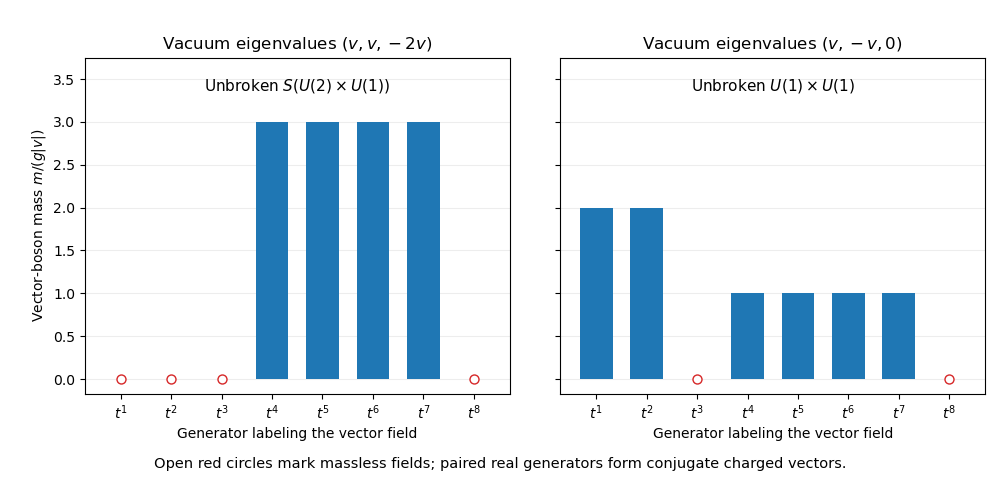
For eigenvalues , all entries are distinct. The difference has magnitude , while both the and differences have magnitude . The adjoint scalar gauge-boson mass matrix therefore givesOnly the two diagonal generators commute with the vacuum. Its unbroken group is the maximal torusThe two real fields belonging to each pair combine into oppositely charged conjugate vector states with equal mass. The further equality between the and masses comes from the equally spaced vacuum eigenvalues; the surviving Abelian group alone does not force distinct root-charge sectors to have equal masses. Thus a fourfold massive degeneracy occurs in both examples, but its relation to the unbroken continuous symmetry differs. The scalar potential has not been specified, so no additional symmetry of that potential or physical scalar mass spectrum can be inferred.

New to topics? Read the docs here!